

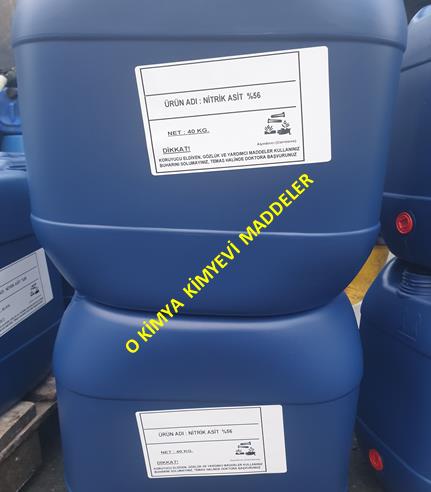
NITRIC ACID PACKAGING
Product Documents | |
What is Nitric Acid?
Molecular Formula (Nitric Acid): HNO3
Molecular Weight: 63.013 g/mol
Chemical Name: Nitric Acid
CAS Number: 7697-32-2
It is a chemical in the class of colorless corrosive acids called Nitrogen Acid. It is commonly known as spirit of nitre and aqua fortis (kezzap). In terms of its molecular formula, it is a nitrogen oxoacid formed by the Nitrogen (N) atom creating single bonds with one Hydroxyl (H) group and two Oxygen (O) atoms.
The concentrated form available on the market has a 60% concentration. The form described as fuming HNO3 has an 85% concentration. Its dissolved form in water should be more than 85% by weight. The reason it is called fuming is due to the smoke rising above it.
The high-strength product has a 90% (v/v) concentration.
Other Names for Nitric Acid are as Follows;
Hydrogen Nitrate
Azotic Acid
Fuming HNO3
Aqua Fortis
Kezzap
Red Fuming HNO3
Solution Form (In Different Concentrations)
Concentrated Form
How is it Produced?
Production is carried out by 2 methods. The first one is the production that creates a weak acid. This method utilizes oxidation, condensation, and absorption methods. The form produced in this reaction has a concentration of 30% to 70%.
The second method includes dehydration, bleaching, condensation, and absorption processes to obtain a high-concentration product from weak acid.
Production of weak HNO3 occurs via the catalytic oxidation of ammonia (NH3) at high temperatures. The reaction for this process is as follows:
4NH3 + 5O2 》 4NO + 6H2O
The catalyst used in the production of weak HNO3 is made of 90% platinum and 10% rhodium gauze, constructed in a fine-wire square shape.
The second reaction in production is the oxidation of nitric oxide. This reaction is as follows:
2NO + O2 》 2NO2 《》 N2O4
The final reaction is the absorption reaction. In this reaction, Nitrogen dioxide (NO2) is obtained by reacting with water. The reaction in this process is as follows:
3NO2 + H2O 》 2HNO3 + NO
The oxidation of ammonia to nitric acid is an exothermic reaction.
What are the Physical and Chemical Properties?
It is a transparent, colorless or yellowish, and fuming corrosive substance. It has hygroscopic properties.
It has suffocating properties if inhaled.
The boiling point is 121 °C.
The melting point is -41.5 °C.
In terms of solubility, it is miscible with water.
Its density is 1.41 g/ml at 20 °C.
A 56% aqueous solution is available on the market.
What are the Areas of Use for Nitric Acid?
The manufacture of fertilizers used in the agricultural sector is carried out with this chemical. It is an industrial acid of great importance.
It is used in the manufacture of fertilizers such as Ammonium Nitrate, Sodium Nitrate, Potassium Nitrate, and Calcium Nitrate. This sector has the largest usage portfolio because it is the best chemical as a nitrate source.
It is used in the synthesis of nitrates and nitroorganics used in the manufacture of explosives, gunpowder, and fireworks.
In nylon production, raw materials such as adipic acid and caprolactam are used. Cyclohexanone is used to produce these raw materials. This chemical is needed to produce cyclohexanone.
It is one of the most important reagents used in the laboratory.
Titanium compounds found on the surfaces of outdoor areas can be dissolved when used together with Hydrofluoric Acid.
It is used as a mineral acid source for cleaning deposits accumulated on heat exchangers used in the food industry.
It is used for cleaning Gold and Silver surfaces in the production of costume jewelry.
If a micro-bacterial process is applied in water treatment systems, nitric acid is used as a nitrogen source in this field.
In the dairy industry, organic pollutants, fats, and proteins occur in milk tanks, boilers, and milk reception lines. These can cause unwanted odors and uncomfortable situations by producing bacteria. Cleaning processes in milk factories and dairy processing plants are carried out with nitric acid.
What are Other Areas of Use?
In the wastewater treatment sector, a combination of sulfuric acid and nitric acid is used together to treat some metals.
Nitric acid is used together with sulfuric acid, hydrofluoric acid, tartaric acid, Citric Acid, and chromic acid in the surface treatments of aluminum, low-capacity steel, copper, and zinc alloys before low and high alloy painting.
Nitric acid is used together with sulfuric acid and phosphoric acid in the manufacture of fertilizers such as Ammonium Nitrate and Ammonium Sulfate.
Stainless pipes are connected by gas shielded welding. It is used by mixing with hydrofluoric acid to remove welding marks and polish stainless pipes.
Welding stains occur in stainless metals where argon welding is performed. A solution is created with another strong acid to remove the welding stains and polish them.
Substances such as nitric oxide and nitric acid are used to solve problems occurring in the digestive systems of birds' stomachs and intestines.
Selenium Dioxide is a compound used as an oxygen source in production.
Argon welding is used to join some stainless materials. After the welding process, darkening and subsequent corrosion occur on the stainless metal. Pickling Gel is produced to remove welding residues and polish the stainless steel; it is used in the production of this gel.
Nitric acid is used in the cleaning of heat exchangers of combi boilers and copper pipes. In this application, the process is performed by the immersion method.
In the agricultural sector, it prevents the growth of weeds by lowering the pH of the soil in drip irrigation systems at the base of apricot trees. This helps to achieve better efficiency from the fruit tree.
It is used as an inorganic solvent acid in the production of corrosion-resistant metal pigments. Instead of this inorganic acid, other inorganic acids such as Sulfuric Acid and Hydrochloric Acid can be used.
It is one of the main compounds used in the production of potassium nitrate.
It is one of the chemicals produced for boiler cleaning. It is used for cleaning the scale inside the boiler. Hydrofluoric Acid can also be used.
Recently, it has been used as the main reagent in the purification processes of metals such as Nickel, Cobalt, and Copper used in the production of Lithium-Ion batteries by dissolving them in hydrometallurgical systems.
What are the Factors Affecting Prices?
The price of Nitric Acid is directly dependent on the prices of ammonia and oxygen. When the prices of ammonia and oxygen used in production increase, companies that sell nitric acid will increase their prices.
Especially before the summer months, since fertilizer production increases, ammonia prices in the market will follow an upward trend. This will cause nitric acid prices to increase.
With the development of the industrial sector, the use of nitric acid has increased every year. The usage rate has caused market prices to rise.
With the development of a country's defense industry, the amount of substances used in this field also increases. Therefore, due to the increase in explosive production, nitric acid prices will show an increase.
Nitric Acid Sales
Chemical substances are packaged in packages determined by international standards. These are sold starting from the smallest package to the largest package or in bulk with tanker. These can be 1 gram packaging, 1 ton big bag packaging, the smallest drum packaging, or packaging-free sales with tanker.
All information here should be used in accordance with the legislation by expert people and professionals in the field.