

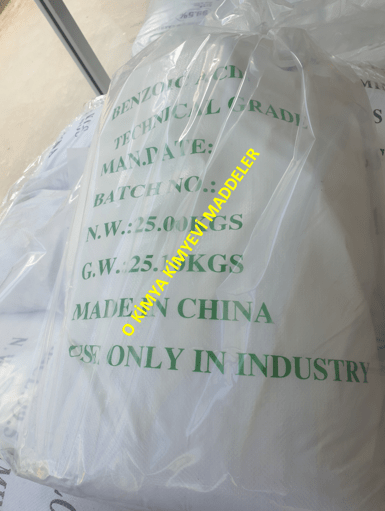
BENZOIC ACID PACKAGING
Product Documents | |
What is Benzoic Acid?
Molecular Formula (Benzoic Acid): C7H6O2
Molecular Weight: 122.12 g/mol
Chemical Name: Benzoic Acid
CAS Number: 65-85-0
It is a chemical belonging to the simplest aromatic carboxylic acid group. It exists in free form in nature.
It binds to plants and animals as an ester type. Structurally, it is described as a carboxylic acid attached to a Benzene compound.
It is used as a starting material in the production of many important organic compounds.
The salts and esters of this chemical are called benzoates.
Other Names Are As Follows;
Benzene Formic Acid
Benzenecarboxylic Acid
Phenylcarboxylic Acid
Phenylformic Acid
65-85-0
Benzenemethanoic Acid
Dracylic Acid
Oracylic Acid
How is Benzoic Acid Produced?
In the production of Benzoic Acid, toluene chemical is used as a starting material. It is carried out by partial oxidation of Toluene in the presence of manganese or cobalt naphthenates.
The chemical reaction is as follows;
C7H8 +O2 – (H2O) 》C7H6O2
What are the Physical and Chemical Properties?
It has a solid appearance in white crystal form. Its odor is almost non-existent or similar to the smell of benzaldehyde.
It has a bitter taste.
Melting point is 122.4 °C.
Boiling point is 249 °C.
The solubility of Benzoic Acid in water is very low. Its solubility at 20 °C is approximately 0.29 g/100 ml water. It has good solubility in ethyl alcohol, methyl alcohol, and acetone.
Its density is 1.3 g/cm3.
Antimicrobial Working Mechanism of Benzoic Acid
It becomes uncharged by passing through the cell membrane. It shows best performance below pH 4.5. That is, it works in an acidic environment. It enters fungal and bacterial cell membranes and makes the environment acidic by releasing protons.
In this way, it disrupts the metabolism of the cell. Enzymes cannot function, ATP production decreases, DNA synthesis slows down, and the cell eventually dies.
What are the Usage Areas of Benzoic Acid?
It is used in the production of phenol and caprolactam.
It acts as a polymerization activator and retarder for rubbers. Its use in rubber production provides very good properties in terms of cut resistance and crumbling resistance. Thus, it is used to prevent rubber crumbling and contribute to rubber cutting.
Sodium Benzoate and Potassium Benzoate are intermediate substances used in production.
It is used as a food preservative in fruit juices and fats.
It is used as an Ultraviolet light absorber in plastics.
Salts of this compound can be used in tomato paste production.
While producing antimicrobial wet wipes, it is used as a preservative by being modified with sorbic acid or its salts.
It is used to create temporary blockages in downhole drilling operations in underground resources.
A condition called beriberi occurs on tools and on the feet of some people. This condition occurs in the presence of certain bacteria. To prevent the formation of such bacteria, it is used together with Salicylic Acid and some active ingredients.
It has been used as a preservative in foods for a long time. Sodium salt is used in this field because the solubility of sodium salt is high.
It is used to prevent black rot in fruits like pineapple or in fruit juices.
It should be mixed with some ethyl alcohol and hot water before use. This is to increase its solubility.
The t-butyl form is used as a corrosion inhibitor in cooling fluids used in vehicle engines.
Some compositions are created to prevent plants from being exposed to fungal, viral, and bacterial attacks. Benzoic Acid is used in the production of these compositions.
What are the Factors Affecting Prices?
Prices are directly dependent on the prices of the chemicals used in its production. As benzene and toluene prices increase, the price of these chemicals will increase.
Prices will increase directly depending on the increase in usage areas. If a new usage area emerges, the price of benzoic acid increases.
As companies selling benzoic acid increase their stocks, prices will experience short-term decreases.
Benzoic Acid Sales
Chemical substances are packaged in packages determined by international standards. These are sold starting from the smallest package to the largest package or in bulk with tanker. These can be 1 gram packaging, 1 ton big bag packaging, the smallest drum packaging, or packaging-free sales with tanker.
All information here should be used in accordance with the legislation by expert people and professionals in the field.