

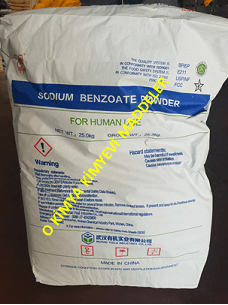
| Product Documents | |
| SODIUM BENZOATE CERTIFICATE OF ANALYSIS | |
What is Sodium Benzoate?
Molecular Formula (Sodium Benzoate); C7H5NaO2
Molecular Weight; 144.11 g/mol
Chemical Name; Sodium Benzoate
CAS Number; 532-32-1
It is a chemical substance that is one of the sodium salts of benzoic acid. It is an aromatic compound. The active chemical is sodium benzoate.
It dissociates in the system where it is used, providing acid and thus ensuring its effectiveness. Benzoic Acid is highly toxic to microbes. The optimal operating level is when the pH value of the system to be used is between 2.5-4.0.
It has properties that generally act as a preservative and anticorrosive agent in various industries. It has antifungal properties.
E Code: E211
Other Names for Sodium Benzoate;
- Benzoic Acid, Sodium Salt
- Antimol
- Benzoan Sodny
- Soda Benzoate
- Benzoate Sodium
- Benzoesäure (Na-salz)
- Sodium Benzoicum
- Sobanate
- E211
- Benzoate
What are its Physical and Chemical Properties?
It is a chemical found as a white powder or flakes. It is used by mixing with liquid chemicals.
Its melting point is above 300°C.
Boiling Point is between 450°C and 475°C.
Sodium Benzoate is easily soluble in water and slightly soluble in ethanol.
Its density is 1.5 g/cm3.
How is it Produced?
Three methods are used for its commercial production. In the 1st method, naphthalene is oxidized with Vanadium Pentoxide to obtain phthalic anhydride. It is then decarboxylated to yield Benzoic Acid.
- In the 2nd method, toluene is mixed with nitric acid and oxidized to produce benzoic acid.
- In the 3rd method, benzotrichloride is hydrolyzed and then treated with a mineral acid to yield Benzoic Acid. Benzotrichloride is formed by the reaction of chlorine and toluene.
In all 3 methods, benzoic acid is refined for production. Here, it can be obtained by dissolving the acid in a sodium hydroxide solution.
The resulting chemical reaction yields Sodium Benzoate and water. The crystalline form of this chemical is obtained by evaporating the water.
How Does It Affect Human Health?
It can cause severe eye irritation.
When used in standard concentrations, Sodium Benzoate is not considered toxic to human health.
In some cases, concentrations below 0.1% are permitted. In other cases, up to 0.125% is allowed. These usage rates are for its application as a food additive.
In case of contact with your skin, the affected area should be washed with plenty of water. If irritation persists, consult a doctor.
How is Sodium Benzoate Used in Mayonnaise?
In mayonnaise production, the most important characteristic is the requirement for a low pH value. For this, the acidity value must be low. This ensures the production of the best quality mayonnaise. Sorbic acid is used in mayonnaise production to balance the acidity.
Sodium benzoate is used in low-fat mayonnaise. Its application in mayonnaise is for its preservative effect.
In mayonnaise, mold can form due to yeast spoilage. These molds can harbor bacteria and cause food spoilage. Sodium benzoate inhibits this spoilage, thus preserving the food.
Mayonnaise is an emulsion. It is in a semi-fluid liquid form. Mayonnaise in this form does not require a preservative. However, in the production of mayonnaise with a high water content, a food preservative is necessary. It is among the most common food additives.
Use of Sodium Benzoate in Tomato Paste Production
In tomato paste production, some microorganisms originating from the structure of tomatoes or peppers can cause mold growth within the paste, leading to spoilage.
To prevent the formation of these bacteria, salt and a preservative are added to the paste. Sodium benzoate is effective against many types of bacteria.
Its use alone in tomato paste production may not be sufficient to prevent mold formation. The environment where the paste is stored after production is also a major factor in bacterial growth.
Factors affecting bacterial growth after tomato paste production.
- Ambient Temperature
- Salt concentration in the tomato paste
- Storage duration after production
- Types of bacteria
What Medications Contain Sodium Benzoate?
For some individuals with urea cycle enzyme deficiency, medication containing this chemical is necessary to treat hyperammonemia and related disorders.
What are the Uses of Sodium Benzoate?
- Due to its antimicrobial and flavor properties, it is used in a wide variety of products.
- In cases of urea cycle disorders in the body, ammonia accumulates in the blood and is not converted to uric acid. It is used in the production of drugs containing sodium benzoate to prevent the accumulation of ammonia in the blood.
- It is the most common chemical preservative used in both food and beverage products. Sodium Benzoate works by entering the cells of microorganisms, lowering their internal pH, and inhibiting their growth.
- It is used in margarine, tomato paste, maple syrup, pickles, canned goods, jams, and jellies.
- It is used in almost all soft drinks, some wine coolers, and fruit juices.
- The sodium salt of benzoic acid is used in the production of toothpastes and dental cleaning chemicals. It is used in personal care products like mouthwashes. In such applications, it is applied in a modified form with Potassium sorbate.
- One of the reasons for its widespread use is its low price advantage.
- In the production of dyes, benzoate is used as an intermediate.
- As it is an antiseptic, it is used as a rust and mold inhibitor.
- It increases clarity and strength. Due to this property, it is a chemical incorporated into the production of plastics like polypropylene. This application of benzoate has recently entered the literature.
- It is used as an active corrosion-inhibiting agent in engine cooling water systems. Its use as a corrosion inhibitor is a relatively recent discovery.
- It is used in pharmaceutical and tobacco preparations. After the raw tobacco material is harvested from the field, it is processed with certain substances to soften its harshness for cigarette production.
- After the tobacco is chopped, during the softening phase when a solution is prepared, this raw material is added to the solution to prevent the tobacco from molding.
- In its free acid form, it is used as a fungicide. That is, it is a chemical used to destroy fungi and fungal forms.
- In the manufacturing of silicone rubber mastic products, it is used together with formic acid, liquid paraffin, methyl alcohol, and some other substances to create a cleaning formula.
- To inhibit corrosion on aluminum surfaces, either sodium metasilicate or sodium benzoate is used in the manufacture of the inhibitors employed.
Other Uses
- Here, benzoate prevents fungi from making foods unusable. The purpose of its use here is to enter the cells of microorganisms, lower the pH level, and prevent the proliferation of fungi.
- In the non-alcoholic beverage industry, it also increases the acidity of soft drinks, which enhances the flavor intensity of high-fructose corn syrup.
- Benzoates are used in the production of foods containing vinegar, such as salad dressing.
- It is used in liquid soap colorants.
- It is used in antifreeze production.
- Other pharmaceutical uses include the manufacturing of liquid cough syrups, liquid acetaminophen, amoxicillin, and medicinal creams.
- It is used as an antimycotic agent in the production of dry pet food. This prevents mold formation and stops the products from spoiling.
- It is used in some dental care products, which are pet care medications.
- Sodium benzoate is an active ingredient in the manufacture of products such as body and face washes, deodorants, and shampoos.
- In the production of anti-rust spray formulations, Sodium Benzoate is used as a protective chemical.
What Factors Affect its Price?
The price of sodium benzoate increases by about 10% each year. If a new sector of use is identified, its price increases in parallel.
The opening of a new sodium benzoate production facility causes a downward fluctuation in prices. However, this fluctuation is not permanent.
The price can change in parallel with the prices of naphthalene and vanadium pentoxide used in its production. If their prices rise, the price of sodium benzoate will also increase.
The price of sodium benzoate also depends on the price of toluene and nitric acid used in its production. If the price of these chemicals used in production increases, the prices will increase.
Although very rare, its prices can rise far above market averages.