

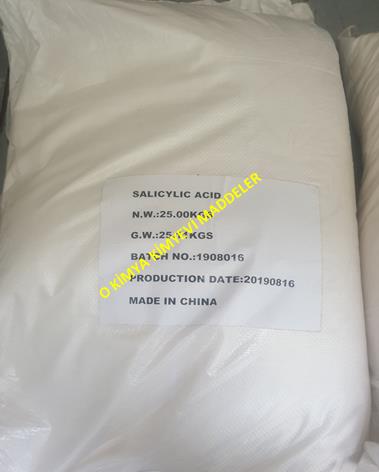
 SALICYLIC ACID PACKAGING
Product Documents |
|
| SALICYLIC ACID ANALYSIS CERTIFICATE | |
What is Salicylic Acid?
Molecular Formula (Salicylic Acid): C7H6O3
Molecular Weight: 138.12 g/mol
Chemical Name: Salicylic Acid
CAS Number: 69-72-7
Salicylic acid is a chemical compound that occurs naturally in plants. It is particularly found in the bark of the willow tree. Chemically, it is a beta hydroxy acid. It is an anti-inflammatory substance with direct activities. Additionally, it has topical antibacterial properties due to its ability to promote exfoliation.
Salicylic acid is a salicin formed with salicin. It has the property of being metabolized. It is one of several beta hydroxy acids. It helps the epidermis cells to shed more easily.
It is naturally found in the bark of the willow tree. Willow bark has been used for centuries to relieve various ailments. In short, this chemical is a wonderful medicine.
Other Names are as Follows;
- Salicylic Acid Medical grade
- Salicylic Acid
- Hydroxybenzenecarboxylic Acid
- 2-hydroxybenzoic Acid
- Salicylate
- o-hydroxybenzoic acid
- Phenol-2-Carboxylic acid
- Ortho-hydroxybenzoic Acid
- 2-hydroxy benzoate
- 69-72-7
- Orthohydroxybenzoic acid
How is it Produced?
Commercial production of salicylic acid is carried out by the Kolbe-Schmitt reaction. Sodium phenoxide and carbon dioxide are used under high pressure during the production process. In this process, sodium phenoxide and carbon dioxide are mixed. This mixture is then acidified by using sulfuric acid.
In the production process, it is formed after the acidification process.
The salicylic acid produced by this method is a high-purity compound for pharmaceutical and commercial use.
Before this method was developed for its production, it was obtained from the bark of the willow tree. However, synthetic production is carried out due to the inability to obtain high-purity products.
What are the Physical and Chemical Properties of Salicylic Acid?
In terms of its properties, it is an odorless, white, and light tan solid in appearance. It is in the form of needles or powder.
The melting point is 158 °C.
The boiling point is 211 °C.
The solubility of salicylic acid is 2.24 g/L at 25 °C. In terms of solubility, it is soluble in turpentine, alcohol, and ether oil. And it has high solubility in toluene.
The density of salicylic acid is 1.443 g/mL.
In terms of stability, it is generally a stable chemical. It is incompatible with oxidizing chemicals. It is sensitive to light. It is incompatible with strong bases.
It has the dual properties of phenol and carboxylic acid. It sublimes if heated. It is heated rapidly. As a result of heating, it decomposes into phenol and carbon dioxide.
What are the Usage Areas of Salicylic Acid?
- Among the usage areas, the area where it is most used is the pharmaceutical sector. In these areas, it is used in the formulas of drugs produced for the treatment of warts occurring in the human body. Salicylic acid here helps the warts to fall off by softening the skin.
- It acts as an active substance in the manufacture of painkillers. Here, it prevents the occurrence of inflammation by relieving pain. It prevents the release of hormones called prostaglandins, which are released from damaged cells.
- If the prostaglandin-secreting parts of the body are not blocked and their functionality is not stopped, it causes the release of other hormones that cause the body to be sensitive to pain. Therefore, the hormone secretion of prostaglandins is eliminated with drugs in the painkiller category containing this chemical.
- It is an active ingredient in the manufacture of dermal products used in the cosmetic sector to exfoliate epidermal cells and unclog pores.
- It is used together with benzoic acid to prevent bacteria occurring on the feet, preventing the occurrence of beriberi disease. It is an ailment seen more especially in athletes. The fact that the shoe does not breathe is among the main reasons.
- Used in the manufacture of skin care products. These include drugs produced for ailments such as warts, calluses, corns, psoriasis, and keratosis.
- Due to its antimicrobial properties, its protective feature is utilized.
- In the agricultural sector, it is included in compositions used with organic amines produced to prevent pathogenic attacks resulting from exposure to fungal, viral, and bacterial attacks that may occur in plants.
- The most effective chemical peeling for acne treatment is produced with this chemical.
- Salicylic Acid is known as various hydroxy acids such as glycolic acid, mandelic acid, and lactic acid. And due to many important features, it benefits from the indication effect in cosmetics.
- In the production of wet wipes, it is used together with gluconolactone, sorbic acid or potassium sorbate to prevent bacterial growth. In this way, it inhibits the formation of bacteria in the residues occurring on the body after the wiping process with the wipe.
Other Usage Areas
- Almost all information regarding chemical peeling produced using this chemical mentions its effects on skin rejuvenation and the repair of dyschromias.
- In formulas applied topically in the medical field, it makes it difficult for the cells between the skin and the stratum corneum to bond. In this way, it helps the skin to detach from the surface. It is a keratolytic chemical. In this way, it prevents inflammation by opening the pores in the area where blackheads and whiteheads are located. Salicylic acid is similar to retinoic acid in properties.
- In the dye industry, it is used for the production of mordant pure yellow, direct yellow GR, acid mordant yellow GG, direct brown 3GN, acid mordant brown G, and acid dye yellow complex. In this field, it is also used as a refining and chemical reagent.
- Used in pesticide production. Here, it is used for the synthesis of the organic phosphorus pesticide isocarbophos and 4-hydroxycoumarin. Unlike classic pesticides, these formulations are safer compared to others.
- Even if not directly, it is used as methyl salicylate for oral cleaning agents as a toothpaste flavor.
- Salicylic acid is used in the production of Phenyl Salicylate, which is a fungicide, and salicylanilide, a mold inhibitor.
- It is one of the organic acids used in Industrial Boiler cleaning. In this application, it functions to form a corrosion inhibitor.
- The rubber industry is also among the usage areas. In this field, it is used as an anti-scorch agent, UV absorber, and foaming agent.
- Methyl Salicylate is a perfume substance used in the preparation of ethyl ester.
- It is used in the production of the following chemicals in the field of main drug production in the pharmaceutical industry.
- Salicylic Acid is a keratolytic agent with effects capable of penetrating comedones (whiteheads and blackheads inside pores), dissolving them, and inhibiting bacteria.
Other Usage Areas 2
- Past applications of Salicylic Acid have great effects on antioxidant systems in plants and various physiological, molecular, and biochemical events. Plant defense is induced against biotic and abiotic stresses. And their main components regulate the activity of many antioxidant enzymes such as catalases, superoxide dismutases, and peroxidases.
These are;
- Sodium Salicylate
- Wintergreen oil (Methyl Salicylate)
- Salicylic Acid Amine
- Aspirin (Acetylsalicylic Acid)
- Phenyl Salicylate
- In the pharmaceutical industry, it is used as an antiseptic for local cutin hyperplasia and skin fungal infection.
- In the manufacture of antibiotics produced for acne treatment, more effective antibiotics are obtained by using it together with benzoyl peroxide.
- In the leather sector, because it is a weak acid, it is used as a suitable acidity regulator for this sector. There are acidification and basification stages in the leather tanning phase. By using Salicylic Acid, oxalic acid and phthalic acid, it does not require separate processing. In this way, after the tanning process, there is no need for acid washing, neutralization, re-chroming, and washing. Briefly, it provides a transposed tanning process.
- Used as a preservative chemical in hair curling and straightening formulas. It inhibits microbial growth.
- Plants are exposed to microbial pathogens and insect pests at certain periods. To prevent this, some of the phytohormones in the structure of the plant activate and go on the defense. One of these phytohormones is Salicylic Acid. However, if it is not at a sufficient level in the plant body, systemic acquired resistance in distant tissues is activated by providing SA support from the outside.
- Clogging occurs in some scalps. As a result of this clogging, hair loss and some problems occur. To prevent this, shampoos with scalp treatment, restorative, and therapeutic properties are produced. In this scalp formulation, it helps to remove dead skin cells by shedding them.
- Used in some agricultural chemicals used to increase the photosynthesis capacity of plants in the agricultural sector. In this way, it can increase the photosynthesis capacity of the plant in the range of 10%-20%.
What Factors Affect the Prices?
As a price, it is directly connected with the prices of the raw materials produced. As phenol prices increase, the price of this chemical will increase.
Salicylic acid price is directly dependent on the Carbon Dioxide price. As the Carbon Dioxide price increases, prices will increase. Because carbon dioxide is used directly in the production of this substance.
Prices are directly dependent on usage areas. With the increase in usage areas, there will be an increase in demand. This will increase the prices.
Prices vary depending on the stocks of the companies that sell salicylic acid. As the stocks of the selling companies decrease, the price of the substance will increase. Salicylic acid prices are directly dependent on logistics costs. The distance of the manufacturer's factory to the usage area is directly effective on prices. As the distance between the production place and the place of use increases, the prices will increase.
Prices change according to the status of usage areas. As the usage area increases, prices will increase.
The unit price depends on the number of manufacturing companies. As the number of manufacturing companies increases, prices will increase.