

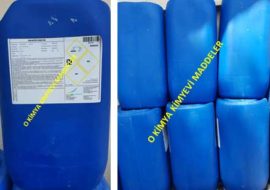
 LACTIC ACID PACKAGING 35 Kg
Product Documents |
|
| LACTIC ACID CERTIFICATE OF ANALYSIS | |
What is Lactic Acid?
Molecular Formula (Lactic Acid): C3H6O3
Molecular Weight: 90.078 g/mol
Chemical Name: 2-Hydroxypropionic Acid
CAS Number: 50-21-5
2-Hydroxypropionic acid is the most commonly occurring hydroxycarboxylic acid. It is a chemical substance first discovered in 1780 by the Swedish chemist Scheele. Lactic acid is a naturally occurring organic acid derivative.
It is an intermediate normally considered in the fermentation (Oxidation, Metabolism) of sugar. The concentrated form of lactic acid is used to prevent gastrointestinal fermentation.
It is a type of carboxylic acid. It can be produced in different concentrations. These concentrations are available as 50%, 80%, and 90%.
The DL-form of Lactic Acid is a racemic isomer, which is the biologically active isoform in humans. Carboxylic acids donate a hydrogen ion to interact with bases if they are present. With this property, they react with all bases, both organic and inorganic.
Carboxylic acids with six or fewer carbon atoms are freely or moderately soluble in water. Those containing more than six carbons are slightly soluble in water.
Lactic Acid formula: C3H6O3
Other Names are as Follows;
- 2-Hydroxypropanoic Acid
- DL-Form
- L-Form
- 50-21-5
- 2-Hydroxypropionic Acid
- Milk Acid
- Ethylidenelactic Acid
- Polylactic Acid
- Racemic Lactic
- USP Grade
- Alpha-Hydroxypropionic Acid
- Propionic acid, 2-hydroxy-
- 2-Hydroxy-2-Methyl Lactic Acid
- Whey
- Solution
- L-Form Calcium Salt
- E 270
How is it Produced?
In industrial systems, it is produced by fermentation or synthetic methods. The fermentation process requires carbohydrates, nutrients, and microorganisms to produce it via fermentation.
The carbohydrates used in the Lactic Acid production process mainly consist of hexose or compounds easily broken down into hexose, such as glucose, corn syrups, molasses, sugar beet juice, whey, as well as rice, wheat, corn, and potato starches.
The nutrients required by microorganisms during production include soluble peptides and amino acids. In many cases, peptides and amino acids are complex nitrogen compounds.
To control the pH during the production process, Lime (CaCO3), Calcium Carbonate (CaCO3), Ammonium Hydroxide (NH4(OH)2), and Sodium Hydroxide (NaOH) are generally used to maintain the pH in the broth.
To obtain high-purity L-Lactic Acid, sugarcane is fermented, then treated with sulfuric acid, resulting in the formation of Calcium Lactate through hydrolysis.
The resulting calcium lactate is reacted to remove calcium sulfate. Through filtration, some purification processes, and a final dilution step, high-purity L-Lactic Acid is obtained.
As a result of recent research, it has become possible to biologically convert Lactose, a byproduct of Whey, into Lactic Acid with the help of bacteria.
What are its Physical and Chemical Properties?
It is a clear, colorless liquid with a slightly irritating odor.
Some forms are a yellow, odorous, syrupy liquid. Or it has yellow crystalline properties.
Its aqueous solution is acidic.
Melting point is 18 °C.
Lactic Acid boiling point is 122 °C.
Density at 25 °C is 1.209 g/mL.
Storage temperature is 2-8 °C.
In terms of stability, it is a stable chemical substance. It is a combustible substance. It is incompatible with strong oxidizing agents.
It is a corrosive chemical for metals and tissue.
In terms of pH, a 10% aqueous solution has a pH of approximately 1.75.
What are its Effects on Human Health?
Inhalation of Lactic Acid fumes causes coughing and irritation of the mucous membranes. If ingested, even when diluted, it causes corrosive effects on the esophagus and stomach. Contact with more concentrated forms causes severe skin and eye burns.
It is a combustible substance, but it is a chemical that does not ignite easily. When this chemical is heated, its vapors can form explosive mixtures with air.
Contact with metals may produce flammable hydrogen gas. If it enters waterways through water flow, it is a chemical with properties that can pollute sewage systems.
It can be transported in a molten state.
What is the Mechanism of Action of Lactic Acid in Foods?
It is not naturally found in foods but is formed during the fermentation of sugar with the help of lactic acid bacteria. At pH 5.0, it inhibits spore-forming bacteria. However, it cannot affect the formation of molds and yeasts.
As a food additive, it is used as a preservative with antifungal properties in fruit-based beverages, fruit products, bakery products, and margarine.
Where is Lactic Acid Used?
- Approximately 85% of Lactic Acid is used in food and food-related applications. The remaining 15% is used in non-food industry sectors.
- Lactic Acid is used to impart acidity to foods. However, it adds a milder acidity compared to other acids.
- In the leather industry, it is used for pH regulation and deproteinization. This softens the leather, preparing it for dyeing and finishing processes.
- Due to its excellent preservative properties, it is used as a preservative in foods. It is used as a pickling agent in sauerkraut, olives, and vegetable pickles. Additionally, it is used as a pH buffering agent, antibacterial agent, and to prevent mold formation.
- It is an important acid in animal feed to prevent the formation of bacteria and mold. It works by lowering the pH level. It also has properties that prevent diarrhea in animals.
- Lactic acid is used to improve feed quality.
- In oil wells, it is used to prevent scaling by sending a solution into the well matrix using a compression process along with precipitation. This process increases the well's productivity. It is applied mixed with Fumaric Acid, citric acid, and some copolymers.
- Technical grade Lactic acid has long been used in leather tanning. Here, it is used for deliming hides and as an acidifier in vegetable tanning. Additionally, technical grade Lactic acid has been used in many different textile finishing processes and in the acid dyeing of wool.
- Due to its cost, cheaper inorganic acids have replaced this chemical. However, environmental restrictions related to the disposal of waste salts will likely make the use of technical grade lactic acid dominant in this field again.
- In the cosmetics industry, it is used in the manufacturing of basic makeup products.
- Its industrial use is very common in the fields of fiber, paint, pesticides, and coatings.
- Due to its plant growth-regulating properties, lactic acid is used in the manufacture of agricultural pesticides.
- It can be used as a food additive due to its aromatic properties.
- It is used in the manufacture of non-pesticide fungicides.
- The reason this type of acid is used in the leather industry is that it regulates pH to facilitate the removal of proteins from the hide.
What are Other Areas of Use?
- It is used in the manufacture of fuels and fuel additives.
- It is one of the acid derivatives used to balance the pH to between 4.0-7.0 during the production of antiseptic hydrogels.
- It is used as a coating agent and surface treatment chemical.
- It is used as a special processing chemical in petroleum production.
- It is used in the manufacture of plastic and rubber products.
- Used in the production of lactide. Used in oil wells.
- It is used as polylactic acid for biodegradable plastics and fibers.
- In the production of confectionery or hard candies, it is used along with citric acid to provide a sour taste and mask undesirable properties from sweeteners.
- It is used to lower the acidity on the scalp to inhibit bacterial growth and reduce sebum. Another acidity-lowering agent is salicylic acid.
- In wine production, malolactic bacteria (LAB) convert Malic acid, a dicarboxylic acid, into monocarboxylic Lactic Acid and Carbon Dioxide. And the sour taste in the wine is reduced.
- It is one of the organic acids used in the manufacture of buffered acid solutions.
- In shampoos produced for fur care, lactic acid is used as a chelating agent and moisturizing agent.
- It is used as an acidity regulator in dietary supplements containing Creatine Monohydrate.
- It is used as a soldering flux in the manufacture of soft solder.
- Used in the production of biodegradable Polylactic Acid, it has now taken its place in the manufacture of more environmentally friendly and harmless drug delivery systems, fibers, and packaging materials.
What Factors Affect its Price?
Lactic Acid prices have continuously increased for many years with the expansion of its application areas. If a new application area emerges, the price increases because the amount of lactic acid produced will not meet the demand.
It is directly dependent on the prices of the chemical substances used in lactic acid production. As the prices of the materials used in production increase, the price of this chemical will directly increase.
Prices depend on the production of this raw material. If a new production facility is established, the price will decrease for a short period. But over time, prices will reach a stable level.
Companies that sell Lactic Acid have a decisive impact on the price of this chemical. If companies selling this raw material increase their stocks, this chemical will be sold at a lower price level.