

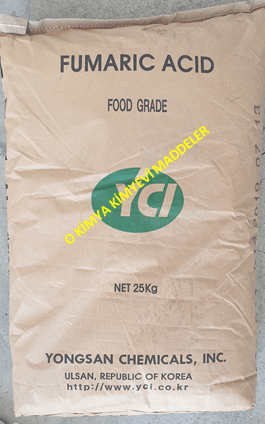
 FUMARIC ACID PACKAGING
Product Documents |
|
| FUMARIC ACID ANALYSIS CERTIFICATE | |
What is Fumaric Acid?
Molecular Formula (Fumaric Acid): C4H4O4
Molecular Weight: 116.072 g/mol
Chemical Name: Trans-Butenedioic Acid
CAS Number: 110-17-8
Evaluating Fumaric Acid as a chemical compound may be perceived as a different situation. It is (E)-2-Butenedioic Acid, first observed in temperate climates in the Northern Hemisphere where plants such as lichens, bolete mushrooms, and Iceland moss are found. In such environments, it is found in a fine white form or a colorless crystalline powder form.
It is not only found naturally in plants but also in humans. When the human body is directly exposed to sunlight, the skin produces Fumaric Acid.
Chemically, it is an unsaturated dicarboxylic acid. It is also a part of the Citric Acid cycle.
It is among the organic acids that have a sour taste-giving property. It is one of the organic acids with the highest buffering value. It has a higher buffering value compared to Citric Acid and Malic Acid.
Molecular Formula: C4H4O4
E Code: 297
Other Names are as Follows;
- E297
- 2-Butenedioic acid
- Allomaleic Acid
- Lichenic Acid
- Tumaric Acid
- Trans-1,2-Ethylenedicarboxylic Acid
- Sodium Fumarate
- Ammonium Fumarate
- Boletate
- E 297
How is Fumaric Acid Produced?
Production is currently carried out by the isomerization of malic acid produced from maleic anhydride. Of course, maleic acid must be produced before this. In the production process, Maleic Anhydride is produced first. Here, maleic anhydride is produced by the catalytic oxidation of suitable hydrocarbons.
Benzene is used as a dominant starting chemical. In addition, mixtures of n-butane or n-butene have been used more frequently recently. The catalysts used in this Maleic Anhydride production are embedded in fixed-bed tubular reactors.
The catalysts here are vanadium and phosphorus oxides. At this stage, water is formed as a by-product. Then, Maleic Anhydride is extracted and purified into its pure form.
In the Fumaric Acid production process, Maleic Anhydride is hydrolyzed into maleic acid. In the subsequent process, Maleic Acid is converted into Fumaric Acid through cis-trans isomerization.
What are the Physical and Chemical Properties?
In terms of its properties, it can be found in white powder form or transparent crystal form in appearance. It has an acidic taste with a fruit-like flavor. It is odorless.
Fumaric Acid has a taste that is 1.5 times more sour than citric acid and is odorless.
The melting point is 287 °C.
Boiling Point: No information available.
It has the property of sublimating above 200 °C.
When heated up to 230 °C, it loses water and converts into Maleic Anhydride.
In terms of solubility, it dissolves in ethanol. It is slightly soluble in water and ether. It dissolves in concentrated sulfuric acid. It is slightly soluble in acetone. Its solubility in water is 0.63 g/100 ml at 25 °C.
Its solubility increases when mixed with Dioctyl Sodium Sulfosuccinate.
It is not a toxic chemical.
Its density is 1.6 g/cm3.
What are the Usage Areas of Fumaric Acid?
- It is used as an antioxidant in the preparation of foods.
- It is used to provide the required acidity in green foods and fish where Sodium Benzoate is used as a preservative.
- It increases the strength of gelatinous gels. It is a chemical that releases calcium when included in formulas containing Alginate.
- It is used in the formulas of drugs produced for the treatment of psoriasis. In the metabolism where a cell affected by psoriasis is located, it acts on immune cells. In this way, it ensures the normalization of chemical regulators called cytokines in cells affected by psoriasis.
- It can be used in the manufacture of some desserts to give a more intense flavor. In addition, some cake fillings contain this chemical.
- It has excellent properties for helping to stabilize some dairy products and adding a sour taste. In this field, fumaric acid is used to enhance flavor in the manufacture of products such as chocolate milk and eggnog. It is also used in the manufacture of milk powder, creams, and cream soups.
- Fumaric Acid is used in the manufacture of some cereal products. These include oatmeal, breakfast cereals, rice pudding, and some cereal products such as pre-cooked pasta and dried pasta.
- Fumaric acid is used to enhance the flavor of some processed foods. These include processed foods such as bacon and canned meats. Besides, mustard, vinegar, and apple juice may contain this chemical.
- It is used in the manufacture of adhesives. The copolymer of Vinyl Acetate and Fumaric Acid has excellent adhesive properties. Casein-free foil lamination adhesives are produced using this method. At the same time, it is used to give a thick consistency to latex adhesives.
What are Other Usage Areas?
- It is used in glass fiber production. Here it is in the form of a styrene copolymer.
- This compound is neutralized with sodium carbonate to produce sodium fumarate. Then, it is exchanged with ferrous sulfate to produce ferrous fumarate for use in the treatment of small red blood cell anemia.
- To increase efficiency in oil wells and prevent scale formation, it is sent into the matrix of the oil well by creating a liquid solution. This solution may consist of lactic acid, citric acid, and some copolymers.
- Fumaric acid is used in silages used as poultry feed or cattle feed to lower acidity and prevent bacteria and yeast formation. In this way, it ensures easier digestion and absorption of the feed. It is used as an antioxidant in animal feeds.
- It is one of the organic acids used to preserve nutritional values and provide energy.
- During wine production, the concentration of ethyl alcohol increases during the fermentation process. This causes the precipitation of tartaric salts. Malolactic fermentation in winemaking causes a decrease in titratable acidity, which triggers the formation of malolactic bacteria (Oenococcus oeni). Fumaric acid is used to prevent this.
- It is used as an acidity regulator in foods. It is used in fruit juices, candies, and processed foods.
- In food additives packaged in dry form, it has both an anti-caking effect and a sour taste effect. It is used in bakery products such as sourdough and pies.
- It is used as a reinforcing agent in the production of alkyd surface coating resins.
What are the Factors Affecting Prices?
Fumaric Acid prices are directly dependent on oil prices. This is because benzene prices produced from oil will increase. This situation causes prices to rise. Therefore, with the excessive increase in oil prices, the production of this chemical by fermentation has gained momentum.
Prices are directly proportional to the usage areas. With the development of usage areas, fumaric acid prices will increase. This is because the production capacity of existing factories will not adequately meet the demand.
Prices change depending on the stocks of the companies that sell fumaric acid. As stocks increase, prices will decrease downward.