

Product Documents |
|
| CITRIC ACID ANHYDROUS CERTIFICATE OF ANALYSIS | |
What is Citric Acid Anhydrous?
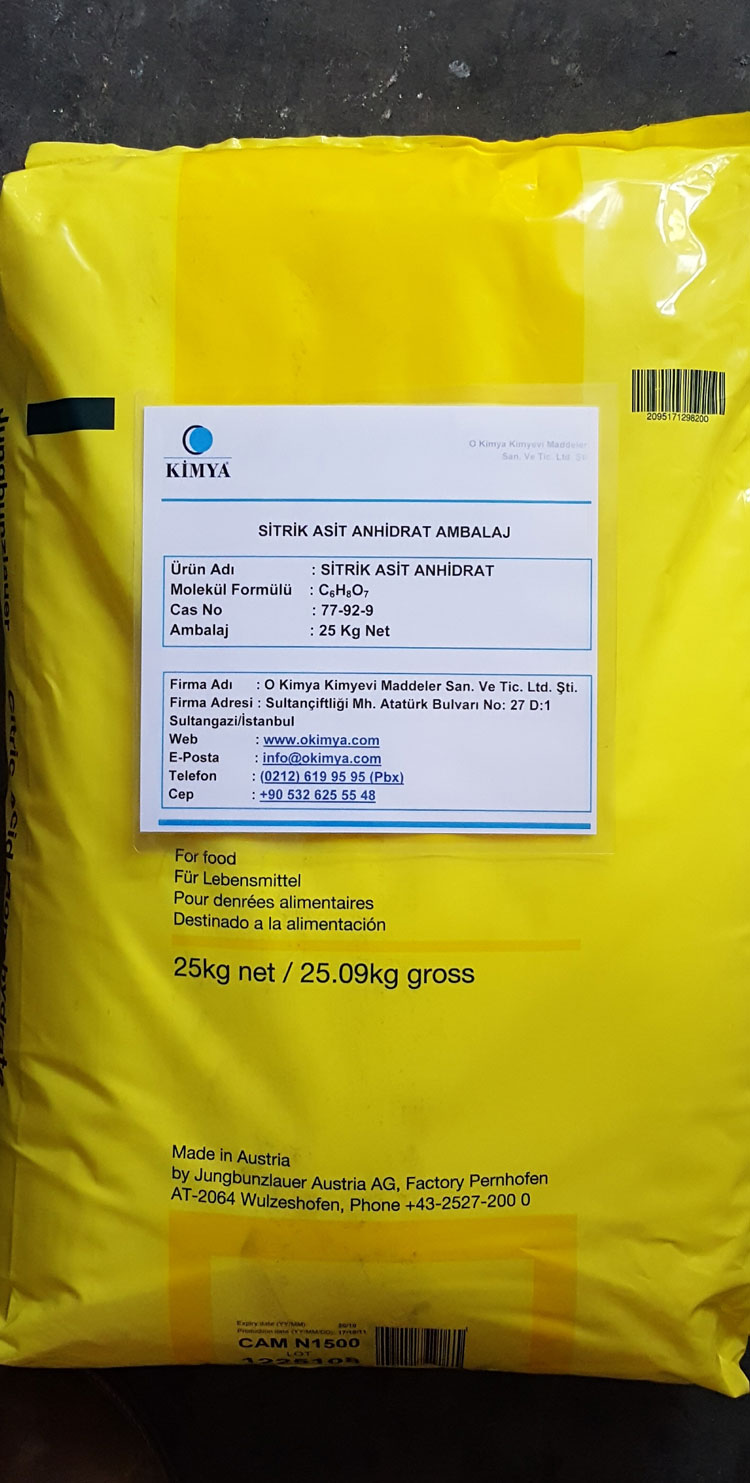
Molecular Formula (Citric Acid Anhydrous); C6H8O7
Molecular Weight; 192.124 g/mol
Chemical Name; Citric Acid Anhydrous
CAS Number; 77-92-9
It is a naturally occurring fruit acid. It is produced commercially by the fermentation of a carbohydrate substrate. Citric Acid is the most widely used organic acid and pH control agent in foods, beverages, pharmaceuticals, and technical applications.
It takes its name from the Latin word for citrus fruit, like lemon.
Citric Acid Anhydrous is a tricarboxylic acid. It is found in small amounts in almost all plants and animals.
It is non-toxic and has low reactivity. Citric Acid is a major part of the tricarboxylic acid cycle, which helps to increase energy.
Other Names Are as Follows;
- Citric Acid
- Citrate
- 77-92-9
- 2-hydroxypropane-1,2,3-tricarboxylic acid
- Anhydrous Citric Acid
- 2-Hydroxytricarballylic Acid
- 3-Carboxy-3-hydroxypentane-1,5-dioic acid
- β-Hydroxytricarballylic Acid
- Citrate Ion
- 99% Citric Acid
- Anhydrous citrate
What are the Physical and Chemical Properties of Citric Acid Anhydrous?
It is an anhydrous acid.
It has a colorless and white appearance.
It is found in crystalline or powder form.
It has a strong acidic nature.
Slightly soluble in ether. Citric Acid Anhydrous dissolves well in ethanol. It is approximately 96% soluble.
It is fully biodegradable. Soluble in water. It is an odorless chemical.
Its density is 1.66 g/cm³ (at 20 °C).
Its boiling point is 310 °C.
Its melting point is 153 °C.
Its pH value is approximately 3.5.
How is it Produced?
Citric Acid was first produced commercially from lemon juice. It was later synthesized from glycerol. Due to cost advantages, it was then synthesized from symmetrical dichloroacetone.
Later, attempts were made to produce Citric Acid by other means from a synthetic chemical, but a competitive price could not be achieved.
Later, it was discovered that citric acid is formed in substances containing sugar and inorganic salts. Based on this, it was proven that a medium containing sugars and salts proliferates at an initial pH of 2.5-3.5. And it was determined that it met the conditions for industrial production.
Many microorganisms can be used for the production of this chemical, but the Aspergillus niger fermentation method is the most suitable Citric Acid production method for industry.
In its production, the yield does not exceed 70% due to losses in the strains. The theoretical yield in its production is 112 g of anhydrous citric acid per 100 g of sucrose.
How is it Stored?
Citric Acid is packaged in 25 kg polyethylene bags for storage. Citric Acid can be stored for 3 years after production.
What is the Difference Between Citric Acid Monohydrate and Citric Acid Anhydrous?
The biggest difference between Citric Acid Anhydrous and Citric Acid Monohydrate is that the Anhydrous form is water-free. In contrast, citric acid monohydrate is formed by the binding of a water molecule to citric acid.
Citric Acid loses its water through crystallization with hot water. This results in the formation of anhydrous citric acid. Citric acid monohydrate is crystallized with cold water. Therefore, the water in its structure remains bound. Both forms crystallize at the same temperature.
The density of the anhydrous form is higher than that of citric acid monohydrate. The molar mass of citric acid monohydrate is greater than the molar mass of the anhydrous form. Both have the same boiling point temperature. However, the melting point of the anhydrous form is higher.
Citric Acid Cycle
The Citric Acid cycle is taught in detail in universities. However, students often do not fully grasp the importance of the citric acid cycle.
Acetyl-CoA is formed from the breakdown of substances such as starch, protein, and lipids. Acetyl-CoA consists of an Acetyl group attached to a Coenzyme A particle. Coenzyme A has an ADP atom with two side-chain groups extending from the phosphate arms. Acetyl groups are added to the end of the side chains. Throughout the chains extending in the Citric Acid cycle, Coenzyme A acts as a carrier for the acetyl groups.
In the Citric Acid cycle, the vitality that directs the citrus extract cycle is discarded with the removal of water. The most common method for removing Acetyl-CoA from the metabolic pathway is with the help of the pyruvate dehydrogenase multienzyme complex.
How is it Used in Confectionery Production?
To get the most out of the product obtained during confectionery production, there must be a very good harmony between sour and sweet tastes. The sour taste of citric acid harmonizes very well with the sweetness of the product during the sugar or confectionery production stage.
In addition, they help mask the unwanted tastes of high-intensity sweeteners used in sugar production, providing an excellent flavor. Some acid combinations are used to suppress unwanted tastes in confectionery and hard candy production.
These acid combinations are as follows;
- Citric Acid-Malic Acid Combination
- Citric Acid-Lactic Acid Combination
- Citric Acid-Lactic Acid-Malic Acid-Gluconic Acid-Phosphoric Acid combination
The raw materials used to add this type of acidity regulator or sour taste can vary according to the user's demand. This is related to whether it is an organic or synthetic raw material.
Since citric acid and lactic acid are produced by fermentation, they can be preferred according to the demand of sensitive users. However, malic acid has a synthetic production method derived from petrochemicals.
Where is Citric Acid Anhydrous Used?
- Provides acidity and acts as a buffer in alcoholic beverages. It regulates pH.
- In the pharmaceutical industry, it is used together with tartaric acid in the production of effervescent tablets to protect them from moisture.
- It is used in the production of energy drinks for athletes. Manufacturers use it to add flavor.
- Used in the manufacturing of tea and coffee.
- Used in fruit juice beverages. It is used as an acidity regulator.
- Used in personal care products for the chelation of metal ions. These personal care products include deodorants, perfumes, hair care, oral care, skin care, soap, and bath products.
- Used to provide consistency in dishwashing chemicals, industrial cleaning chemicals, laundry detergents, and surface care chemicals.
- In industrial applications, it is used extensively in the manufacturing of adhesives, agricultural chemicals and fertilizers, production of construction materials, in the ink, paint, and coating sectors, metal surface treatments, petroleum extraction processes, ore mining and refining operations, the paper industry, plastic and polymer manufacturing, and the Textile and leather industry.
- It is used to balance pH in the production of antiseptic hydrogels for wound treatment.
- It is used in drug manufacturing to enhance the absorption of these drugs by the user.
- We can use citric acid to alter the taste in the manufacturing of sugar-free sweeteners.
- Its preservative property is utilized to prevent enzymatic esterification during the freeze-drying of foods.
- Citric Acid Anhydrous is used in the manufacturing of clinical nutrition products, food supplements, for applications in medical devices, and in pharmaceutical products.
- It is used in the production of pet food.
- The main structure of confectionery products is glucose. However, recently, different formulations are being tested in the sugar industry to reduce glucose. The important thing in confectionery production is to achieve the right flavor combination. Organic acids are very suitable for flavor modification.
The reaction headings of the Citric Acid cycle are as follows.
- Citrate Synthesis
- Aconitase
- Isocitrate Dehydrogenase
- Alpha-Ketoglutarate Dehydrogenase
- Succinyl-CoA Synthetase
- Succinate Dehydrogenase
What Factors Affect its Price?
The price of Citric Acid Anhydrous increases in parallel with the rise in raw material costs. Prices increase steadily every year.
The price of Citric Acid Anhydrous increases as its application areas expand.
Although the price of Citric Acid Anhydrous may briefly increase with the emergence of new production facilities, it eventually stabilizes.