

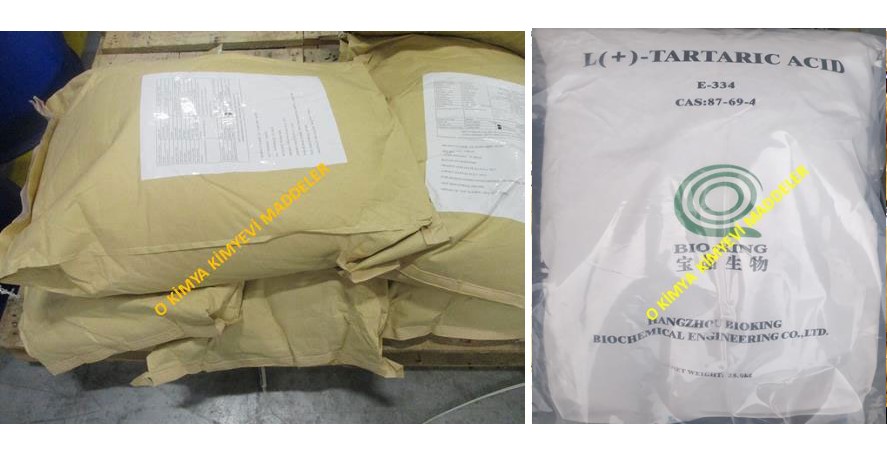
 TARTARIC ACID PACKAGING 25 Kg
Product Documents |
|
| TARTARIC ACID CERTIFICATE OF ANALYSIS | |
What is Tartaric Acid?
Molecular Formula (Tartaric Acid); C4H6O6
Molecular Weight; 150.087 g/mol
Chemical Name; Dihydroxybutanedioic acid.
CAS Number; 133-37-9
It is an organic chemical substance naturally found in various plants, fruits, and wines. It is also obtained naturally during wine production.
It is found in many plants, especially tamarind and grapes. It has a white color and a crystalline structure. Tartaric Acid, a member of the dicarboxylic acid group, is a dihydroxyl derivative of succinic acid. It has the ability to rotate polarized light.
It is the acidic potassium salt that derives from accumulation in fermented grape juice.
Tartaric Acid E Code: E 334.
Other Names for Tartaric Acid are as Follows;
- DL-Form
- 2,3-Dihydroxybutanedioic Acid
- 2,3-Dihidroxysuccinic Acid
- Racemic Acid
- Racemic
- DL-Tartrate
- Paratartaric Acid
- Tartrate
- Uvic Acid
- L-Form
What is L(+) Tartaric Acid?
L(+) Tartaric Acid is described as the natural form. It is a product of nature.
In its natural form, it is obtained as a byproduct of winemaking after the production of alcoholic products.
It should not be confused with the synthetic form obtained starting from synthetic maleic acid.
Two stages of crystallization are applied. It has 2 purity grades. L(+) Tartaric Acid, the natural raw crystal, is dissolved and then recrystallized. This production method eliminates process residues.
The high-cost product is Natural Tartaric Acid, which is produced from Calcium Tartrate crystals that form during fermentation in wine barrels. Commercial calcium tartrate contains 50% Tartaric Acid.
Calcium Tartrate in wine barrels has a relatively low solubility in water. To isolate these sediments, Calcium Carbonate and Calcium Sulfate are added to precipitate the Calcium Tartrate. Calcium Carbonate is added as a neutralizing agent in the form of an aqueous suspension. Another reason for using calcium carbonate is that it does not dissolve in water and does not affect the alkalization of the solution.
What are its Physical and Chemical Properties?
It has a white crystalline color. It can also be in the form of a crystalline powder. It gives a sour, acidic taste.
Melting point is 206 °C.
Boiling Point: Decomposes, no boiling point.
Density is 1.984 g/mol.
It dissolves well in water at 20 °C. Its solubility in water is 133 g/100 mL. It is soluble in alcohol but insoluble in ether.
It is a chiral chemical. This means we can think of it as having a molecular structure that is non-superimposable on its mirror image.
What are its Effects on Human Health?
It is a chemical that works by inhibiting the production of malic acid . In this process, exposure to high doses of tartaric acid can cause toxic accumulation in the muscles. High-dose accumulation can lead to paralysis and death.
What are its Benefits?
- It increases the resistance of the immune system. The long-term consumption of foods containing this chemical compound protects the metabolism from infections and health-threatening diseases. Fruits where it is naturally found include; Grapes, apricots, apples, avocados, and tamarinds, etc. At the same time, medications containing tartaric acid as an active ingredient are given to people with weak immune systems and health problems.
- This chemical compound is one of the substances that helps the digestive system function well. It benefits the digestive system by enabling the faster breakdown of the food we eat.
- It has been found to increase glucose intolerance in people with a potential for impaired sugar-insulin balance, which is a progression towards diabetes.
What are its Harms?
Long-term consumption of natural or processed foods containing tartaric acid can trigger unwanted symptoms in the human body. This can result in digestive problems such as abdominal pain, nausea, and gastrointestinal infections. Therefore, the use of pure tartaric acid should be avoided.
How is it Produced?
Tartaric Acid production can be achieved through the chemical reaction between Calcium Tartrate and an aqueous solution of sulfuric acid.
CaC4H4O6 + H2SO4 > H2C4H4O6 + CaSO4
Tartaric acid produced by this reaction is the only chemical additive used in Europe to regulate acidity in wine production.
The main chemical substances and components used in the production of this chemical are water, sulfuric acid, and calcium tartrate.
How Should it be Stored?
It should not be stored in areas exposed to direct sunlight. When stored in areas with direct sunlight, it is observed to convert to glyoxylic acid. Under these conditions, hydrogen peroxide and glyoxylic acid will react with each other to produce formic acid. Therefore, it does not exhibit a stable appearance.
It is packaged in 25 kg, 500 kg, and 1500 kg paper bags.
What are the Usage Areas of Tartaric Acid?
- Tartaric Acid is used to produce sodium carbonate through its interaction with sodium bicarbonate via oral administration. As a result of this effect, the carbon dioxide produced distends the stomach.
- It is used in many food products to impart a sour taste and as an antioxidant.
- It is used in food additives for bakery products like cakes, pastries, etc., to provide leavening properties.
- It is used as a preservative in foods. It also adds flavor to foods. It is commonly used in the production of carbonated beverages, fruit candies, and effervescent tablets.
- It is also used in gold and silver plating processes. Additionally, tartaric acid is used for polishing and cleaning metals and in leather tanning. It is the chemical that provides the tanning effect in sunscreens.
- It is used in the manufacture of blue inks. Besides this, it is used as a component that reacts with Silver Nitrate to give mirrors their silver color.
- Fabric dyeing processes are carried out with the ester derivatives of Tartaric Acid.
- Tartaric acid is one of the organic acid sources in the production of water-soluble plastics.
- In wine production, tartaric acid is used to preserve the color, chemical stability, and taste of the finished wine products. It also controls the acidity of the wines.
- One of the reasons for its use in wine production is that it lowers the pH of the medium, preventing the growth of unwanted bacteria. It has an antioxidant effect.
- Tartaric acid is one of the chemicals used for the production of chiral molecules in organic chemistry.
- Patients with dysphagia experience swallowing problems. In such disorders, food returns from the stomach. It is used in the production of effervescent tablets designed to prevent these muscle and nerve disorders.
- Cream of tartar is used to clean copper coins. In this application, the chemical penetrates the copper metal and acts by corroding it.
- It is used as a flavoring agent in food and beverages.
- It is used in fruit juice manufacturing to adjust the taste of orange juice.
- Natural tartaric acid is used in dried fruits to provide a pleasant sour taste and an antioxidant effect.
- As an anionic surfactant and corrosion inhibitor, tartaric acid can be used in vehicle window cleaning compositions. The prepared composition exhibits superior performance in preventing noise and abrasion caused by friction.
- It is used to reduce the amount of sugar added to fruit juice, thereby balancing the taste.
What Factors Affect its Prices?
Tartaric Acid prices are constantly being pushed up due to increasing wine consumption. The price of this chemical will rise during periods of high demand.
The increasing popularity of packaged food products also increases the demand for tartaric acid. Therefore, its price is increasing.
Its use as an emulsifier in bread production leads to an increase in its price.
In countries where this chemical is produced, grape production is sometimes low. During these periods, companies that have difficulty finding raw materials raise the prices of tartaric acid.