

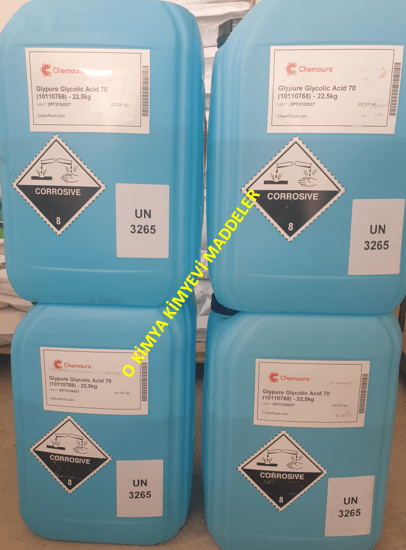
 GLYCOLIC ACID PACKAGING
Product Documents |
|
| GLYCOLIC ACID ANALYSIS CERTIFICATE | |
What is Glycolic Acid?
Molecular Formula (Glycolic Acid): C2H4O3
Molecular Weight: 76.05 g/mol
Chemical Name: 2-Hydroxyacetic Acid
CAS Number: 79-14-1
It is also called hydroxyacetic acid. This chemical is the smallest of the Alpha-Hydroxy acids. The chemical in this group is briefly referred to as AHA.
It is an important compound with functionality in quality skin care products in the cosmetics sector and in the field of dermatology in the pharmaceutical sector.
It has a stimulating effect on collagen and elastin production in the skin.
Other Names Are as Follows;
- Acetic Acid, 2-Hydroxy
- Alpha-Hydroxyacetic Acid
- Glycoside
- GlyPure
- Glycolate
- 70% Concentration
- Glycolic Acid Homopolymer
- 79-14-1
How is Glycolic Acid Produced?
Glycolic Acid is naturally found in some plants and vegetables.
This Alpha-Hydroxy Acetic acid production is carried out by hydrolyzing monochloroacetic acid with Sodium Hydroxide . The temperature of the reaction here is in the range of 90 °C to 130 °C.
After this reaction, Glycolic Acid at 60% concentration and a certain amount of Sodium Chloride are obtained. Removal of the salt in the solution can be carried out by the acid extraction method with acetone.
One of the Glycolic Acid production methods can be carried out by the electrolytic reduction method of Oxalic Acid’s.
It can be produced by the oxidation of glycol with dilute nitric acid.
One of the production methods is that during the production of Sodium Croscarmellose, after all excess sodium hydroxide is used, monochloroacetic acid hydrolyzes to Glycolic Acid.
What are the Physical and Chemical Properties?
Commercially available Alpha-Hydroxyacetic Acid is in a colorless, transparent, and clear liquid form. Pure Glycolic Acid is in the form of a colorless hygroscopic solid.
It is odorless.
The boiling point is 100 °C.
The melting point is 79.5 °C.
Density: 1.25 g/cm³.
In terms of solubility, it dissolves in Acetic Acid, Methyl Alcohol, Ethyl Alcohol , Water, and Acetone.
Its solubility in water is very good.
What are the Usage Areas of Glycolic Acid?
- Dead skin cells accumulate on human skin. This results in dry skin, acne formation, and skin wrinkles. Skin care products containing Glycolic Acid are produced to prevent the accumulation of dead skin cells on the skin.
- Chemicals containing 2-Hydroxyacetic Acid are used to increase the moisture level of the skin. In this way, the water-binding capacity of the skin is increased. Hyaluronic Acid is present in the skin. Glycolic Acid is used to increase the water-holding capacity of Hyaluronic Acid.
- As people age, age spots form. In the cosmetic sector, formulas containing Glycolic Acid are used to remove these age spots to look younger.
- Acne and pimples occur on the skin due to the problem of excess sebum secretion. It is included in recipes produced for their elimination.
- Used for pH control purposes.
- It is an important component in chemical milling processes of metals.
- It can be used in formulas where organic acid is required.
- Used in the composition of products made to brighten the skin in the cosmetics sector.
- Products containing Glycolic Acid produced in cream form are formulated with several different compounds. These include Salicylic Acid, Vitamin E, and Oils.
- Used in the manufacture of creams produced for the treatment of scaly skin.
- Due to its chemical structure, Glycolic Acid reacts with the keratin in the hair structure, making the hair shinier, healthier, and helping it gain a smoother form.
- Used in the production of chemical peels produced for the treatment of acne occurring on the skin.
- Some hydrogels are produced to treat wounds. In the production of these hydrogels, the pH is desired to be between 4.0-7.0. It is used here as an acidity regulator.
- Used in cosmetic preparations produced for filling wrinkles on the skin, to prevent moisture loss of the skin and increase hyaluronic acid production. Xanthan Gum is used as a stabilizer in this application.
- Glycolic Acid in the Alpha-Hydroxy Acid category, which is therapeutically effective for the elimination of dermatological disorders occurring on the skin, is used. It is formulated in amphoteric composition and polymeric form. These dermatological disorders include blackheads. At the same time, it indirectly contributes to the production of collagen proteins.
- It is used to increase resistance to environmental and biological stress in plants and for plant growth. The most suitable glycolic acid concentration to prevent stress in plants is in the range of 2-500 ppm. Method of use: it can be added to the leaves, soil, and irrigation system of the plant.
- Used to increase the bonding strength of bioceramic root canal sealers.
- In the agricultural sector, irrigation systems become clogged due to substances in the water and chemicals. It has usage areas such as preventing clogging in irrigation systems, providing pH control, preventing insoluble phosphate formation, and preventing bacteria formation.
- Alpha-Hydroxy Acids (AHA) have effective properties against skin aging. Among these properties, it stimulates the cellular renewal process. It helps dull-looking and photoaged skin gain vitality. Glycolic Acid is an important organic compound among Alpha-Hydroxy Acids that can provide these features.
What Factors Affect the Prices?
Glycolic Acid prices change directly with the prices of the chemicals used in the production of this chemical. With the rise in the prices of Oxalic Acid, Nitric Acid, and Sodium Hydroxide, this chemical increases in price.
The prices of Glycolic Acid increase as its usage areas expand. Prices have risen recently with the increase in use in the cosmetic sector.