

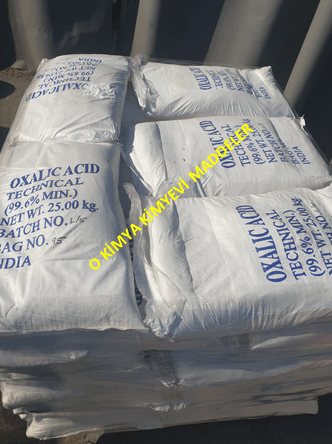
 OXALIC ACID PACKAGING 25 Kg
Product Documents |
|
| OXALIC ACID ANALYSIS CERTIFICATE | |
What is Oxalic Acid?
Molecular Formula (Oxalic Acid): C2H2O4
Molecular Weight: 90.03 gr/mol
Chemical Name: Oxalic Acid
CAS Number: 144-62-7
This acid is generally a strong dicarboxylic acid that occurs in many plants and vegetables as Potassium and Calcium salts. These compounds are found in greens, vegetables, fruits, cocoa, nuts, and seeds.
The human body can convert certain substances into Oxalate on its own. It can also obtain it from food. Vitamin C can also be converted to oxalate when metabolized.
It is the only possible compound where two carboxyl groups are directly joined. Due to this property, it is one of the strongest organic acids.
The most significant feature that distinguishes it from other carboxylic acids is that it can be easily oxidized (except for Formic Acid). Due to the oxidation property of oxalic acid here, it provides benefits as a reducing agent in photography, bleaching, and the removal of ink color.
Other Names are as Follows;
- Oxalic Acid
- Oxalate
- Oxyric Acid
- Ethanedioic Acid
- 144-62-7
- Ethane-1,2-dioic acid
- Anhydrous
- Dihydrate
- Diammonium salt
- Dianion
How is it Produced?
Production: commercially, it is produced via the nitric acid oxidation of starch, sugar, or ethylene glycol.
It is a co-product for the fermentation of sugar cane to citric acid. Oxalic acid can be obtained by melting sawdust (or other forms of cellulose) with a mixture of sodium hydroxide and potassium hydroxide.
What are the Physical and Chemical Properties?
It is an odorless white solid chemical. It can be found in powder or granular form.
The melting point is 189.5 °C.
Boiling Point: Decomposes, no boiling point.
Oxalic Acid solubility is 220 mg/Lt at 25 °C. At the same time, it dissolves in ethyl alcohol, chloroform, and benzene.
Its density is 1.9 gr/cm3.
In terms of stability, it is hygroscopic. It is a heat-sensitive chemical.
It can react violently with furfuryl alcohol, silver, sodium, perchlorate, sodium hypochlorite, sodium chloride, acid chlorides, alkali metals, and metals.
What are the Usage Areas of Oxalic Acid?
- Among its usage areas, it is generally used as a mordant, reducing agent, and bleaching agent for the dyeing and printing industry.
- It is used in the manufacture of fruit juices.
- It is also used as an analytical reagent in the refining of rare metals and the synthesis of various oxalate esters, amides, oxalates, and grass treatments.
- It is used in the synthesis of cleaning products.
- Oxalic Acid, when used in appropriate concentrations, helps in removing rust stains from carpets.
- It is among the Organic Acid derivatives used for cleaning the pale color found on titanium and titanium alloy materials.
- It is used as a cleaning chemical in plating processes.
- In industry, it is used in the manufacture of corrosion inhibitors and scale inhibitors.
- It is used in the furniture sector to prepare wooden floors for painting. In this field, it is used for preparation in lightening excessively stained wood furniture areas.
- It is used to remove rusting that occurs in plumbing pipes and kitchen countertops. It is the main component of commercial rust removers used to remove metal rust stains found in sinks and bathtubs.
- Wastewater treatments are also among its usage areas because oxalic acid effectively separates the calcium present in wastewater.
- It is used as a marble polishing and grinding agent. In the production of marble polishing powder, oxalic acid is used together with stearic acid. The obtained polishing powder is applied to the marble and processed. A chemical reaction occurs. After the polishing process, a buffing process is performed. In this way, it protects the marble for a long time against external influences.
- It acts as a synthesis chemical for preparing Allyl Alcohol and formic acid in the laboratory environment.
- In the beekeeping sector, a 3.2% solution in evaporated form or sugar syrup can be used by some beekeepers as a miticide against the parasitic varroa mite.
- In the bleaching processes of linden, birch, maple, and poplar trees, the bleaching process is carried out by using it together with sodium carbonate after the surface of the wood is cleaned with acetone or spirit.
- It is used to coat the surface and provide shine to finished marble statues.
- In the leather sector, it is used in a transposed tanning process that does not require separate acidification and basification processes. In this application, it is used together with chemicals such as salisilic acid and phthalic acid.
- It can be used to clean iron and manganese deposits from quartz crystals.
- In some aluminum anodizing processes, it is used with sulfuric acid or anhydrously. Compared to anodizing where sulfuric acid is used, processes performed with Oxalic Acid result in smoother surfaces.
- For a greener world and a cleaner environment, the production of water-soluble plastics has gained momentum. Therefore, water-soluble organic acids are used in the production of these plastics. Oxalic Acid is an organic acid used in the production of biodegradable plastics.
- Oxalic Acid is used to clean organic or inorganic impurities occurring on aluminum surfaces.
- In the field of dyes and pigments, it creates an acidic environment to ensure color stability and help bind the pigments.
What are the Factors Affecting Prices?
In terms of price, it is directly dependent on the stocks of companies that manufacture this chemical. As stocks increase, oxalic acid will decrease in price.
Another factor affecting prices is directly dependent on the prices of materials used in the production of this chemical. As the prices of the materials used in its production increase, the prices will increase. As nitric acid prices increase, Oxalic acid will increase in price.