

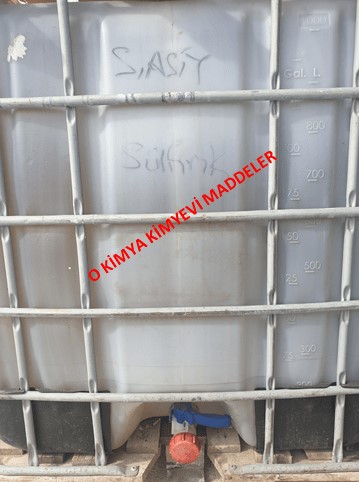
SULFURIC ACID PACKAGING
Product Documents | |
What is Sulfuric Acid?
Molecular Formula (Sulfuric Acid): H2SO4
Molecular Weight: 98.08 g/mol
Chemical Name: Sulfuric Acid
CAS Number: 7664-93-9
It is one of the most important industrial chemicals in the world, available in varying purities. Depending on its purity, it can have a colorless or brown physical appearance. It is a very strong mineral acid. When it reacts, it releases 2 protons. Therefore, it has diprotic acid properties.
It is among the most used chemicals in the world. It is utilized in almost every chemical process and in the production processes of many chemical substances.
The factor that makes this chemical in demand industrially is the Leblanc reaction, which is the production reaction of sodium carbonate.
It is also known as battery acid. This is because sulfuric acid is the chemical that triggers and assists the reactions within the battery.
Other Names are as Follows;
Battery Acid
H2SO4
Plating Acid
Dipping Acid
Electrolyte Acid
Oil of Vitriol
7664-93-9
Dilute Form
Concentrated Form
How is Sulfuric Acid Produced?
Sulfur (S) is used as the main source in its production. Sulfur is found in abundance in volcanic craters. The production reaction takes place in several steps. First, solid sulfur is burned with oxygen to obtain sulfur dioxide. This reaction is as follows.
S (k) + O2 (g) 》SO2 (g)
In the reaction, it is oxidized to Sulfur Trioxide with a Vanadium (V) oxide catalyst. This reaction is as follows.
2SO2 + O2(g) 》2SO3 (g)
In the reaction, Sulfur Trioxide is treated with water to obtain a concentration of 97%-98%. This reaction is as follows.
SO3(g) + H2O 》H2SO4
What are the Physical and Chemical Properties?
It is a colorless and viscous acid with a sharp odor. When its concentrated form reacts with water, it releases heat to the environment.
Its density is 1.84 g/cm³.
Its boiling point is 337 °C.
Its melting point is 10 °C.
In terms of stability, the 98% form is the most stable state in water.
It is hygroscopic. It can easily absorb moisture from the air.
It has an oxidizing effect. At the same time, it is extremely corrosive.
The pH of the concentrated form is 0.1. This value shows that the chemical in this form has a very strong acidic structure.
What are the Usage Areas of Sulfuric Acid?
It is an excellent acid as a sulfate source in the manufacture of fertilizers such as ammonium nitrate, ammonium sulfate, and aluminum sulfate.
In the production of costume jewelry, it is used to clean oxides and polluting substances on metal surfaces.
Used in copper and uranium mines for the extraction of copper and uranium.
It is a mineral acid used for removing paints on metal surfaces.
Sulfuric acid is used as an electrolyte source in battery manufacturing. Its function here is to produce energy by creating an electrical charge that passes from one plate to another by converting lead and lead oxide electrons in the electrolytes that power the batteries into lead sulfate.
In the chemical industry, it is used as a decomposition effect and a sulfate source in the manufacture of hydrochloric acid, nitric acid, and sulfate salts.
In the metal sector, the surfaces of aluminum, copper, and zinc alloy materials are processed using sulfuric acid together with hydrochloric acid, nitric acid, tartaric acid, citric acid monohydrate, and hydrofluoric acid.
Used in municipal sewage wastewater to eliminate bacteria in concrete pipes. In this application, its corrosive effect is utilized to kill bacteria.
Sulfuric acid is used together with hydrochloric acid to absorb sulfur in wet flue gases.
Used in iron and steel pickling processes. It is used in the production of pickling gel produced to remove argon welding residues on stainless steel and to prevent corrosion.
In biodiesel production, it can be used as an acid catalyst for the reaction to occur quickly and with high efficiency.
Polyester yarns are used in the manufacture of glass fibers used for wind turbine blades. Concentrated mineral acid is used to dissolve these yarns.
In the textile sector, sulfuric acid is used for desizing purposes after the retting process of textile fibers to make them suitable for spinning and weaving processes.
Mineral acids are used in the production of some chemical compounds. One of the most important among these mineral acids is sulfuric acid. It is used to acidify sodium salicylate in salicylic acid production.
It is used in the production of all batteries, including those used in solar power plants. The reason for using H2SO4 in batteries in solar power plants is that it acts as an electrolyte that conducts electricity in the battery.
Sulfuric acid is used to create an inorganic acid solution in the production of metallic pigments coated with silicon dioxide, which are resistant to corrosion.
Used for removing paint during the metal recycling stage.
Sulfuric acid is used as the main input in the manufacture of thermal and acoustic insulation products, which are insulation materials produced with phenol-formaldehyde and mineral wool. In addition, sulfamic acid or L-glutamic acid can be used due to their easier neutralization properties.
It is one of the mineral acids used for the production of aqueous silica gel. It is a substance obtained from the reaction with alkali silicate.
Used in metal refineries to ensure the dissolution of oxides found in ores. In this way, oxides and sulfides dissolve and pass into the acidic solution.
Cyanide is an extremely dangerous substance for the environment. Therefore, it is used in the chemical components produced for the disposal and destruction of cyanide and for the decomposition of toxic chemicals such as cyanide in the mining industry. Some taurine derivatives are also used in this composition.
Cyanide is widely used to leach gold in precious ore mines. There are 2 different methods to separate gold: heap leaching and vat leaching. Although the vat leaching process is more controlled, if the procedures are not fully implemented, toxic cyanide accumulates behind dams, posing a threat to the environment and living things. To prevent this, these wastes must be disposed of. It enables the obtaining of compositions that offer a safer method compared to Caro's acid used for the destruction of toxic cyanide with sulfuric acid and some components.
Sulfuric acid is one of the main components in ore leaching, electrolytic refining, and metal sulfate production, especially in copper, nickel, zinc, and cobalt mining.
What are the Factors Affecting Prices?
The price of sulfuric acid varies depending on the prices of the chemical substances used in the production of this chemical. As sulfur and oxygen prices increase, sulfuric acid prices will increase.
Its use will increase depending on the development of industry worldwide. An increase in the usage area will increase prices.
The price of sulfuric acid depends on transportation prices. Since an increase in shipping prices will increase the costs of companies selling sulfuric acid, the price of the chemical will increase.
Sulfuric Acid Sales
Chemical substances are packaged in packages determined by international standards. These are sold starting from the smallest package to the largest package or in bulk with tanker. These can be 1 gram packaging, 1 ton big bag packaging, the smallest drum packaging, or packaging-free sales with tanker.
All information here should be used in accordance with the legislation by expert people and professionals in the field.