

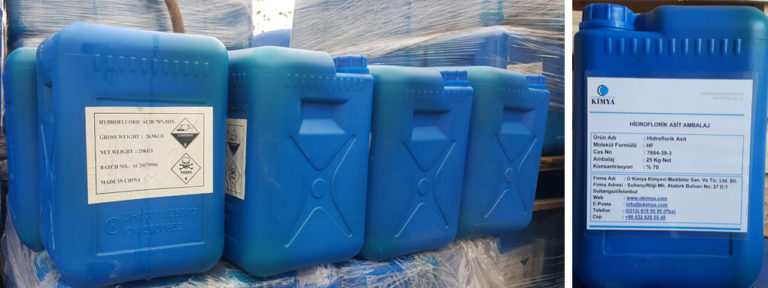
 HYDROFLUORIC ACID PACKAGING
Product Documents |
|
| HYDROFLUORIC ACID CERTIFICATE OF ANALYSIS | |
What is Hydrofluoric Acid?
Molecular Formula (Hydrofluoric Acid); HF
Molecular Weight; 20.01 g/mol
Chemical Name; HF
CAS Number; 7664-39-3
The chemical formula of Hydrofluoric Acid is HF. Its molar mass is 20.01 g/mol. The compound hydrogen fluoride is in a gaseous state, but this is the form of HF dissolved in water. The aqueous solution of hydrogen fluoride (HF) is called hydrofluoric acid. It is a chemical compound containing fluoride. If hydrogen fluoride (HF) is diluted with water, a product with different concentrations is obtained. Hydrofluoric Acid can be found as a colorless gas, a fuming liquid, or dissolved in water. Hydrogen fluoride is a simple diatomic molecule.
H-F
H—–F
With the help of fluorine's electronegativity, hydrogen fluoride polarizes and allows Hydrogen (H) to dissociate easily, thus forming Hydrofluoric Acid.
Other names for Hydrofluoric Acid are as follows;
- Hydrogen Fluoride
- Fluorhydric Acid
- Hydroloride
- Hydrogen Fluoride (HF)
- Hypofluorous Acid
- Hydrogen Fluorite
- Fluorohydric Acid
- Anhydrous Hydrogen Fluoride
- Hydrofluoric Acid
- Hydrofluoric Acid technical grade
- Fluoride hydrogen
- 70% Hydrofluoric Acid
What are the Physical Properties of Hydrofluoric Acid?
Pure Hydrogen Fluoride (HF) can be found at 25 °C (Room temperature) as a colorless gas with a density of 1.15 g/L or as a colorless liquid with a density of 0.99 g/L (at temperatures below 20 °C). Its boiling point, melting point, and density depend on the concentration of hydrogen fluoride (HF) in the solution.
Melting Point: -83.6 °C
Boiling Point: 19.5 °C
Solubility: Very soluble in water.
What are its Chemical Properties?
Hydrofluoric Acid is generally classified as a weak acid. However, its effects are extremely strong. Its concentrated solution is extremely reactive. It is in the category of acids that cause corrosive effects. This chemical can react very quickly with bases, acids, and oxidizing agents. It is its most reactive form, with the highest tendency to engage in chemical reactions.
How is it Produced?
The production of Hydrofluoric Acid is carried out according to the following chemical equation.
The most common production method;
CaF2 + H2SO4 》2HF(g) + CaSO4
The Calcium Fluoride used in the chemical reaction must be at least 97% pure (Acid-grade Fluorspar). This is because it affects the properties of the Hydrofluoric Acid we will obtain. The temperature in this chemical equation is approximately 285 °C. The gaseous Hydrogen Fluoride obtained from the chemical equation is first purified, meaning its impurities are removed. It is then passed through a cooler and subsequently condensed. Here, anhydrous Hydrofluoric Acid is obtained. This form of the solution is dissolved in water to obtain Hydrofluoric Acid at different concentrations. The most commonly used Hydrofluoric Acid solutions are at 55%, 70%, and 99% concentrations.
To produce 1 ton of hydrofluoric acid, 2.25 tons of acid-grade fluorspar are needed.
How Does it Affect Human Health?
In the event of a natural disaster in an area where Hydrofluoric Acid is present, or if its storage packaging is damaged, the chemical may be released as a gas (HF) or liquid. This can lead to high levels of exposure to Hydrofluoric Acid.
Hydrofluoric Acid can easily penetrate the skin of an exposed person and destroy tissues. This acid prevents the cells it penetrates from functioning properly.
It can cause severe poisoning. The severity depends on the age of the exposed person, their pre-existing health conditions, the route of exposure in the body, and the duration of exposure.
Exposure to Hydrofluoric Acid fumes can cause damage to a person's lung tissues. As a result of exposure to this chemical, swelling of the lungs and fluid accumulation can lead to pulmonary edema.
In case of skin contact, it may go unnoticed for several hours. This results in burns that form skin ulcers.
How is it Stored?
It is stored in 35 kg blue or white drums and 235 kg large barrels. However, as it is considered a more dangerous acid than others, smaller packaging is preferred. This is because transporting large packages and transferring their contents to smaller ones is equally difficult. Since Hydrofluoric Acid has a low boiling point, leaving it in direct sunlight is extremely dangerous.
What Procedures Should a Person Exposed to Hydrofluoric Acid Follow?
If a person is exposed to Hydrofluoric Acid gas in the air, they should leave the area immediately. If the gas release occurred in an enclosed space, it must be evacuated. Inhaling even a very small amount of this substance into the lungs can cause long-term lung diseases.
If you feel that Hydrofluoric Acid has come into contact with or spilled on you, you must remove your clothing.
If it has contacted your skin, wash with plenty of water. If your eyes are burning and you are having difficulty seeing, you should rinse them with plain water.
Examination of Hydrofluoric Acid Usage Areas
Hydrofluoric acid is used in the formulations of chemicals produced for car wash systems. Residues such as rubber dust accumulated on vehicle rims are easily removed by spraying hydrofluoric-based cleaning chemicals, followed by a simple mechanical action. Good efficiency is obtained from rim cleaners produced in this way.
Due to its highly corrosive nature, it has spurred the search for alternative formulations in car shampoos. The most important properties here are those that enable the removal of polymer particles from rims or the surface they adhere to.
Among these, the chemical with the best determining properties is ammonium bifluoride. Ammonium Bifluoride has been found to be safer compared to hydrofluoric acid. Besides being safer, its ability to polish vehicle rims is also an advantage.
Due to brake pad and tire wear, residues form on vehicle discs; to clean these, a Hydrogen Fluoride solution is combined with surfactants and applied.
Where is Hydrofluoric Acid Used?
- Hydrofluoric Acid should absolutely not be used without training from an expert who has technical knowledge and detailed information about this chemical. All properties of this chemical must be explained in detail to the user.
- It is used in the production of refrigerants and the manufacturing of Teflon (PTFE Plastic).
- If weld stains occurring in stainless steel welds made with argon welding are not removed, they cause corrosion over time. Welding gels are used to remove them. It is used together with Nitric Acid in the production of these welding gels.
- It is used in the preparation of fluorocarbons and many fluorine compounds.
- It is used in the glass manufacturing industry to shape glass by etching. It is used together with Sulfuric acid to polish glass and ensure smoothness. In this application, processing is done by immersion in an acid bath.
- In the metal plating industry, it is mixed with sulfuric acid for cleaning metal and removing rust.
- In facilities that manufacture semiconductors, its solution is used to clean silicon wafers. In semiconductor production, after one surface of a stack structure comes into contact with Hydrogen Peroxide, excess layers on the surface of the stack structures are cleaned.
- It is used in the production of high-octane fuel for airplanes and automobiles to increase the octane number.
Other Usage Areas;
- It is used for purification purposes in the production of certain substances in countries with nuclear power.
- It is used to produce fluoroaromatic compounds. These include 2-fluoroaminobenzene, 2,4-difluoroaminobenzene, and trifluoromethylbenzene. These produced compounds are used in very different and varied sectors.
- For example, it is used in the manufacturing of chemical compounds that serve as intermediates in the production of antidepressants and insecticides.
- Hydrofluoric acid is used to produce the liquid crystals used in LCD television screens, computer monitors, and the now-ubiquitous mobile phone monitors.
- In the production of cover glass for mobile phones or laptops, an etching process is applied with hydrochloric acid to smooth both surfaces. To remove hydrofluoric acid from the glass surface, it is treated with Sodium Hydroxide.
- It is a crucial compound in the manufacturing of alkanes from smaller alkenes.
- To produce crude oil and natural gas from underground wells and to facilitate their production, an acidic environment must be created in the wells. During the creation of this acidic environment, an organic acid with a pKa value of less than 1 is used. The longer the acid acts within the well, the higher the yield. The acids used here must be Hydrofluoric Acid, Hydrochloric acid, or a compound like ammonium bifluoride that will yield HF when dissolved in water.
- At the reactive level, during the uranium enrichment process, it is used to produce Uranium (IV) fluoride (UF4) from Uranium Oxide (U2O3).
- It is used in the manufacture of alkylbenzene sulfonates, which are used as surfactants in anionically classified detergents.
- It is used in acid baths for stainless steel plate and pipe manufacturing with 60%-70% Hydrofluoric Acid mixed with Nitric acid.
- The connection points of stainless steel pipes are joined by MIG/MAG welding or argon welding. After the welding process, a solution with nitric acid is created to remove the resulting weld stains, and these stains are eliminated. Pickling is performed.
- It is used for the decomposition of silicon dioxide during silicon production.
- The concentration of the product is important. In some areas, low-concentration hydrofluoric acid is used. This ratio can be 40%.
- In Oil and Gas wells, one of the acids with a low pH level is used to characterize sandstone formations to facilitate the easier extraction of oil and gas. These are strong acids.
- It is used in the manufacturing of electrodes for Lithium-Ion batteries used in electric vehicles.
What Factors Affect its Price?
The price of Hydrofluoric Acid is generally related to production. As a result of the Chinese government restricting Fluorspar production, the price of this chemical has increased by 100% in the last year. It is directly dependent on the increase in Fluorspar production.
As its areas of use expand, the price will also increase.
At the same time, its price is directly dependent on the concentration of hydrogen fluoride. Accordingly, the higher the percentage of hydrogen fluoride in the solution, the higher the price.
These chemicals are products listed in the Australia Group category. The export of these products is subject to the permission of the ministry of defense.