

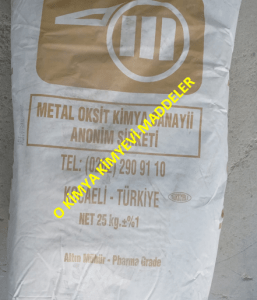
ZINC OXIDE PACKAGING
Product Documents | |
What is Zinc Oxide?
Molecular Formula (Zinc Oxide): ZnO
Molecular Weight: 81.4 g/mol
Chemical Name: Zinc Oxide
CAS Number: 1314-13-2
It is obtained by the reaction of the element zinc with the element oxygen. It is a zinc compound that holds an important place in the manufacturing sector. It is an inorganic chemical substance.
It is a mineral found in nature as zincite. It is one of the most important zinc compounds. The pigment in white paints consists of this zinc compound.
This zinc compound has been used for many years. It is a chemical substance that has proven itself, especially in the field of topical medicine and coatings.
This chemical, which has an important place in the Hui recipe, was included in this recipe in 1025 for the treatment of skin cancer along with many other skin diseases. It is a natural sunscreen chemical.
Other Names are as Follows;
Zinc White
Snow White
Zinc Monoxide
White Seal
Gold Seal
Zinc Powder
1314-13-2
How is Zinc Oxide Produced?
Zinc Oxide production industrially involves the indirect method using zinc ingots. Zinc ore is used as the direct raw material method and is in wet form.
The reaction in the indirect method production is as follows.
2ZnO + O2 》2ZnO
During production, zinc ingots to be used as a zinc source, obtained by the electrolysis method, are heated to approximately 600-700 °C. It is then transferred into a crucible with a higher internal temperature, and the melting process continues. Zinc is vaporized by increasing the temperature to 1200-1300 °C.
It is sent to hot air for the oxidation reaction to occur. The resulting zinc oxide is cooled. Fine particle separation is carried out using cyclone separation.
The reactions occurring here are as follows:
C + O2 》CO2
CO2 + C 》2CO
ZnO +CO 》Zn (Vapor) + CO2
Zn (Vapor) +CO +O2 》 ZnO + CO2
Another production method involves roasting zinc ore with sulfuric acid to produce zinc sulfate, followed by reacting zinc sulfate with sodium carbonate. Subsequently, zinc sulfate is reacted with aqueous ammonia. As a result, zinc hydroxide and ammonium sulfate are formed.
What are the Physical and Chemical Properties?
Physically, it is a chemical in powder form with a white or pale yellow color.
Its density is 5.60 g/cm³.
Its melting point is 1975 °C.
Its boiling point is 1949.9 °C.
In terms of stability, it is stable under normal conditions. However, it is incompatible with strong acids and magnesium compounds. For example, it is not a compound compatible with magnesium chloride.
It is an odorless compound. It has a bitter taste.
In terms of solubility, it does not dissolve in water. It dissolves in dilute acid. For example, it dissolves in Acetic Acid. It does not dissolve in alcohols.
What are the Usage Areas of Zinc Oxide?
It is used as a pigment instead of lead carbonate in the manufacture of white paints.
It is used together with phosphoric acid and zinc chloride in the manufacture of dental cements to obtain a quick-setting cement form.
It is used as a semiconductor material in the electronics industry.
It is an important compound as a zinc source in the manufacture of pesticides.
It is the substance used as an anode in the production of alkaline batteries.
It is an important component in the manufacture of opaque glass and some transparent glasses.
It is used in the production of topical creams due to its pigment substance and anti-mold properties.
It is used as an accelerator and activator in rubber manufacturing.
Zinc oxide is used for the treatment of skin cracks and minor skin irritations.
It is an important component for relieving itching caused by hemorrhoids and painful intestinal disorders.
It is used in the manufacture of diaper rash creams and sunscreens.
It is a pigment substance in the manufacture of baby lotions, bath soaps, and foot powders.
Zinc oxide is used to heal, soothe, and protect the skin.
It is used in the production of Zinc Acetate.
It serves as a zinc source in the production of nano silver creams and also functions as a white pigment substance.
It can be used as a raw material in Zinc Nitrate production, but it is not commercially advantageous due to high costs.
Rust is likely to form on the metal surfaces of materials. To prevent this, anti-rust sprays are produced. It is used as a protective agent in the manufacture of these sprays.
It is used in Zinc Acetate production by reacting with Acetic Acid. Water release occurs as a result of this reaction.
What are the Factors Affecting Prices?
The price of zinc oxide is directly dependent on the prices of the chemicals used in its production. As reserves in zinc mines decrease, prices will rise. In addition, as the prices of sodium carbonate and sulfuric acid used in its production increase, prices will also increase.
As companies that are distributors of zinc oxide increase their stocks, prices will experience a short-term decrease.
Companies that sell zinc oxide are responsible for the distribution of this chemical. As the distance from the production site increases, prices increase.
Zinc Oxide Sales
Chemical substances are packaged in packages determined by international standards. These are sold starting from the smallest package to the largest package or in bulk with tanker. These can be 1 gram packaging, 1 ton big bag packaging, the smallest drum packaging, or packaging-free sales with tanker.
All information here should be used in accordance with the legislation by expert people and professionals in the field.