

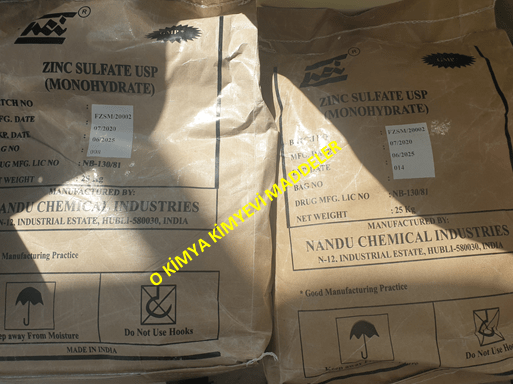
ZINC SULFATE PACKAGING
Product Documents | |
What is Zinc Sulfate?
Molecular Formula (Zinc Sulfate): ZnSO4
Molecular Weight: 161.4 g / mol
Chemical Name: Zinc Sulfate
CAS Number: 7733-02-0
It is a chemical with different forms. These include monohydrate, hexahydrate, and heptahydrate. The chemical in anhydrous form is a colorless solid in crystalline form.
The reaction of zinc mineral with sulfuric acid results in the formation of sulfuric acid salts or esters by the substitution of 1 or 2 hydrogen atoms. The sulfate salt formed here is Zinc Sulfate.
This chemical can decompose into other types in its different forms.
Other Names are as follows;
Monohydrate
Hexahydrate
Pentahydrate
7733-02-0
Sulfuric Acid zinc salt
Zinc vitriol
Anhydrous zinc sulfate
How is Zinc Sulfate Produced?
There are several methods in production processes. One of these is obtained as an intermediate in the recovery reaction of zinc sulfide. In this process, zinc sulfide is burned at a temperature above 1000 °C to form zinc oxide and sulfur dioxide. The reaction data for this is as follows.
For example; 2ZnS + 3O 2》 2ZnO + 2SO 2
Zinc oxide is converted to zinc sulfate by heating the medium in the presence of sufficient air. The reaction for this process is as follows.
For example; 2ZnO + 2SO2 + O2 》2ZnSO4
Another production reaction is the zinc recovery process. In this reaction, dilute sulfuric acid is added to roasted zinc oxide to convert zinc oxide into the main chemical. The production reaction is as follows.
For example; ZnO + H2SO4 》ZnSO4 + H2O
A third reaction involves the reaction of zinc metal with dilute sulfuric acid, followed by an evaporation process. It is then precipitated by crystallization. The production reaction is as follows.
For example; Zn + H2SO4 》ZnSO4 + H2O
What are the Physical and Chemical Properties?
The chemical in anhydrous form is colorless. It is not flammable. It is in solid form. It has hygroscopic properties.
Melting point is 680 °C.
Boiling Point: Information not available.
In terms of solubility, all forms dissolve in water. Its solubility in water is 101 g of zinc per 100 g of water.
Its density is 3.8 g/cm3 .
In terms of stability, it partially hydrolyzes depending on the environmental conditions.
What are the Usage Areas of Zinc Sulfate?
The main usage areas are fertilizer production; the monohydrate form is used in this field.
Termites cause decay in wooden materials. It is used as a preservative to inhibit termites in some wooden materials for the protection of wood. In this area, impregnation with chromated zinc sulfate has yielded very good results in wood protection.
Fungi that cause decay on wood attack the cell wall of the wood. As a result, wooden materials decay, leading to a reduction in their strength. Therefore, it is used as a wood preservative in the production of protective materials.
It is used to correct zinc deficiency in plants.
Zinc deficiency is observed in some soils where wheat is produced. The characteristics of soils where zinc deficiency is seen are high pH levels and low zinc content due to the soil structure. Zinc sulfate forms are used to correct zinc deficiency in the soil.
It is used to inhibit weeds in the field.
It is used in the bleaching process of wood pulp by being modified with Thiourea dioxide. When modified with Thiourea dioxide, a stronger bleaching agent is formed. Additionally, the increase in pH level also increases the bleaching effect.
It is used in the mining sector to carry out flotation processes.
Zinc is an important element for reproduction and lactation, and for ensuring hoof cornification. By using zinc sulfate in animal feed, the occurrence of such animal diseases is prevented.
A soluble metal salt is used for the recovery of molybdenite by flotation. This soluble metal salt can be Zinc Sulfate Heptahydrate.
Companies producing food supplements use it by modifying it with zinc Gluconate or on its own.
In the agricultural sector, the IAB/ABA and Cytokinin/ABA ratio in potato production is not appropriate. Therefore, the tuber weight and tuber count of potatoes are low. Zinc Monohydrate or Zinc Heptahydrate is used to increase the tuber weight and tuber count of potatoes.
In the agricultural sector, when used with a Glycolic acid solvent, it serves as a very beneficial source of zinc in plants. The most important features in this application include preventing bacterial formation, pH control, and the control of phosphates with a risk of precipitation.
Ailments that cause lameness such as Papillomatous digital dermatitis (PDD, Foot rot, Infectious Pododermatitis) in cattle, sheep, goats, horses, and other hoofed animals. Treatments containing Quaternary Ammonium Antiseptics, Iodine or Zinc Sulfate solutions are applied to resolve these types of ailments caused by 3 or 4 bacterial species.
In water treatment processes, it can be used as a coagulation and flocculation agent to clean water. In particular, it forms complexes with heavy metals such as Lead, Cadmium, and Copper, ensuring the removal of these heavy metals from water.
What are the Factors Affecting Prices?
Zinc Sulfate prices are influenced by the costs of the chemicals used in its production. As the price of zinc metal increases, the prices will rise. As the price of sulfuric acid increases, the price of zinc sulfate will also increase.
The price of Zinc Sulfate is directly proportional to its usage areas. As the usage areas expand, the prices will increase.
As the stocks of companies selling Zinc Sulfate increase, the price will decrease.
Zinc Sulfate Sales
Chemical substances are packaged in packages determined by international standards. These are sold starting from the smallest package to the largest package or in bulk with tanker. These can be 1 gram packaging, 1 ton big bag packaging, the smallest drum packaging, or packaging-free sales with tanker.
All information here should be used in accordance with the legislation by expert people and professionals in the field.