

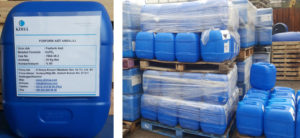
 PHOSPHORIC ACID PACKAGING 35 Kg
Product Documents |
|
| PHOSPHORIC ACID CERTIFICATE OF ANALYSIS | |
What is Phosphoric Acid?
Molecular Formula (Phosphoric Acid); H3PO4
Molecular Weight; 97.994 g/mol
Chemical Name; Orthophosphoric Acid
CAS Number; 7664-38-2
Phosphoric Acid is a corrosive inorganic acid. It is a sequestration agent that binds +2 charged atoms such as Fe+2, Cu+2, Ca+2, and Mg+2. It is a tribasic acid.
Other Names for Phosphoric Acid Include;
- Orthophosphoric Acid
- Trihydroxidooxidophosphorus
- O-Phosphoric Acid
- Polyphosphoric Acid
- Acidum Phosphoricum
- 7664-38-2
It is made from the mineral phosphorus, which is naturally found in the body. It works in conjunction with calcium.
What are its Physical Properties?
It is a colorless, odorless, and crystalline liquid or solid. The solid form of pure Phosphoric Acid melts at 42.35 °C. Its density is 1.834 g/cm³. Liquid phosphoric acid is available in 75% and 85% concentrations. It has a corrosive effect on contact with metals and tissues. It is miscible with water. Its flash point is not hazardous enough to cause a fire. It is a stable compound under normal conditions.
What are its Chemical Properties?
It was first obtained in 1694 by dissolving phosphorus pentoxide in water. It is the most important compound of the element phosphorus. It is used to produce phosphate salts.
Boiling Point: 158 °C (in pure form).
How is it Produced?
There are multiple methods for producing Phosphoric Acid. The production of this chemical varies depending on its intended application.
If it is produced for use in fertilizers, the goal is to obtain a low-purity, technical-grade form. This is achieved by decomposing phosphate rocks with concentrated sulfuric acid. Apatite types, primarily consisting of calcium phosphate from phosphate rocks, are used. The chemical reaction for this production is as follows:
Ca3(PO4)2 + 3 H2SO4 + 6H2O 》2H3PO4 + 3(CaSO4. 2H2O)
Since the phosphoric acid obtained in this reaction is impure, it can be purified using various methods. The purification steps during production involve techniques such as precipitation, solvent extraction, crystallization, and ion exchange.
Pure phosphoric acid is obtained by burning phosphorus in a mixture of air and steam.
Phosphoric acid can be prepared by heating purple phosphorus with 33% Nitric Acid, or it can be obtained by heating red phosphorus with Nitric Acid.
How Does It Affect Human Health?
The human body needs phosphorus, but an excess is harmful to human health. Research suggests that excessive phosphorus intake may lead to osteoporosis and heart disease. Since this chemical contains phosphorus, its effects on human health arise from this point.
When phosphorus enters the human body, too much of it can reduce the amount of calcium in our body, leading to bone loss. Too much phosphorus can also impair our body's ability to use other minerals like iron, zinc, and magnesium.
This chemical is dangerous for people who come into direct contact with it. The toxic fumes from this chemical can irritate your skin and throat.
It is not expected to be an inhalation hazard unless heated.
In case of skin contact, its highly corrosive nature can cause pain, redness, burns, and blistering of the skin.
In case of eye contact, its corrosive property can cause swelling, blurred vision, and severe burns.
Before use, be sure to wear appropriate personal protective equipment. In case of skin contact, immediately remove contaminated clothing. Wash the areas where the chemical has made contact with plenty of water for 30 minutes. Contact a poison center and seek medical attention. Follow the same procedure if it comes into contact with your eyes.
How is it Stored?
It is stored in 35 kg jerrycans, 330 kg drums, and 1600 kg IBC tanks.
In cold weather, when the cap is opened, it comes into contact with air. This can cause the chemical to freeze.
Ensure that the packaging to be filled is suitable for this chemical. It should be stored in cool, dry, and well-ventilated warehouses.
Packages should be kept away from areas exposed to direct sunlight. It should be kept away from fire and sources of ignition.
It should be stored in a separate area from substances with which it may react. Basic substances, in particular, fall into this class.
The storage area, shelves, floors, walls, etc., must be made of materials resistant to this chemical.
The lids of the packages should be closed and correctly labeled.
It would be beneficial to regularly inspect the containers for physical changes, crystallization, damage, or signs of leakage.
Uses of Phosphoric Acid
- Phosphoric acid is used as a solvent and gastric acidifier in pharmaceutical preparations.
- It is used in agriculture for the production of fertilizer solutions. It is used in making electrolyte solutions.
- It is mixed with other chemicals to make electroplating and rust removal solutions.
- Phosphoric acid is used to create an inorganic acid solution in the production of metallic effect pigments used in corrosion-resistant paint manufacturing. The main compound in this application is silicon dioxide.
- It is used in the production of industrial cleaning products. In this field, it is used as a source of mineral acid. It also has a phosphating property.
- It is used in the production of some inorganic and organic phosphoric chemicals.
- Phosphoric acid can be used in the production of casting resins.
- It is used to provide acidity to solutions during the application phase in the production of paints, enamels, and refractories.
- It is a component in the production of antifreeze products.
- Domestic wastewater generally does not contain excessive amounts of ammonia, and groundwater has high hardness. A high concentration of ammonia is not a suitable condition. Therefore, it is used in the Water Treatment sector. The form used here is food-grade phosphoric acid.
- It can be used in the manufacturing of textile processing materials.
- In alcohol production, it helps achieve a high fermentation rate by lowering the pH before or during fermentation while mashing the malt.
- It is used as an acidity regulator in many beverages. When used for direct human consumption, a food-grade product must be used. acidulant
- It is used to control pH in hair gels.
- It is added as a nutrient in yeast production.
- Some processed foods are modified with phosphoric acid to inhibit bacterial growth.
Other Uses
- It is used in the manufacture of superphosphates for detergents. It is used as an auxiliary agent in the formulas of rust removers.
- It is used as an acid catalyst to purify hydrogen peroxide in ethylene production.
- It is used as a synergistic antioxidant and a sequestering agent in food.
- It is used as a solvent in pharmaceutical production. Food-grade phosphoric acid is used in this field.
- In the production of confectionery and hard candy, it is modified with citric acid, malic acid, gluconic acid, and lactic acid to give flavor and a sour taste to sweets.
- Phosphoric acid is used to phosphate coat metals to prevent rusting before painting.
- In biodiesel production, acid catalysts are used for some types of raw materials to achieve higher reaction yields. Phosphoric acid can be used for this purpose.
- It is used with different chemicals to coat the surfaces of magnesium alloy materials to provide resistance against acid, alkali, and shock.
- Materials with a metal structure are coated with paint to be resistant to environmental conditions. Metals that have completed their lifespan are recycled. In this process, the paint on the metal needs to be stripped. It is one of the mineral acids used for stripping these paints.
Where Else is it Used?
- During coagulation, the phosphate group binds to the insoluble aluminum released into the water when coagulants (Polyaluminium chloride) are used, forming precipitates in the water. This way, the precipitated substance is removed from the system. Phosphoric acid is used as a phosphate source in coagulation.
- The element phosphorus is very important for plants. It is one of the basic elements found in ATP and ADP. It is used within the plant to form energy-carrying compounds. It is one of the compounds used to meet the plant's phosphorus needs.
- It is applied to leathers for tanning and polishing in leather production.
- In the production of some wood materials, highly flammable raw materials are used as binders. Therefore, wood products, which are already flammable by nature, exhibit greater flammability. Flame retardants are used in wood products such as plywood and MDF. Phosphoric Acid can be used in the formulas of these flame retardant products.
- Swelling occurs in the production of hair bleaching oxidants. It is used together with HEDP to prevent this swelling.
- It is used as an acidity regulating agent in toothpaste production. It is an important component for bringing substances like calcium carbonate and sodium carbonate to a paste consistency with this acid.
- Phosphoric acid and its salts can be used along with monoethylene glycol and corrosion inhibitors in chemicals produced as engine coolants.
- It is used in the refined oil sector for the manufacturing of refined oil.
- It is the main compound used with ammonia in the production of Monoammonium Phosphate (MAP). In this application, it is used as a source of phosphate.
- It is used by applying at certain concentrations to remove the dark color (degumming) caused by chlorophyll in vegetable oil.
- It is used in sugar factories to clean stainless steel plates without damaging the heater plates.
- It is one of the mineral acids used in the production of aqueous silica gels. The most commonly used mineral acid in this application is Sulfuric Acid.
- It is used as a preservative to prevent enzymatic degradation in the food industry. pH is important in this application.
- It is used in toothpaste production for many of its properties. It is used to strengthen tooth enamel and to clean very small particle stains within the tooth enamel. Additionally, the use of Phosphoric Acid in toothpaste production is for pH balancing and creating viscosity.
- Special compositions are produced to clean paints on metal surfaces. It is one of the acids contained in these compositions.
What Factors Affect the Price of Phosphoric Acid?
The price of Phosphoric Acid has generally been increasing over time. As new mines for phosphate rock production are discovered worldwide, the production volume in tons/year increases. Consequently, although its price shows a short-term decrease, it exhibits a continuously increasing trend in the medium and long term.
It can change depending on the prices of other chemicals used in production processes.
Its price changes in direct proportion to changes in the prices of sulfuric acid and nitric acid.
Prices increase in parallel with the expansion of phosphoric acid's application areas. This is because its price changes due to shifts in the supply/demand balance.
Although it doesn't change much, it increases by a total of 10% each year.
During periods when producers restrict production, the price experiences radical increases.