

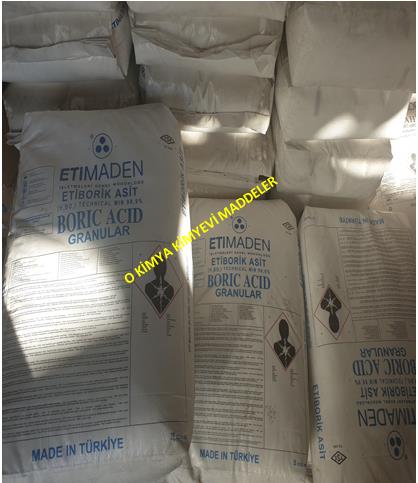
 BORIC ACID PACKAGING
Product Documents |
|
| BORIC ACID ANALYSIS CERTIFICATE | |
What is Boric Acid?
Molecular Formula (Boric Acid): H3BO3
Molecular Weight: 61.84 g/mol
Chemical Name: Boric Acid
Boric Acid CAS Number: 10043-35-3
It is also known by the name orthoboric acid. It consists of 3 Hydrogen, 3 Oxygen, and 1 Boron atom. This naturally occurring compound is most commonly found in Turkey worldwide. These ores are extracted by digging from the soil and then obtained by purification. Another derivative is Borax. This general group of species is referred to as Borates.
Due to its chemical properties, it can exhibit many different effects. These properties include mild antiseptic, antifungal, and antiviral properties. It is known as the conjugate acid of dihydrogen borate.
Other Names are as Follows;
- Borax
- Orthoboric acid
- H3-BO3
- H3BO3
- Boron Hydroxide
- Boron Trihydroxide
- Homberg's Salt
- Hardening Chemical
- Hydrogen Orthoborate
- Eye Wash Chemical
How is it Produced?
Its industrial production is obtained from borate minerals and salts. It is obtained as a result of the reaction of alkaline earth metals such as Borax, hydroboracite, ascharite, colemanite, Kernite, and ulexite with strong mineral acids. In Turkey, it is produced from colemanite.
Generally, it is obtained from ores containing sodium and calcium. Ores containing this chemical are first crushed and ground, and then reacted with sulfuric acid. After the addition of Sulfuric Acid, the Calcium and Sodium Sulfate that emerge as by-products are separated.
Another production method is obtained by reacting Borax with hydrochloric acid, which is one of the strong acids. The production reaction is as follows.
Na2B4O7.10H2O + 2HCl 》4B(OH)3 + 2NaCl + 5H2
What are the Physical and Chemical Properties of Boric Acid?
It is an odorless, white, and crystalline chemical in solid form.
The melting point is 171 °C.
It has a slightly bitter taste.
In terms of solubility, it dissolves in hot water. It partially dissolves in cold water. In methanol, it is 173.9 g/L at 25 °C. It is 94.4 g/L at 25 °C.
The solubility of boric acid increases as the temperature increases. At 25 °C, it has a solubility of 5.74 g/100 g Water in water.
To increase its solubility in water, hydrochloric acid is added.
Its density is 1.435 g/cm3. Looking at its vapor pressure at 20 °C, it is at a negligible level.
In terms of stability, it is a stable chemical under normal conditions. It is a stable chemical in air when heated up to 100 °C. It decomposes at temperatures above 100 °C, subsequently forming boric anhydride and water. The form dissolved in water is a very weak acid.
What are the Usage Areas of Boric Acid?
- It prevents the growth of microorganisms on the outer surfaces of the body. It is used in this field to benefit from its antiseptic properties.
- Yeasts cause infections which must be treated. Medicines containing this chemical are used to resolve such problems and treat the human body.
- In the agricultural sector, Boric Acid and a Molybdenum source are used together in the manufacture of Boron-Molybdenum fertilizers. Sodium Molybdate or Ammonium Molybdate is used as the Molybdenum source.
- During combustion, it prevents the release of cellulose emitted from organic materials such as paper and wood. In this way, it prevents the fire from progressing further. Thanks to its effect in these applications, it is used in the manufacture of formulations described as flame retardants.
- Fungi are often seen forming in wooden materials. Chlorophyll does not occur naturally in fungal physiology, so they need it from outside sources. They meet this need through certain nutrients, often attacking cellulose. Boric acid protects wooden structures by inhibiting (preventing) fungi in the environment where it is present.
- This chemical is used instead of insecticides containing high levels of toxic chemicals to kill different types of insects. This allows for more specific insecticide production methods. Using it in this field prevents harm to wasps and ants, targeting only unwanted insects. It acts as a desiccant on the exoskeletons of insects, dehydrating them.
- By creating hydraulic fracturing underground, oil and natural gas are brought to the surface more quickly. These cracks are formed under extreme pressure using special solutions. It is a main component of the chemical solutions applied here.
- In fiberglass used for insulation and reinforcement, it increases the fiber properties by lowering viscosity. Additionally, it reduces crystallization, making fiber-based materials more durable under physical conditions and moisture.
Other Usage Areas?
- It is used as a hardening agent in many fields due to its chemical properties. These materials include products from the pottery, artificial stone, porcelain, enamel, and glass sectors.
- Cooling waters are found in nuclear reactors. These cooling liquids are manufactured with certain additives, where it acts as a reinforcing agent.
- It is used in the manufacture of certain boron compounds.
- It is used to produce contact lens solutions and as a food preservative.
- In the metallurgy sector, it is used as a hardener to toughen steel alloys and for processing metal alloys.
- In the glass sector, it is added as an additive to glass to increase its heat resistance.
- During the manufacture of play dough, it is used to provide hardness to the dough.
- Its use in the health sector is a relatively new application. It is currently processed as a supportive supplement chemical rather than a direct active ingredient.
- It is used in the manufacture of vaginal medications to ensure the inhibition of bacteria and microorganisms resulting from related ailments.
- Together with Magnesium Sulfate, it is used in the manufacture of treatment products for sitz baths used in hemorrhoid treatment.
- Boric Acid is used together with lithium hydroxide and stearic acid within base oils used in grease manufacture to create advanced grease lubricants.
- To better dilute Resol, which is used in the manufacture of thermal and acoustic insulation products made with Phenol-Formaldehyde resin and mineral wool, it is neutralized with Boric Acid.
- It is used in the production of boron salts to improve and develop specific characteristics.
What are the Factors Affecting Prices?
The price is directly dependent on the prices of the materials used in its manufacture. As the price of colemanite increases, the price of this chemical increases worldwide. As hydrochloric acid increases in price, prices will rise.
The prices of this chemical are directly related to its areas of usage. As usage areas expand, prices will increase. When a new usage area emerges, demand increases and raw material prices go up.
Boric Acid prices are directly dependent on the stocks of the companies that sell this chemical. As the stocks of selling companies increase, prices may fluctuate. As the number of companies producing Boric Acid increases, the price of boric acid will experience a short-term decrease.