

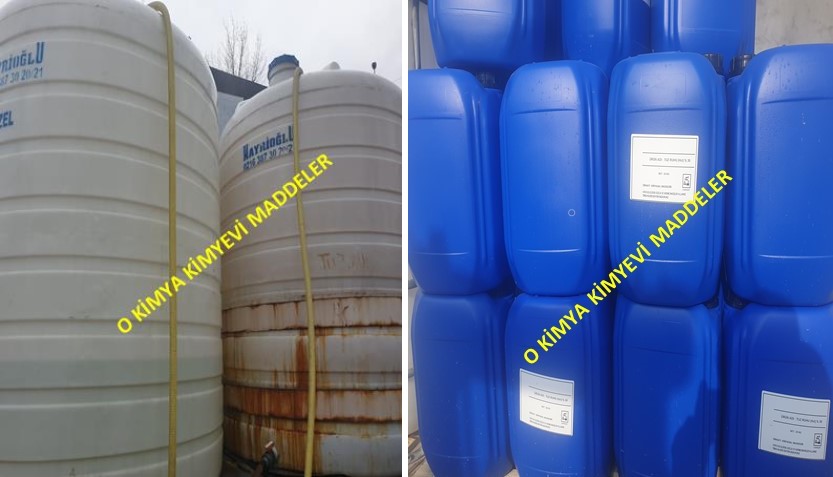
 HYDROCHLORIC ACID PACKAGING
Product Documents |
|
| HYDROCHLORIC ANALYSIS CERTIFICATE | |
What is Hydrochloric Acid?
Molecular Formula (Hydrochloric Acid): HCl
Molecular Weight: 36.46 g/mol
Chemical Name: Hydrochloric Acid
CAS Number: 7647-01-0
It is among the most important industrial chemicals. It is also found in the stomachs of mammals in the form of a dilute solution. The first person to isolate this acid was the Italian Basilus Valentinus. The pH of stomach acid is approximately 2.
Its other most important name is Hydrogen Chloride. Hydrochloric acid, also called muriatic acid, is a clear, colorless, and pungent-smelling solution of hydrogen chloride in water.
The aqueous solution produced in factories ranges between 33% and 37%. Depending on the area of use, it is applied by diluting to different concentrations.
It is a chemical in the general acid category. Hydrogen Chloride occurs naturally during the burning of plastic materials.
Among the public, it is generally known as Spirit of Salt.
Other Names Are As Follows;
- Spirit of Salt
- Muriatic Acid
- Hydrogen Chloride
- Aqueous hydrogen chloride
- Acid
- Chlorohydric Acid
- 7647-01-0
How is it Produced?
In the industrial production of this chemical, hydrogen chloride is first produced through an electrolysis process. In production, hydrogen and chlorine are combined in an aqueous solution via electrolysis.
The reaction in the production process is an exothermic reaction. For this purpose, there is a furnace or burner in the production facility. The resulting hydrogen chloride gas is dissolved in pure water to obtain spirit of salt. As a result, it is obtained in pure form.
Its most common production in the chemical industry is as a by-product during the chlorination production process. It is produced as a by-product during the production of sodium hypochlorite.
It occurs during the production of common organic chemicals such as Teflon, polyvinyl chloride, and perchloroethylene.
What are the Physical and Chemical Properties?
In terms of properties, it is colorless, anhydrous (Hydrogen Chloride), and has a pungent and irritating odor. It does not have flammable properties. Its vapors are heavier than air. Aqueous solutions are available.
The boiling point is -35 °C.
The Melting Point is above 100 °C.
Its solubility in water at 0 °C is 82.3 g/100 g water.
It dissolves in water, ethanol, methyl alcohol, and ether. The solubility of hydrochloric acid decreases as temperature increases.
Its density is 1.637 g/L.
If heated, it decomposes and emits Chlorine gas.
It reacts rapidly and exothermically with bases.
What are the Application Areas of Hydrochloric Acid?
- In factories where steel pickling processes are carried out, hydrogen chloride solution is used to prevent corrosion on the steel surface, to prepare the steel surface for protective coating, and to remove rust and dirt from the steel. Because its acidic property at a low pH level attacks the metal, creating a corrosive effect.
- It is one of the most commonly used acids. it is an excellent laboratory reagent.
- It is used to create acid leaching in the sorting of metal ores. In this application, it dissolves limestone and iron oxide compounds.
- Urea Hydrochloride is used to remove scale from the surface of metal equipment. This has advantages over the use of Hydrochloric Acid.
- It is applied as a dilute solution in immersion baths to clean grease and oil from iron and steel materials. With this method, oxidation on the metal is also removed.
- Limestone and carbonate formations occur in oil wells. To dissolve these formations, the inside of the oil well is acidified with spirit of salt. Thanks to its strong acidic properties, carbonate and limestone are broken down. This allows the channels to expand and also helps new cracks to widen.
- In the pharmaceutical industry, acid with pharmaceutical-grade properties is used in the manufacture of hydrochloride salts.
- Metals are coated with paints to gain protection against external factors and an aesthetic structure. Metals are recyclable materials. To recycle metals, the paint on them must be stripped. It is used in such applications.
- It is one of the mineral acids used to strip paint from metal materials.
- In sugar factories, it is used to prevent scale formation in the processes of syrup evaporation and heating stages.
- There are many areas of use in the food industry as well. These include sugar refining, converting corn starch into syrup form, and hydrochloric acid is used as an acidifier in some food production.
- It is used as a tanning agent in the leather industry.
- In the treatment sector, it is used for ion exchange resin regeneration in chemical treatment systems. Again, in the water treatment sector, hydrochloric acid is used as a pH control chemical.
- It is used as a chlorine source in the production of many chemicals containing chloride.
- Hydrochloric acid is used in refining Tin and Tantalum ores.
- It is one of the acids used in industrial boiler cleaning. It is used to dissolve the lime inside the boiler. At the same time, Nitric Acid or Hydrofluoric Acid is used.
- It is used in the surface cleaning of iron and steel metals in the manufacture of bijouterie products.
What are Other Application Areas of Hydrochloric Acid?
- Used in hot-dip galvanizing processes and acidic coating processes.
- Used in product reactions carried out via organic synthesis.
- It has the ability to dissolve iron. Therefore, it is used to remove rust stains that occur on household items such as carpets.
- In the textile and rubber industries, hydrochloric acid is used as a catalyst and solvent for the hydrolysis of starches and proteins.
- It is used in the production of phosphorous acid, which falls under the category of agricultural chemicals.
- It is one of the mineral acids used for the acidification of Sodium Salicylate in the production of Salicylic Acid.
- Used as an inorganic acid source in metallic pigment production. These produced metallic pigments are preferred in the automotive sector and many industrial applications because they are resistant to corrosion.
- To remove scale deposits accumulated in cooling towers, washing is carried out using a dilute hydrochloric acid solution with an inhibitor mixture.
- In the production of aqueous silica gel, the reaction of hydrochloric acid with alkali silicate is utilized.
- Hydrochloric acid is used to purify and clean marble stones from rust and different types of pollutants.
- It is a chemical used by mixing with Hydrofluoric Acid to extract gas and natural gas by characterizing sandstone formations in oil and gas wells.
- In the production of Cobalt Chloride, the mentioned product is obtained as a result of an acid-base reaction with Cobalt Hydroxide.
- It is used in chemical products developed to reduce corrosion, volatile components, and transport and storage difficulties as an alternative to problematic mineral acids for use in well stimulation and well drilling activities in the oil and gas industry.
- This component is used in the oil and gas industry for matrix acidizing, fracture acidizing, cleaning pipes and lines in these systems, pickling of production pipes, and also for cleaning perforations.
What are the Factors Affecting Prices?
Hydrochloric Acid prices are directly dependent on the prices of the materials used in the production stage. For example, as salt prices increase and chlorine prices increase, prices will rise. One of the biggest costs in the chlorination system is energy. As energy prices increase, the price of hydrochloric acid will increase.
With the expansion of the construction industry, the use of iron and steel will increase. As the use of hydrochloric acid in iron/steel processes also increases, prices will rise.
In some periods, companies producing spirit of salt make downward revisions to prices to reduce their stocks. Therefore, prices will start to decline.
One of the factors that constitute the biggest cost factor for Hydrochloric Acid prices is transportation prices. When transportation prices increase, the sales price of this chemical increases.