

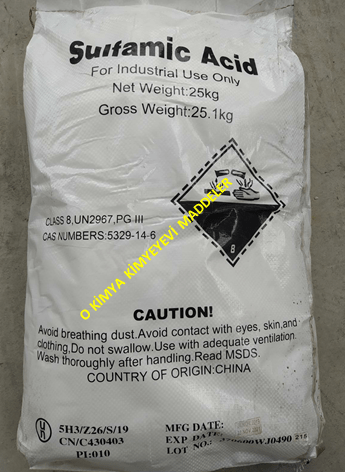
 SULFAMIC ACID PACKAGING
Product Documents |
|
| SULFAMIC ACID ANALYSIS CERTIFICATE | |
What is Sulfamic Acid?
Molecular Formula (Sulfamic Acid): H3NO3S
Molecular Weight: 97.1 g/mol
Chemical Name: Amidosulfuric Acid
CAS Number: 5329-14-6
It is the simplest form of sulfamic acids, consisting of a single sulfur atom. It has the ability to easily form sulfamate salts.
Other Names Are As Follows;
- Sulfamidic Acid
- Sulfuramidic Acid
- Amidosulfonic Acid
- Sulfamic
- Sulfamide
- 5329-14-6
How is Sulfamic Acid Produced?
Sulfamic acid production is achieved through the reaction of several chemical substances. These compounds are obtained from the reaction of urea, sulfur trioxide, and sulfuric acid.
First, urea and sulfuric acid are reacted in equal amounts. Then, the resulting compound is reacted with sulfur trioxide to be produced simply. The sulfur trioxide used in this production reaction is in liquid form.
The parameter that presents the most difficulty in the production process here is the difficulty of properly controlling the temperature.
What are the Physical and Chemical Properties?
In terms of physical appearance, it is in the form of a white crystalline powder.
Melting point is 205 °C.
Boiling Point: It sublimes.
Density is 2.1 g/cm³.
It exhibits acidic and corrosive properties when dissolved in water.
If it reacts with bases, an exothermic reaction occurs.
It is an odorless chemical.
In terms of solubility, it has free solubility in water. Solubility increases as the temperature increases. It dissolves in Ethyl Alcohol, Methyl Alcohol, and Formamide.
What are the Application Areas of Sulfamic Acid?
- It is an important component in the manufacture of flame-retardant fabrics.
- It is a suitable plating chemical in the electroplating industry because it forms metal salts very easily.
- It is used in acid cleaning and nitrite removal processes.
- Sulfamic is used for bleaching wood pulp. In this field, it is used for chlorine stabilization.
- It is used in wool dyeing processes together with acidic dyes.
- It is used for the purpose of killing weeds in the agricultural sector by dissolving it in water.
- It is an important component in organic synthesis as a solid acid catalyst.
- Sulfamic Acid is used because of its ability to modify resole and reduce the emission of pollutants in the manufacture of insulation materials produced with Phenol-Formaldehyde, mineral wool, and an organic binder.
- It is used in the manufacture of artificial sweeteners.
- It is used as a descaler in hard water.
- It has important properties for keeping the pH of buffer acids stable in polyester dyeing operations.
- Limescale occurs due to ions in water on the surfaces of ice machines and freezers that come into contact with water, on the surfaces of water heaters. Powder descaler mixtures are used to remove limescale. In these mixtures, it is used together with Trisodium Citrate. At the same time, polyethylene glycol is also used.
- Washing is performed to remove limescale problems in areas caused by some limescale blockages in closed-circuit systems. It is used in these washing chemicals.
- Limescale deposits occur in cooling towers located in power plants. Sulfamic Acid is used to prevent scale formation in the cooling tower or to prevent damage to galvanized surfaces during the removal of scale deposits in cooling towers.
- In the manufacture of rough circuit boards, a bath is created to obtain a uniform thickness and a resistance film. The components of this plating bath include Nickel, Sulfamic Acid, and Phosphoric Acid. In this process, there is also an etching solution. This solution includes a mixture containing Ammonium Persulfate.
What Factors Affect Its Prices?
The price of sulfamic acid is directly dependent on the prices of the chemicals used in its production. As the prices of Sulfuric Acid and urea increase, the prices of this chemical substance will increase.
With the development of the industry, its prices have continuously increased.
As companies that sell this chemical substance increase their stocks, sulfamic acid prices will experience short-term decreases.