

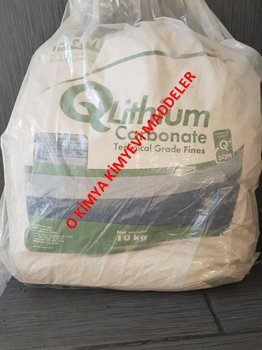
 LITHIUM CARBONATE PACKAGING 10 kg
Product Documents |
|
| LITHIUM CARBONATE CERTIFICATE OF ANALYSIS | |
What is Lithium Carbonate?
Molecular Formula (Lithium Carbonate): Li2CO3
Molecular Weight: 73.888 g/mol
Carbonate Chemical Name: Lithium Carbonate
CAS Number: 554-13-2
This chemical substance has been discovered to have properties of great importance recently. After this process, it has become known for its use in many sectors.
It is a soft alkali metal salt exhibiting antimanic and hematopoietic properties.
It is a lithium salt classified as a mood-stabilizing substance. The most important feature of Lithium is that it is a simple alkali salt that has been widely used in mania treatments for a long time, about 50 years.
Other Names Are As Follows;
- Dilithium Carbonate
- 554-13-2
- Carbonic Acid Lithium Salt
- Lithobid
- Lithane
- Carbonic Acid Dilithium Salt
- Lithium Carbonate
- Carbolithium
How is it Produced?
Lithium Carbonate production is monopolized by 3 manufacturers.
It is obtained from Lithium Metal ore. Here, it is produced as an intermediate product by the method of recovering Lithium ore from spodumene.
In the production process, lithium ore ground into fine particles is first roasted with sulfuric acid at 250 °C. Then, Lithium Sulfate is filtered.
The obtained Lithium compounds are produced by mixing hot and concentrated Sodium Carbonate (Na2CO3) solution with Lithium Sulfate or Lithium Chloride solutions during the Lithium production process.
The main reaction in its production is as follows;
Li2SO4 + Na2CO3 》Li2CO3 + Na2SO4
Finally, Eti Maden has developed a method at its boron production facility that recovers the lithium compound from wastewater while producing refined boron with high technology. In this way, 600 tons of Lithium Carbonate will be produced annually from wastewater.
In response to the increasing demand for lithium in recent years, some users are working on production methods from different substances. Among these, studies proposed recently have focused on lithium production techniques from a clay mineral and its composite structures without using acid.
The clay used in this production process also contains elements such as Na, K, Al, Ca, and Mg. With acid leach extraction, filtration of high-concentration impurities involving these elements is also ensured.
What are the Physical and Chemical Properties of Lithium Carbonate?
It is a colorless or white monoclinic powder.
Its density is 2.11 g/cm³.
Its melting point is 723 °C.
Boiling Point: 1310 °C. It decomposes above this temperature.
Lithium Carbonate is a chemical compound that shows different effects in terms of solubility. It dissolves more in cold water than in hot water. As the temperature of the water increases, its solubility decreases. It does not dissolve in alcohol but dissolves well in dilute acid.
Its solubility in water is 1.3 mg/ml.
As for stability, it is a stable chemical under normal conditions.
Particle size may vary from manufacturer to manufacturer. Some users use the product in powder form, while some manufacturers may prefer slightly thicker forms.
Effect of Lithium Carbonate on Calcium Aluminate Cement
Lithium Carbonate is a setting accelerator active ingredient used in cements used in the construction sector to accelerate freezing. In this way, it provides rapid freezing, allowing the cement to be applied according to its area of use and saving time.
These accelerators are used to shorten the setting time or increase early strength development.
Lithium Carbonate type accelerators speed up both setting and hardening. Some accelerators are used for the purpose of setting or accelerating hardening.
These accelerator substances are generally preferred in liquid form. Some are preferred in solid form. The reason for this is the dissolution problem.
Application areas are for both accelerating normal concrete and for shotcrete.
What is the Cheapest and Most Effective Setting Accelerator?
Calcium chloride has been the most effective setting accelerator since its preference in the 1880s due to its ease of use and cost advantage.
The kinetic effect of Calcium Chloride on concrete has been documented by reports and research.
Other effects of CaCl2 on cement paste are as follows;
• Freeze Resistance
• Thaw Resistance
• Sulfate Coefficient
• Porosity
What are the Usage Areas of Lithium Carbonate?
- Among its usage areas, it is used as process regulators in industry.
- Lithium-ion battery cells require Lithium, cobalt, nickel, and graphite. This need is estimated to rise to 1.9 million tons. The biggest reason for this is the increase in the production of Electric vehicles.
- It is used as oxidizing and reducing agents in industry.
- The most specific usage area is in medicine for the treatment of mania. In this field, its property of improving emotional disorders in schizophrenia is utilized.
- The lithium element within it interferes with transmembrane sodium exchanges within nerve cells by affecting Adenosine Triphosphate stimulated with sodium and potassium. In this way, it alters the release of neurotransmitters.
- It also affects cyclic Adenosine monophosphate concentrations. Lithium Carbonate therefore blocks inositol metabolism, resulting in the inhibition of phospholipase C-mediated signal transduction through the depletion of cellular inositol. In this way, it helps positive changes in neurological diseases.
- It is used for treatment in bipolar disorder.
- It is used to remove impurities because the polarization property of the lithium ion is very strong.
- It has the effect of raising peripheral leukocytes.
- It is used as a reinforcing agent in the manufacture of synthetic rubber, paints, and military defense materials.
- Battery-grade Lithium Carbonate is used in a matrix modifier in the manufacture of Lithium-Ion battery cathode materials. The most important feature of the lithium-ion battery is that it is rechargeable and uses its charge capacity in the best way. The most suitably rechargeable lithium-ion battery is the LiMnO2 liquid electrolyte battery.
- It is used as an auxiliary chemical to accelerate freezing in construction chemicals.
- The most important effect of the lithium element on the human structure is its mood-regulating property. The lithium element within Lithium Carbonate has some biochemical and biological effects on the brain. One of these is its effects on neurotransmitter signals such as dopamine and serotonin.
- To produce the Lithium metal oxide compound, it is reacted with phosphoric acid to obtain Lithium phosphate. Then, it is sintered with Cobalt Oxide, a cobalt source, at 350 °C and the Lithium Metal Oxide compound is obtained.
- Wind turbine blades are exposed to cracking and corrosion in cold weather. To prevent cracks from forming on the turbine blades, soft metal is added into the resin. The most suitable soft metal here is lithium compounds. Lithium carbonate can be used in these applications.
- In arc welding electrodes, it allows the electrode to burn more stably and easily with its low ionization effect. Li2O compound is utilized in this application.
- It increases the fluidity of the slag by showing melting properties within the coating. In this way, it protects the weld pool.
What are the Factors Affecting Prices?
In terms of price, it is directly proportional to the prices of Lithium ores used in Lithium Carbonate production. As Lithium ore prices increase, the price of this chemical substance will increase.
Prices depend directly on the number of mines where Lithium ore is produced. As ore mines increase, prices will decrease because producers of this chemical will be able to find enough Lithium ore.
Lithium Carbonate prices are directly dependent on the prices of the chemicals used in its production. As Sodium Carbonate prices increase, the price of this raw material will increase.
Since its production is monopolized by 3 major producers, prices are kept under control. Its prices have doubled in recent years.
As its usage areas increase, it will increase in price. Because the raw material produced will not meet the requested product quantity.
Due to the demand for lithium metal occurring in the world in recent years, supply does not meet demand. For this reason, prices have increased by 350% and are still experiencing an increase.