

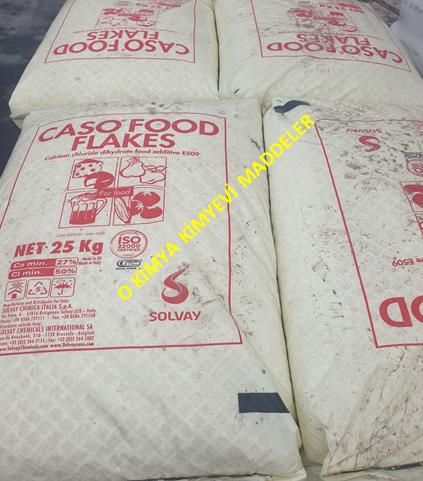
 CALCIUM CHLORIDE PACKAGING
Product Documents |
|
| CALCIUM CHLORIDE CERTIFICATE OF ANALYSIS | |
What is Calcium Chloride?
Molecular Formula (Calcium Chloride); CaCl2
Molecular Weight; 110.98 g/mol
Chemical Name; Calcium Chloride
CAS Number; 10043-52-4
It is a chemical with a halogenated ionic structure at room temperature. The classic salt we know is Sodium Chloride. It has similar properties to it. It even has more effective properties.
It has the property of attracting moisture from the air. Therefore, it is called a "thirsty" chemical.
It has different forms. These are hydrated and anhydrous forms.
Other Names for Calcium Chloride are as Follows;
- Anhydrous Form
- Calcium Dichloride
- Liquid Form
- 10043-52-4
- Calcium Chloride
How is Calcium Chloride Produced?
Its production has a very long history. It has been produced for more than 100 years.
In the production process of this chemical, crude calcium chloride is produced from the reaction of limestone with hydrochloric acid. The chemical produced here is in liquid form with a 36% concentration.
The reaction of the production is as follows;
CaCO3+2HCl = CaCl2 + H2O + CO2
A series of purification processes are performed in the production in this reaction. Magnesium is removed in this purification phase. The purification process here is carried out with Ca(OH)2.
In the continuation of the production process, it is sent to a fluidized bed dryer/grinder to obtain a product at 94%-97% concentration.
What are the Physical and Chemical Properties?
It is in a white solid form as physical appearance. It has hygroscopic properties.
The boiling point is 1670 °C.
The melting point is 782 °C.
Its solubility in water is 0.745 g/ml. Its solubility at 20 °C occurs in this amount. It dissolves in Ethanol.
Its density is 2.2 g/cm3. The density here is valid for a temperature of 25 °C.
It has stability in non-humid environments. It attracts moisture in environments where water is present.
It is not a flammable chemical. However, it emits toxic levels of gas and smoke during a fire.
What are the Areas of Use?
- In winter months, icing occurs on highways. Sodium chloride (Salt) and Calcium Chloride, which has a greater de-icing or prevention capability, are used to prevent icing or to ensure the melting of ice when icing occurs. It is applied to the ice on the roads by spreading or pouring in liquid form.
- It is used in the manufacture of many calcium salts.
- In the cleaning of metal surfaces such as Aluminum and Steel, it is used together with chemicals such as sodium hydroxide and potassium hydroxide to benefit from its corrosion-inhibiting properties.
- Concrete made with cement in cold weather has a late curing time. It is used in cement manufacturing to shorten this period. This chemical has the effect of accelerating the setting of concrete.
- It is used in road pavements to ensure that dust formation is reduced to minimum levels.
- The chemical in food-grade form is used as a calcium source in the pickling of cheese and in beer production.
- It is used after tractor tire manufacturing to ensure the tractor provides better traction. Because; during the tire manufacturing process, the freezing temperature of the water added into the tire is lowered.
- Thanks to its hygroscopic structure, it is used for moisture retention.
- In the wastewater treatment sector, it is effective in removing fluorides, phosphates, heavy metals, and oily wastes.
- It is used in orange juice production to preserve the taste of the juice. At the same time, Malic Acid can also be used in this field to preserve the fruit juice flavor.
- In paper manufacturing, it increases the durability of corrugated papers.
- To drill in oil wells, the density must be above a certain level. With the effect of this salt, this density is brought to the desired level.
- It is used as an additive in the manufacture of fire extinguishers.
- In regions where cold climates prevail, water may freeze before the concrete sets after the concrete is poured. To prevent this, the amount of water in the concrete should be reduced. In this way, the freezing point is lowered, and the freezing resistance of the concrete is increased.
- To solidify Sodium Alginate on the surface of Polyvinyl Alcohol, an aqueous Calcium Chloride solution is contacted with the solution of these components to produce PVA hydrogel.
- Calcium Chloride is used to maintain fluid balance and pH balance in metabolic systems.
- It has the ability to form stronger gelling bonds with gelling agents and also acts as a firming agent. Calcium Chloride is used in the production of wine processing agents, i.e., in the production of tablets. It is also a source of calcium.
- It is used together with Edta in the manufacture of foam-type bubble toys.
- In halva production, it has the ability to increase the stability of the halva by cross-linking with proteins.
- In the agricultural sector, it is used as the source of the Calcium element needed by plants. In plants, it plays an important role in protein synthesis for the formation of the plant's cell wall. It can also contribute to the plant by eliminating calcium deficiency in the soil.
What Factors Affect the Prices?
Calcium carbonate and hydrochloric acid are used in its production. As the prices of chemicals used in the production of this chemical increase, its price will increase.
With the cooling of the weather in the winter months, the use of calcium chloride increases. Therefore, calcium chloride will increase in price.
Calcium Chloride prices vary depending on the stocks of the companies selling this chemical. As stocks increase, prices will decrease.