

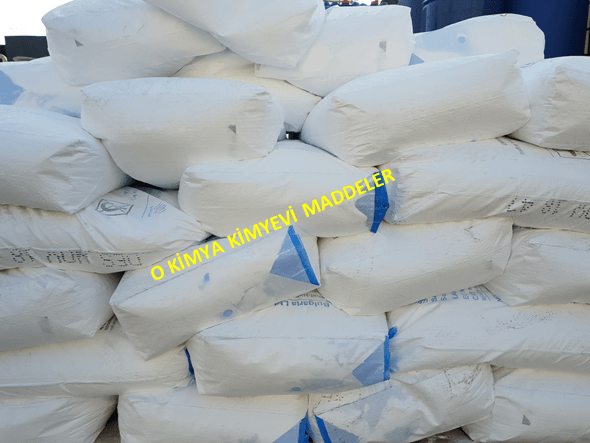
 SODIUM CARBONATE PACKAGING 25 KG
Product Documents |
|
| SODIUM CARBONATE CERTIFICATE OF ANALYSIS | |
What is Sodium Carbonate?
Molecular Formula (Sodium Carbonate): Na2CO3
Molecular Weight: 105.988 g/mol
Chemical Name: Sodium Carbonate
CAS Number: 497-19-8
It is the disodium salt of carbonic acid, which imparts its alkaline properties. When dissolved in water, it dissociates into Carbonic Acid and Sodium Hydroxide. After this dissociation, the strong base Sodium Hydroxide exhibits antacid properties.
It has high hygroscopic properties. In its pure form, it has strong alkaline properties.
It is a chemical with properties similar to Sodium Bicarbonate. When dissolved in water, it releases Na+ and CO3-2 ions. When Sodium Bicarbonate dissolves in water, it also forms H+ ions in addition to Na+ and CO3-2 ions.
The benefits of this chemical are evident in food applications. We can see the benefits of sodium carbonate in the pastry and baking industries. It should not be used in amounts exceeding the standards.
Its salts are described as sticky salts that easily precipitate on reactor walls. If salt precipitates inside the reactor, conductivity decreases. This method is used to analyze its solubility in supercritical water.
Sodium Bicarbonate is non-toxic, but Sodium Carbonate has toxic properties.
It is classified as Light Soda and Dense Soda. The Sodium Carbonate referred to as dense soda has a higher bulk density.
Other Names Are as Follows;
- Soda Ash
- Light Soda
- Soda
- Disodium Salt of Carbonic Acid
- Calcined Soda
- Washing Soda
- Anhydrous
- Anhydrate
- Anhydrous Soda
- Soda Ash
How is it Produced?
Sodium Carbonate is generally produced from natural deposits. However, synthetic production has now become dominant because production from natural deposits cannot adequately meet the demand.
It is produced worldwide using the Solvay process. Production via the Solvay process occurs through a series of chemical reactions.
In the Sodium Carbonate production process, the first chemical step is the calcination of Calcium Carbonate (CaCO3) to form Lime and CO2. In this stage, Lime is converted to Calcium Hydroxide.
The most crucial stage in the production process is where the brine solution reacts with Carbon Dioxide (CO2) and Ammonia (NH3) to produce Sodium Bicarbonate and Ammonium Chloride. In this stage, Sodium Bicarbonate is converted to Sodium Carbonate. Calcium Hydroxide (Ca(OH)2) and Ammonium Chloride react to form the by-product CaCl2.
The reactions in the production process are as follows;
CaCO3 》CaO + CO2
CaO + H2O 》Ca(OH)2
2NaCl + 2CO2 + 2NH3 + 2H2O 》2NaHCO3 + 2NH4Cl
2NaHCO3 》Na2CO3 + CO2 + H2O
Ca(OH)2 + 2NH4Cl 》CaCl2 + 2NH3 + 2H2O
Overall Reaction View:
CaCO3 + 2NaCl 》Na2CO3 + CaCl2
Production is carried out in this manner.
What are the Physical and Chemical Properties of Sodium Carbonate?
It is a white powder in appearance. It has an alkaline taste.
The density of Sodium Carbonate is 2.54 g/cm3.
In terms of solubility, it is highly soluble in water. It is insoluble in alcohol. It dissolves in acids, releasing carbon dioxide.
Melting Point is 851 °C.
Density: 2.53 g/cm³
Boiling Point: Decomposes.
Solubility has been determined as 30.7 g / 100 g of water at 25 °C.
In terms of stability, it is stable under normal temperature and atmospheric conditions.
Heating above 400 °C releases CO2 gas.
Regarding pH, the pH of 1%, 5%, and 10% by weight solutions of Sodium Carbonate at 25 °C are 11.37, 11.58, and 11.70, respectively.
What is its Solubility in Water?
It has the ability to absorb water. Its solubility in water depends on the amount of water present in the sodium carbonate. If the substance is anhydrous, it has very good solubility. This allows for the formation of hydrates with different properties. The anhydrous form has a lower density.
Where are the Usage Areas of Sodium Carbonate?
- Its most common use worldwide is in the glass industry.
- In dried meats, it is used together with dextrose, citric acid monohydrate, and sodium acetate to prevent moisture loss, reducing moisture loss during drying.
- In the glass industry, 0.2 tons of soda ash are used for every ton of glass.
- It is used as a neutralizing agent in the food industry. We can think of neutralizing as adjusting the pH level. It is used as a leavening agent in the production of amino acids, soy sauce, bread, and pasta.
- In pasta production, the alkaline property of this chemical is utilized to provide flexibility and elasticity.
- In the detergent industry, soda can be used as a wool rinsing agent.
- It is used as an alkaline agent in the tanning industry. In this sector, it is used for degreasing raw hides, neutralizing chrome-tanned leathers, and also for increasing the alkalinity of the chrome liquor.
- Industrial Soda Ash is generally used in light industry, building materials, and the chemical industry.
- In the production of cement mortars, it is used to retard the setting (solidification) process, reduce air bubbles, and increase water resistance.
Its uses in the chemical industry are as follows;
- Sodium Silicate Production
- Sodium Dichromate Production
- Sodium Nitrate Production
- Sodium Fluoride Production
- Baking Soda Production
- Borax Production
- Trisodium Phosphate Production
It can be used for these purposes.
- In the metallurgy industry, it is used as a fluxing agent for steel and antimony. It also has properties as a mineral flotation agent and a desulfurizing agent.
- In the printing and dyeing industry, it is used as a water softening chemical.
- It is an active ingredient in the manufacturing of corrosion inhibitors and anti-scaling agents.
- It is used in battery manufacturing.
- It is used in the manufacturing of lubricants and lubricant additives.
- It is used in the manufacturing of chemical property modifiers.
- It is used in the manufacturing of laundry and dishwashing products.
- In photographic developer formulas, it is used together with Sodium Thiosulfate and Sodium Sulfate. Additionally, Potassium Bromide is also included in this formulation.
- It is used as a pH stabilizer in the manufacturing of cleaning and floor care products.
- The application of dense soda ash reduces the flying of alkaline dust. This, in turn, reduces erosion in refractory materials, thereby improving product quality.
- It is among the Basic Chemicals used in medicine, metallurgy, the food sector, the chemical industry, and many other fields.
- To avoid inhibition of the enzymatic effects of aromatic phosphoric acid esters, to have a useful pH range, and to obtain the required alkaline medium, it is used with Sodium bicarbonate to prepare a buffer solution.
- Sodium Carbonate can be used to determine water hardness in magnesium-containing cleaning compositions.
- In coal briquette production, it helps make the coal bulky and light by stimulating gas formation within the coal.
- It is one of the chemicals used in glass production to lower the melting temperature of the glass.
What are the Factors Affecting its Prices?
With the development of industry, prices have continuously increased.
The price of Sodium Carbonate varies depending on the prices of the chemical substances used in its production. Therefore, as Salt prices increase, the price of this chemical will increase. As the price of Ammonia increases, its price will also increase.
Sodium Carbonate sellers are generally large wholesalers. The stock level affects the price of this product. If stocks increase, it can be sold at a lower price. It is directly linked to the prices of Soda Ash production facilities. As the number of Soda Ash production facilities increases, there will be a short-term price decrease. Even if prices fall, they will settle at a normal level after a short time.
In terms of price, it is directly linked to the construction industry. This is because Sodium Carbonate is used in the production of glass used in the construction sector. As the construction industry grows, the use of Soda increases. If production facilities remain constant, this will create a supply issue in the market, pushing prices up.