

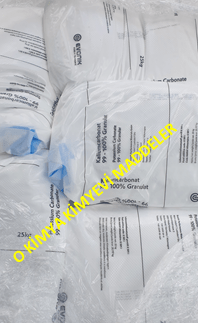
POTASSIUM CARBONATE PACKAGING
Product Documents | |
What is Potassium Carbonate?
Molecular Formula (Potassium Carbonate): K2CO3
Molecular Weight: 138.2 g/mol
Chemical Name: Potassium Carbonate
CAS Number: 584-08-7
It is the dipotassium salt of carbonic acid. It is also known as pearl ash. It is an inorganic salt with alkaline properties.
Other Names are as Follows;
Dipotassium Carbonate
Potash Carbonate
Salt of Tartar
Pearl ash
Anhydrous K2CO3
Carbonic acid potassium salt
How is Potassium Carbonate Produced?
There are several different methods to produce this chemical. These are;
Potassium Chloride is electrolyzed and decomposes into potassium and chlorine. It is then obtained by passing Carbonate over the Potassium element.
Additionally, another method for its production is by reacting Potassium Hydroxide solution with an excess of Carbon Dioxide.
What are the Physical and Chemical Properties?
It can be found in many different physical forms. It can exist as crystal powder or granules. Similarly, it can appear as a very soft white powder.
Likewise, for comparison, it can be in a hygroscopic crystalline form.
It has alkaline properties. It is odorless.
Melting point is 891 °C.
Boiling Point: 1500 °C.
In terms of solubility, it has high solubility in water. To give a solubility value, it is 111 g/100 g water. As can be understood, it dissolves more than the solvent by weight in water. For reasons not fully understood, it does not dissolve in ethanol, which is a very good solvent.
Its density is 2.43 g/cm3.
It exhibits stable properties under normal conditions. it is not compatible with strong acids in the presence of moisture.
What are the Usage Areas of Potassium Carbonate?
A potassium source is required in some cases in laboratory studies. The compound you may want to use as a potassium source in your laboratory reactions can be potassium carbonate. It is used in such areas for drying or in acid-salt, base-salt reactions, or more precisely, in buffering reactions.
Potassium Carbonate is used for its excellent moisture-absorbing properties to dry harvested grapes and to lighten the color of the grapes. It is used not only as a drying accelerator for grapes but also for the dehydration of pears, apples, apricots, and other fruits.
One of its most striking features is creating an alkaline environment. For this reason, it has excellent properties in cocoa manufacturing to neutralize the excess acidity of cocoa beans.
Potassium carbonate is used to provide CO absorption in environments where carbon monoxide release occurs in the presence of high pressure and high temperature. Similarly, it provides less absorption compared to amine-based formulas.
Similarly, it is the most efficient chemical for carbon dioxide absorption used to capture CO2 in pressurized fluidized bed combined cycle power plants. In comparison, the percentage of carbon dioxide capture in this method is approximately 98%. In another method, carbon dioxide absorption with the use of monoethanolamine ranges between 85% - 95%.
In the medical field, some potassium-containing drug supplements are given to people with low potassium levels. It is used as a potassium source in the production of such suitable effervescent tablets.
It also has water-softening capabilities.
It is used as a complementary chemical for brines to reduce corrosion stress force.
In Sodium Bichromate production, it is used as a chromium source by processing chrome ore. Some factories use Potassium Hydroxide.
Another comparison is its use in flue gas treatment systems.
Sodium carbonate is used in glass manufacturing. However, television glass contains lead, barium, and strontium oxide salts. These compounds are not very compatible with sodium carbonate. However, potassium carbonate is more compatible with these compounds. Therefore, in comparison, it is a more suitable chemical for television glass. A large part of the usage area of this chemical is television glass production.
It can be used as a micronutrient source in fertilizer manufacturing.
Corrosion inhibitors contain potassium carbonate depending on the area of use.
What are the Factors Affecting Prices?
The price of this chemical is directly proportional to the prices of the chemicals used in its production. As the prices of Potassium Chloride and Potassium hydroxide chemicals increase, the market price of this chemical will increase.
Sales companies and distributors have a price-determining effect on this chemical. When companies selling potassium carbonate increase their stocks, the price may experience a short-term decrease. Conversely, when stocks decrease, prices move upwards.
One of the biggest factors affecting prices is transportation costs. Distance from the production facility has a negative impact on prices.
Potassium Carbonate Sales
Chemical substances are packaged in packages determined by international standards. These are sold starting from the smallest package to the largest package or in bulk with tanker. These can be 1 gram packaging, 1 ton big bag packaging, the smallest drum packaging, or packaging-free sales with tanker.
All information here should be used in accordance with the legislation by expert people and professionals in the field.