

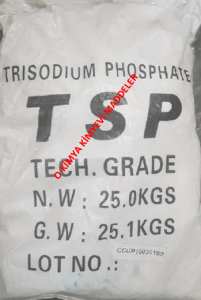
 TRISODIUM PHOSPHATE PACKAGING
Product Documents |
|
| TRISODIUM PHOSPHATE ANALYSIS CERTIFICATE | |
What is Trisodium Phosphate?
Trisodium Phosphate Molecular Formula: Na3PO4
Molecular Weight: 163.94 g/mol
Chemical Name: Trisodium Phosphate
CAS Number: 7601-54-9
It is the phosphate salt of sodium in inorganic form, produced as a result of the combination of 3 sodium atoms and a phosphate molecule.
It is one of the 3 forms of Sodium Phosphate. It is tribasic sodium phosphate. The form offered for commercial sale is in hydrated form. In addition to the anhydrous form, there is also the dodecahydrate form.
Trisodium Phosphate E Code: E 339
Other Names are as Follows;
- Phosphoric Acid Trisodium Salt
- Tribasic sodium phosphate
- E 339
- 7601-54-9
- Anhydrous Trisodium Phosphate
- Phosphate chemical
- Tertiary sodium phosphate
- TSP solution
- Sodium Ortho phosphate
- TSP
- Trisodium Phosphate Anhydrate
- Trisodium Phosphate Anhydrous
How is it Produced?
In its production, an excess amount of sodium carbonate is added to the reaction of phosphoric acid and sodium carbonate. The 2nd stage is the process of expelling the carbon dioxide within the solution. During this process, the solution is boiled. Carbon dioxide is expelled during boiling. In the subsequent process, sodium hydroxide is added to the solution to obtain TSP.
What are the Physical and Chemical Properties?
In terms of physical appearance, it is in white, granular, or crystalline powder form. It has hygroscopic properties, meaning it has the ability to attract moisture from the air.
The melting point is 1583 °C.
Boiling Point: No information available.
Regarding solubility, it has good solubility in water. It is approximately 14.5 g/100 g water at 25 °C. It does not dissolve in ethanol.
Its density is 2.54 g/cm3.
This chemical decomposes if heated up to 75 °C.
Its aqueous solution has very strong alkaline properties. The pH in its 1% solution is in the range of approximately 11.5-11.7.
What are the Usage Areas of Trisodium Phosphate?
- Among the most important usage areas are the manufacture of soap powders, detergents, and cleaning agents. TSP has a pH value of approximately 12. Due to its high alkaline property, it acts on greases and oils, providing the effect of removing them from the area they have penetrated.
- In the coating and painting sector, TSP is used to clean oils from metal surfaces. When used before the painting process, it creates a smooth surface on the painted metal.
- There are hard copper brazing processes in the manufacture of machines used in the pharmaceutical sector. Trisodium phosphate is used to braze hard copper in these areas.
- Ceramic materials are coated with glaze. To obtain a good glassy surface on ceramics, the flow point of the glazes must be lowered. The glassy film layer must adhere well to the ceramic and provide a feeling of smoothness. Trisodium phosphate is used to lower the flow point of glazes on ceramics.
- Energy is produced in the Krebs cycle in the human body. Phosphate is a necessary component for the Krebs cycle to produce energy. It is used as a nutritional supplement in the components of such energy drinks because it contributes to energy production in athlete nutrition.
- In the medical field, tribasic sodium salt is used as an active ingredient in the treatment of intestines or in the manufacture of laxatives. This process is called an enema. The purpose of the enema is to soften solid substances that harden and become stuck in the intestine with the effect of trisodium phosphate and to expel them.
- There are some ions in the water found in closed-circuit systems that give hardness to the water. As a result, scale formation occurs within the system due to the presence of these ions. Scale formation within the system causes clogging. Subsequently, undesirable events occur in closed-circuit systems. Therefore, the water within the system needs to be softened. Tribasic sodium salt is an excellent chemical for softening hard water.
- Yarns made of cotton and cotton blends must be resistant to different pH levels after dyeing. It is desired that cotton and cotton-blend yarns be more resistant to pH changes. As a result, they are treated with trisodium phosphate before the dyeing process.
- It is used in the creation of insecticide formulas.
- Scale-like pests occur on some plants and fruit trees. To inhibit scale pests, Tetrasodium Pyrophosphate is used together with sodium nitrate salt.
- It is among the core chemicals used to prevent corrosion occurring in geothermal power plants. Sodium Phosphate is a cost-advantageous chemical for preventing corrosion or reducing the corrosion rate of this metallic system.
- It is used in sugar factories or sugar production to clarify the sugar.
- It is used in chemical mixtures used for the removal of oily dirt in restaurant kitchens and areas containing intense oily dirt.
What are the Factors Affecting Prices?
Trisodium prices are directly dependent on the prices of the chemicals used in the production of this chemical. As the prices of Phosphoric Acid and sodium carbonate increase, the price of this chemical will increase in parallel.
Prices depend on the stocks of firms that are distributors of Trisodium Phosphate. As a result, as stocks increase, prices will decrease in the short term.
The biggest effect on the prices of this chemical is the transportation costs. As oil prices increase, prices will increase.