

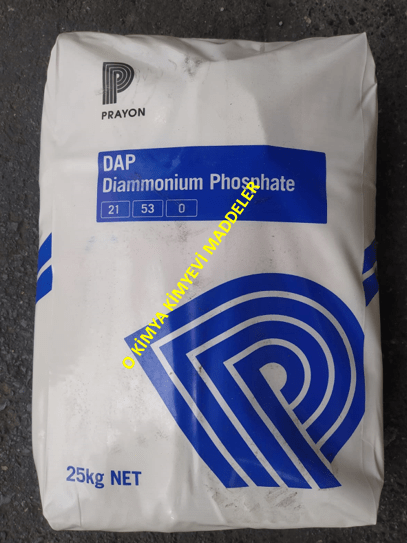
 DIAMMONIUM PHOSPHATE (DAP) PACKAGING
Product Documents |
|
DIAMMONIUM PHOSPHATE CERTIFICATE OF ANALYSIS |
|
What is Diammonium Phosphate (DAP)?
Molecular Formula (Diammonium Phosphate (DAP)): (NH4)2HPO4
Molecular Weight: 132.06 g/mol
Chemical Name: Diammonium Hydrogen Phosphate
CAS Number: 7783-28-0
It is an inorganic phosphate formed by 2 Ammonium molecules of Phosphoric Acid. These types of compounds are referred to as ammonium salts.
It is among the most important precursors of fertilizer-grade Ammonium Phosphate compounds. It does not contain heavy metals. At the same time, it is extremely important for the production of agricultural-grade Ammonium Phosphate, which has high water solubility.
Other Names Are As Follows;
- Ammonium Phosphate
- Diammonium Hydrogen Phosphate
- 7783-28-0
- Ammonium Orthophosphate Dibasic
- Ammonium Monohydrogen Orthophosphate
- Phosphoric Acid Diammonium Salt
- Diammonium Acid Phosphate
How is it Produced?
Industrial production of Diammonium Phosphate (DAP) is obtained from the reaction of the Ammonia molecule with Phosphoric Acid. When 2 moles of Ammonia react with 1 mole of Phosphoric Acid, Diammonium Hydrogen Phosphate is obtained.
The production reaction here is as follows.
2NH3 + H3PO4 》(NH4)2HPO4
The phosphoric acid used in DAP production can be obtained by dissolving raw phosphate rock with Sulfuric Acid. However, the resulting phosphoric acid may contain heavy metals. For this, a series of purification processes are necessary. Otherwise, heavy metals in Diammonium Hydrogen Phosphate penetrate the plants if this product is used as a fertilizer. Therefore, 2 different types of purified DAP production exist.
- In Method 1
Purified phosphoric acid is used. In this way, a product without heavy metals is obtained.
- In Method 2
This method is not advantageous in terms of cost for industrial production. This is because it has a complex production process. In the Diammonium Phosphate (DAP) production here, phosphoric acid is purified with a solvent in the wet process method.
The process here is a neutralization reaction.
What are the Physical and Chemical Properties?
It is in white crystal form in physical appearance.
It is odorless or has a very slight ammonia odor.
It has a salty and cooling taste.
In terms of solubility, it does not dissolve in Ethyl Alcohol and Acetone. At 25 °C, it was determined to be 69.50 g/100 g of water. That is, it has high solubility in water.
Its density is 1.619 g/cm³.
It is not a stable compound. In case of contact with air, it loses 8% of the ammonium contained within it over time.
The pH level is approximately 8.
What are the Usage Areas of Diammonium Phosphate (DAP)?
- The sector with the largest share among the usage areas is the agriculture sector. It is used in fertilizer manufacturing in this sector. It is used in the production of phosphorus and nitrogen sources such that the nitrogen rate is 18% and the phosphorus rate (in terms of P2O5) is 46%. This field also includes Monoammonium Phosphate (MKP) production.
- In wine production, it has important effects on ensuring that yeasts survive during the 1st fermentation. In this way, fermentation yield increases. The most important mineral nitrogen source to ensure yeast viability in wine production is DAP.
- Diammonium Phosphate (DAP) is used to prevent the formation of hydrogen sulfide gas during wine production. In wine cellars, addition is made in 2 stages. The first stage is added at the beginning of the fermentation process, and the second stage is added at what is considered the midpoint of the fermentation period.
- It can be used as a ruminant feed additive.
- In the Textile Sector and Furniture Sector, it is applied by the impregnation method to increase the durability of fabric and wood. Durability is ensured by adding diammonium hydrogen phosphate to wood and fabric.
- Biological treatment is carried out after chemical treatment in wastewater or alone. It is an important component in biochemical treatment plants for wastewater.
- In the defense industry, it is used as motor insulation material during the production of rocket motors. Since rocket motors generate high heat, this heat must be insulated. It is used as a flame retardant to prevent motors that reach high heat from burning.
- High-purity DAP is used in the medical field.
- For plants, Nitrogen is an important element for plant development and plant growth. Phosphorus is an element necessary for energy and nutrient metabolism and cell division and proliferation. This type of fertilizer grade can be used during soil preparation for planting.
What are the Factors Affecting Prices?
Diammonium phosphate (DAP) prices are directly dependent on the prices of the chemical substances used in its production. As Phosphoric Acid and Ammonia prices increase, the prices of this chemical compound will increase.
Diammonium Phosphate (DAP) will experience a slight increase in price with the start of the crop planting season in agriculture.
The agriculture sector is expanding with the increase in human population. Thus, the use of Diammonium Phosphate (DAP) is increasing. This process will raise the prices of this raw material.