

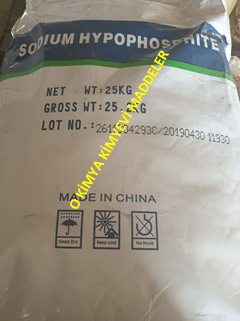
 SODIUM HYPOPHOSPHITE PACKAGING
Product Documents |
|
| SODIUM HYPOPHOSPHITE ANALYSIS CERTIFICATE | |
What is Sodium Hypophosphite?
Molecular Formula (Sodium Hypophosphite): NaH2PO2
Molecular Weight: 85.96 g/mol
Chemical Name: Sodium Hypophosphite
CAS Number: 7681-53-0
It is in a fine granular structure or white powder form. It is odorless. It is sometimes found in anhydrous hypophosphite form and sometimes in monohydrate form.
The difference between the two chemical forms is that in the monohydrate form, one water molecule is attached. The anhydrous form has higher solubility compared to the hydrous form.
Sodium Hypophosphite Molecular Formula: NaH2PO2
Other Names Are as Follows;
- Hypophosphite
- Hypophosphite Monohydrate
- Anhydrous Hypophosphite
- 7681-53-0
- White Phosphorus
- Hypophosphorous Acid
- Calcium Hypophosphite
- Phosphite
How is Sodium Hypophosphite Produced?
There is no very detailed information regarding the production of this chemical. However, it is obtained by reacting white phosphorus with sodium hydroxide solution.
Sulfuric Acid and phosphoric acid can produce phosphorus-containing inorganic salts when reacted on an industrial scale. In such reactions, calcium sulfate (gypsum) is obtained as a by-product. These types of chemicals can be used as an excellent phosphorus source for factories producing yellow phosphorus.
Synthesizing phosphorus from such sludge materials is a major problem. However, applying alkaline chemical support in this production process is the most common synthesis method.
What are the Physical and Chemical Properties?
It has a colorless appearance. It is odorless. It also has a taste between bitter and sweet.
The melting point is 238 °C. It begins to decompose after this temperature.
Boiling Point: No information available.
In terms of solubility, it has good solubility in water. It is slightly soluble in alcohol.
In terms of stability, it is a stable chemical under the storage conditions in the relevant standards.
If heated, it causes the formation of phosphine. The resulting gas has flammable properties. If the sodium hypophosphite workspace is an application area requiring heat, appropriate ventilation conditions must be provided in this workspace. Otherwise, there is a risk of fire.
Its solution in water produces Na+ and H2PO2- ions.
Its density is 1.77 g/cm3. This density applies to the monohydrate form.
What are the Usage Areas of Sodium Hypophosphite?
- It is used in the formulations of electro-catalysts in the plating industry. Electroless plating baths are created by using it together with formaldehyde. This method in electroplating does not have a very long history. These composition variations provide great contributions to the efficiency in electroplating. It is used as a reducing agent in such applications.
- It is used for the inhibition of gram-negative anaerobic bacteria in model meat systems. Rather than the inhibition of some spores, it leads to cell development, division of defective cells, and cell lysis. In this usage area, pH balance must be very well maintained. Bacteria use pH values very effectively to produce spores.
- In the production of concrete admixtures, the strength of the concrete is increased by using sodium hypophosphite. Concrete slump is reduced. According to the usage amount, while the strength of the concrete increases, the slump decreases. At the same time, with this additive used in concrete, the bleeding problem occurring in concrete is eliminated. That is, the liquid forming on the concrete surface is prevented.
- If we want to nickel-plate plastic materials without using electricity, we should use sodium hypophosphite.
- Hypophosphite is used to provide a flame-retardant effect in the manufacturing of materials produced to prevent fire formation. Plastics are among these usage areas.
- It is used in the manufacture of polyacrylates.
- Calcium Hypophosphite, which has similar properties, is used as a phosphorus source in fertilizer production.
- It should be used to provide a smooth coating on ceramics.
- It is an important component in the plating sector for the deposition of Cu and Ni metal ions at a certain pH level when used together with formaldehyde.
- It is used in the production of non-electrolytic Palladium deposition. In this way, barrier layers, conductive films, and corrosion-resistant non-porous deposits are produced in the electronics sector.
- It is used together with Nickel Sulfate to perform electroless Nickel plating in the plating sector. In this application, it acts as a reducing agent.
What are the Factors Affecting Its Prices?
Prices are directly proportional to the prices of chemicals used in production. Increasing prices of White Phosphorus and Sodium hydroxide will increase hypophosphite prices.
If the stocks of companies selling sodium hypophosphite increase, the price of this chemical will decrease. The relationship between stock and time has a great significance on chemical prices.
An increase in the usage area of this chemical will have a positive impact on the hypophosphite price. It will increase the prices.