

Product Documents |
|
| DISODIUM PHOSPHATE CERTIFICATE OF ANALYSIS | |
What is Disodium Phosphate?
Molecular Formula (Disodium Phosphate); Anhydrous = Na 2 HPO 4 , hydrate = Na2HPO 4 .nH 2 O (n = 2, 7, or 12)
Molecular Weight; 141.957 g/mol
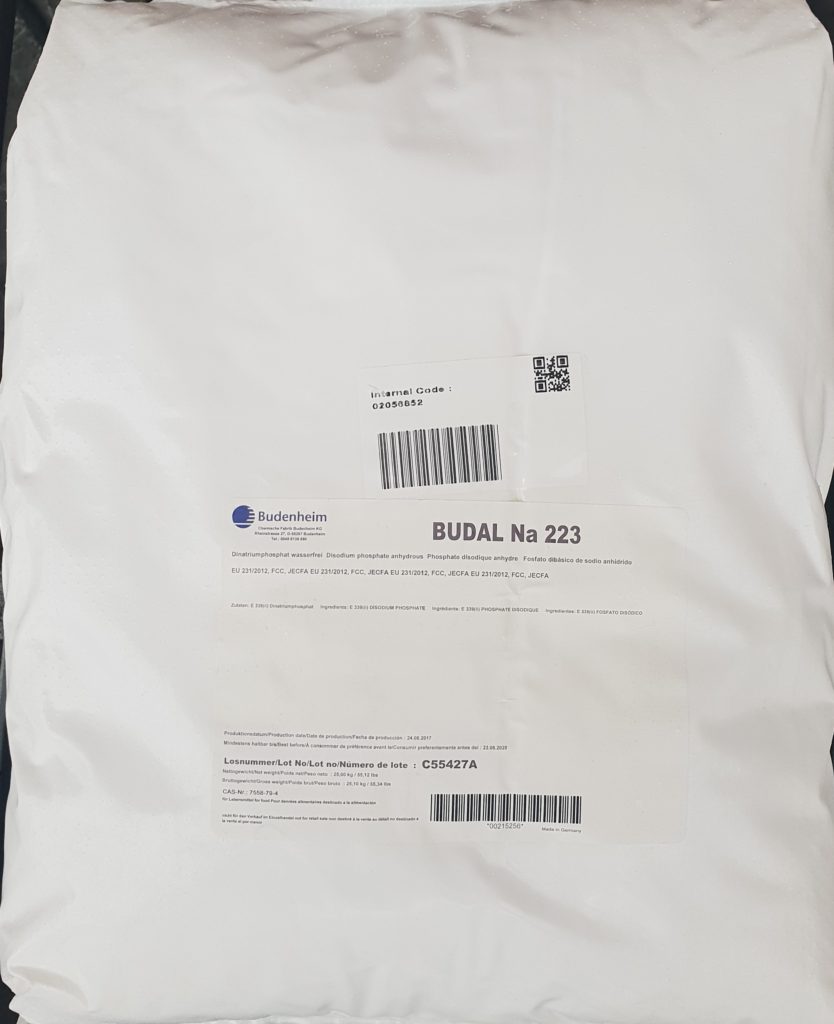
CAS Number; 7558-79-4
Chemical Name; Disodium Hydrogen Phosphate
Disodium Phosphate is a food additive that combines sodium and phosphorus from the mineral phosphate group.
It is a chemical substance with two sodium atoms and one hydrogen atom.
E Number: E 339 (ii).
Other names include;
- Disodium Hydrogen Phosphate
- DSP Anhydrous
- Sodium Phosphate
- Sodium Acid Phosphate, Anhydrous
- Sodium Orthophosphate, Anhydrous
- Sodium Monohydrogen Phosphate
- Soda phosphate
- Phosphoric Acid, disodium salt
- sec-Sodium Phosphate
- Sodium Phosphate, Dibasic
- Dibasic sodium phosphate
- Buffer Salt
- Disodium Monohydrogen Phosphate
How is Disodium Phosphate Produced?
There are several methods. We can list them as follows.
It is produced from phosphoric acid and Sodium Carbonate.
It can be obtained by precipitating Calcium Carbonate from a Dicalcium Phosphate solution with soda ash.
In its production, the solution is treated with a slight excess of soda ash relative to the phosphoric acid, then heated to remove carbon dioxide and cooled to allow the dodecahydrate to crystallize.
In this reaction, sodium monophosphates are obtained by neutralizing phosphoric acid with soda ash or caustic soda.
Disodium Phosphate production in Germany is a more costly method. Production in America has lower costs as it uses cheaper soda ash. In the production of trisodium phosphate, the basicity of sodium carbonate is insufficient. Therefore, caustic soda is used at this stage.
In this reaction, the phosphates crystallize as hydrates and are separated from the solutions by centrifugation.
In the production process, anhydrous salts are obtained using the dehydration method (i.e., water removal) with the help of rotary dryers, or directly from solutions by spray drying or in furnaces.
Both thermal phosphoric acid and the cheaper wet-process phosphoric acid are used as starting chemicals in production.
Very pure thermal phosphoric acid is used in the production of disodium phosphate for manufacturing food-grade products.
What are its Physical and Chemical Properties?
It is a white, hygroscopic, and odorless powder. A powder crystal form is also available.
Its density is in the range of 0.5 g/cm3– 1.2 g/cm3.
A 1% solution of this compound has a pH between 8.4 and 9.6. The pH of a 1% aqueous solution at 25 °C is 9.1.
In terms of solubility, it is freely soluble in water. It is insoluble in Ethanol.
It has a solubility of 11.8 g / 100 g of water at 25 °C.
Anhydrous DSP absorbs 2-7 moles of water when exposed to air and moisture, depending on the temperature.
The heptahydrate form is stable in air.
The dodecahydrate form easily loses 5 moles of water under normal temperature conditions.
When heated, it produces toxic fumes of phosphorus and sodium oxides, making it a dangerous chemical process.
It has more basic properties than monosodium phosphate.
Melting Point: 250 °C (anhydrous form)
Boiling Point: Information not available.
What are the Uses of Disodium Phosphate?
- It is generally used as a food additive.
- Disodium Phosphate is used in foods to regulate acidity. It helps with thickening, acts as a stabilizer, and helps maintain proper moisture levels.
- The addition of the compound helps to keep oil-based and water-based ingredients from separating. In this application, it acts as a stabilizer.
- It is used to help fish and seafood retain moisture. If DSP is not used during the processing and transportation of seafood, it loses a significant amount of water.
- It is used in preserving sausages and cooked meats, and helps to smooth the texture of beverages and cheeses.
- It is used in the manufacture of corrosion inhibitors and anti-scaling agents.
- It is used in the production of many chemicals in industry.
- It is used in the manufacture of paint additives and coating additives. When used as a coating additive, disodium phosphate provides effective protection against corrosion on the applied surface before coating and painting. It also creates a slippery surface, adding different properties to its frictional capabilities.
- It is used in the manufacture of intermediate products in industry. In some production processes, the effects of this phosphate chemical are utilized to reach the final chemical substance.
- It is used as a laboratory chemical.
- It is used in the manufacture of cleaning and floor care products. The purpose of using disodium phosphate is that it is less harmful than other types of phosphates. It is also used to provide shine to floors.
- It is used in the manufacturing of textile, leather, and fabric products. Some fabrics and their fibers are sensitive to high-pH bleaching agents. During the bleaching of such high-pH sensitive fabrics, the solution needs to be buffered to an alkaline state. It is used to impart alkaline properties.
- Disodium Phosphate helps preserve baked goods and enriched farina. It also helps maintain the softness of ice cream and artificially sweetened jelly.
- It can be used in the water treatment sector and as a flame retardant. Additionally, in medicine, hypercalcemia occurs when high calcium levels are present in the blood. It has been found that calcium leaking from the bones into the blood can harm the heart. Drugs containing DSP help to lower blood calcium levels or increase low blood phosphate levels.
- It is used as an auxiliary agent in the manufacture of nasal decongestant sprays.
What Factors Affect its Price?
The price of Disodium Phosphate varies depending on the prices of the chemicals used in its production.
As the price of phosphoric acid increases, the price of this phosphate compound will also increase.
As the price of liquid caustic soda used in its production increases, prices will rise. As soda ash prices increase, the price of disodium phosphate will increase.
Prices tend to increase as the applications for disodium phosphate expand. This is because supply may not meet the increased chemical demand.
The price of this chemical is dependent on production volume; it will decrease as production increases and increase as production decreases.
High-purity disodium phosphate commands higher prices.