

Product Documents |
|
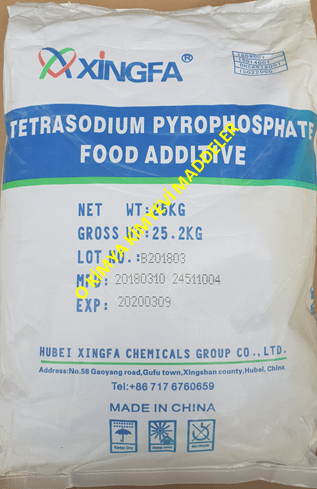
| TETRASODIUM PYROPHOSPHATE CERTIFICATE OF ANALYSIS | |
What is Tetrasodium Pyrophosphate (TSPP)?
Molecular Formula (Tetrasodium Pyrophosphate); Na4P2O7
Molecular Weight; 265.9 g/mol
Chemical Name; Tetrasodium Pyrophosphate
CAS Number; 7722-88-5
It is an anhydrous chemical substance that is an odorless, colorless white powder or granular form. Tetrasodium Pyrophosphate (TSPP) is known as a normal component of human body fluid. It is used extensively in many foods. It is an inorganic phosphate salt.
Other names include the following;
- Anhydrous TSPP
- Sodium Pyrophosphate
- TSPP
- Anhydrate
- Pyrophosphate
- Pyrophosphoric Acid, Sodium Salt
- Diphosphoric Acid, Tetrasodium salt
- Sodium Diphosphate
- Sodium Pyrophosphate(Na4P2O7)
- Tetrasodium Diphosphate
How is it Produced?
Tetrasodium Pyrophosphate (TSPP) is produced from the reaction of Phosphoric Acid (H3PO4) with Sodium Carbonate (Na2CO3) to produce Disodium Phosphate (Na2HPO4). It is then heated to 450 °C to obtain TSPP.
What are the Physical and Chemical Properties of Tetrasodium Pyrophosphate?
Melting point is 80 °C.
Boiling point is 93.8 °C.
The density of Tetrasodium Pyrophosphate (TSPP) at 25 °C is 2.53 g/mL.
In terms of solubility, it forms a 0.1 M colorless and clear solution in water at 20 °C. However, it is insoluble in Ethyl Alcohol.
It is a stable chemical. Incompatible with strong oxidizing agents.
How is it Stored?
It should be stored at room temperature in sealed containers in a moisture-free environment.
It should be kept in areas away from direct sunlight.
What are the Usage Areas of Tetrasodium Pyrophosphate?
- Tetrasodium Pyrophosphate (TSPP) is used as a pH buffering agent. That is, it is used to maintain a certain level of acidity within a substance. It is a substance used in processed and milled grain products.
- TSPP is used as a dough conditioner in soy-based meat products.
- Tetrasodium pyrophosphate is used for washing and peeling potatoes. The usage rate here should not exceed 0.3 ppm.
- As its name suggests, it is a very good source of phosphorus (as a nutrient) and also a good emulsifier.
- It is used as an anticoagulant in well drilling operations.
- It is used as a dispersing agent for the electrodeposition of metals and to remove rust stains.
- In toothpaste production, one of the substances used as a good emulsifier, buffer, and cleaning aid is Tetrasodium Pyrophosphate (TSPP).
- It is a very good tartar control chemical.
- It is used extensively in toothpaste manufacturing because it has the effect of removing Calcium and Magnesium metals from human saliva.
- Tetrasodium pyrophosphate (TSPP) is used as an auxiliary agent in the manufacture of industrial and institutional detergents.
- Tetrasodium Pyrophosphate (TSPP) is used in water treatment systems for buildings. Its use in this context plays a key role. It is used as an auxiliary chemical in the production of corrosion control agents.
- It is used in the paper processing industry.
- In the paint and coating industry, polyphosphates are chemicals that help wet and disperse pigments. TSPP is commonly used as a sequestrant, stabilizer, and dispersing agent in water-based latex paints.
- It is used as a preservative in the food industry.
- It is an important component along with trisodium phosphate in the manufacture of pesticides.
- Tetrasodium pyrophosphate is used in the manufacture of milk powders used in beverages like coffee. Here, it is not used alone but in a mixture with disodium phosphate.
- It is used as a bleaching agent in industry. The corrosion prevention and anti-scaling properties of pyrophosphates are utilized.
- It is used as an intermediate in paint manufacturing and as a coating agent in the surface treatment field. It is used in the manufacture of surfactants.
- It is used in the manufacture of non-pesticidal agricultural products. It is used in the manufacture of automotive care products.
- It is used in the manufacture of ink, toner, and colorant products.
- It is used in the manufacture of laundry and dishwashing products.
- It is used as a wetting and dispersing agent when adding color in the manufacture of plastic and rubber products.
- It is used in paint production to take advantage of its corrosion-inhibiting effects.
- TSPP is used in the production of purifying fluids for oil fields to act as a clay-stabilizing particulate salt.
What Factors Affect its Price?
Tetrasodium Pyrophosphate (TSPP) prices are directly proportional to the prices of the chemicals used in its production. As the price of Phosphoric Acid increases, its price increases. As the price of Sodium Carbonate increases, pyrophosphate prices increase.
Its price has been increasing linearly for many years. Sometimes, with the establishment of new production facilities, its price experiences a short-term decrease. But over time, it stabilizes at a certain level.
Its prices also vary depending on the prices of phosphate rocks. Because phosphoric acid is produced from phosphate rocks, the effect of phosphate rocks on the price of Tetrasodium Pyrophosphate (TSPP) is high.
In addition, with the emergence of a new application area for Tetrasodium Pyrophosphate (TSPP), prices increase due to the supply-demand balance. Because; the demand for this chemical will increase, and the supply will have difficulty meeting it.