

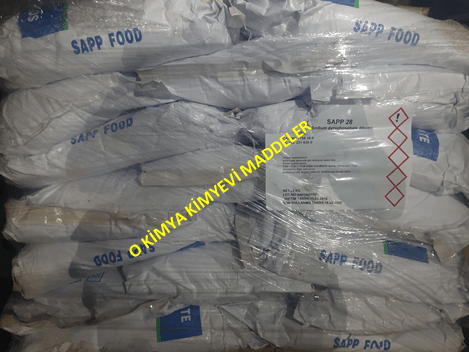
Product Documents |
|
| SODIUM ACID PYROPHOSPHATE CERTIFICATE OF ANALYSIS | |
What is Sodium Acid Pyrophosphate (SAPP)?
Molecular Formula (Sodium Acid Pyrophosphate);Na2H2P2O7
Molecular Weight;221.936 g/mol
CAS Number;7758-16-9
Sodium Acid Pyrophosphate, or Disodium Pyrophosphate, is a chemical in the phosphate group. It is one of the edible phosphorus salts that prevents food discoloration and aids in the leavening process in foods.
It is also commonly referred to as Disodium Diphosphate.
Sodium Acid Pyrophosphate E Number= E 450
Other Names Include;
- Disodium Pyrophosphate
- Polyphosphoric Acids, Sodium Salts
- Disodium Dihydrogen Pyrophosphate
- Sodium Polyphosphate
- Diphosphoric Acid, Sodium Salt
- Disodium Dihydrogen Diphosphate
- SAPP
- Disodium Diphosphate
- E 450
- Polyphosphoric Acids, Sodium Salts
- Pyrophosphoric Acid, Disodium Salt
- Disodium [Hydroxy(oxido)phosphoryl] Hydrogen Phosphate
- Disodium
How is it Produced?
In the production process, the procedure begins with the neutralization reaction of Phosphoric Acid with Sodium Hydroxide or Sodium Carbonate to form Monosodium Phosphate. Here, Monosodium Phosphate is obtained.
H3PO4 + NaOH 》NaH2PO4 + H2O
2H3PO4 + 2Na2CO3 》2NAH2PO4 + H2O + CO2
After the Monosodium Phosphate production process, to produce SAPP 28, the production is carried out by the molecular dehydration method of Monosodium Phosphate at a temperature of approximately 250 °C.
The production reaction here is as follows;
2NaH2PO4 》Na2H2P2O7 + H2O
What are its Physical and Chemical Properties?
It is a white powder and crystalline in structure. It has a lumpy structure. It is an odorless compound.
It is a water-soluble chemical.
Sodium Acid Pyrophosphate (SAPP) has a pH range between 3.7 and 5.0 (in a 1% solution).
Melting point is above 600 °C.
In terms of stability, it is synthetic and stable.
Its density is 1.1-1.3 g/mL.
SAPP has a solubility of approximately 11.9 g in 100 grams of water at 0 °C.
Boiling point is unknown.
The shelf life is approximately 2 years. After this period, it loses its functionality.
What are its Effects on Human Health?
SAPP 28 has been determined to be a safe chemical. However, if used above certain dosages, it can pose a health risk.
There are situations where it is very toxic to aquatic life. SAPP 28 can cause serious eye irritation.
In case of contact with Sodium Acid, wash with plenty of water.
Is it a Harmful Chemical?
At standard usage rates, sodium acid pyrophosphate is not harmful. These usage rates are determined according to the relevant legislative provisions. Use outside the scope of the legislation may be harmful to health.
How Should it be Stored?
Sodium Acid Pyrophosphate (SAPP) should be stored in closed areas away from direct sunlight. It has a shelf life of 2 years. It can be stored safely for this period under appropriate conditions.
What is the Effect of Sodium Acid Pyrophosphate in Foods?
Foods naturally contain Copper, Iron, and Nickel. In the food industry, metals cause a lot of damage to foods. These naturally occurring metals in food act as oxidation catalysts. For this reason, they cause the color of foods to fade.
SAPP 28 chelates with polyvalent metal ions to form complex ions. In this way, the metal ions that cause color change are removed from the food as a chelated structure. Sodium Acid Pyrophosphate is a food additive used for the purpose of removing metals from foods.
What are the Conditions Required to Form a Chelated Structure with Sodium Acid Pyrophosphate?
For the chelation process to occur, the following conditions must be met simultaneously.
- The sequestering agent must be suitable for the steric and electron-donating/accepting structure of the metal ion. That is, the chelating agent and the metal must have a structure that will form the desired complex.
- The pH, ionic strength, and solubility in the reaction environment must be compatible. When these conditions are met, SAPP 28 can perform the desired chelation.
What are the Usage Areas of Sodium Acid Pyrophosphate?
- In the baking industry, sodium acid pyrophosphate is used to control the rate of leavening reactions.
- Due to its pH regulating property in foods, it is used to balance pH in this field.
- It is used in canned goods, seafood, frozen fish fillets, and frozen shellfish. Its purpose here is as a buffering and chelating chemical.
- It is used in cakes, wafers, cake batters, refrigerated dough, baking flours, and mixes.
- It is used as a sequestering agent in the processing of potato products.
- It is used for coloring in hot dog meat and casings.
- In crab meat processing, using Sodium Tripolyphosphate, water, and SAPP 28 in solutions with pH levels of 4.5 and 5.5 increases the shear strength that occurs when cutting the crab. In solutions with a pH of 5.5, cooking loss is minimized. It is used for this purpose.
- It is used in the manufacture of cooked meat products as a water-retaining agent (water binder).
- It is used in foods as a firming agent, to make sausages firmer, less fatty, and to provide salt, smoke, and spice contribution in sausage products. Sodium Acid Pyrophosphate (SAPP) intensifies sour tastes and reduces odors.
- It is used in the formulations of drugs produced to prevent kidney stones.
- It is used in the manufacture of drugs for skin treatment.
- It is used to enable enterotoxin growth.
- In the production of liquid carpet shampoo, Sodium Acid Pyrophosphate (SAPP) is used as an alkaline chemical together with SLS (Sodium Lauryl Sulfate).
- Its use on chicken carcasses extends the shelf life by 1 or 2 days. Sodium Tripolyphosphate is also used.
- It is used in dairy and leather manufacturing. In leather manufacturing, it is used to remove iron stains on the leather. In dairy production, it has significant effects for cleaning when mixed with Sulfamic Acid.
- It is used for chemical stabilization, metal cleaning, and in drilling mud.
- It is used in oil well drilling operations. It is used in the production of treatment fluids in the oilfield for hydraulic fracturing operations.
- It is also used in petroleum production. The purpose of using Sodium Acid Pyrophosphate (SAPP) here is as a dispersant in oil well drilling muds.
- It is used as a sequestrant agent in food products containing polyvalent metal ions, such as potatoes, to prevent darkening and to remove metal ions by forming a complex structure.
What are the Factors Affecting its Price?
SAPP 28 has been used for many years. Its price has shown a linear increase over time. The price is directly dependent on the raw materials used in the production of SAPP 28.
In particular, as the price of Phosphoric Acid increases, the price of SAPP will also increase. The main component of SAPP 28 production is Phosphoric Acid.
It is also directly dependent on the price of Sodium Hydroxide. As the price of Sodium Hydroxide increases, the prices will increase due to the rising costs for companies producing Sodium Acid Pyrophosphate (SAPP).
Producers using the Sodium Carbonate process differ due to their use of sodium carbonate. When the price of Sodium Carbonate increases, the price of Sodium Acid Pyrophosphate (SAPP) will show an increase.
At the same time, if a global production facility is established, the price of this chemical will experience a short-term decline. This is because there will be changes in the supply-demand balance. But the price of SAPP 28 will eventually reach equilibrium.