

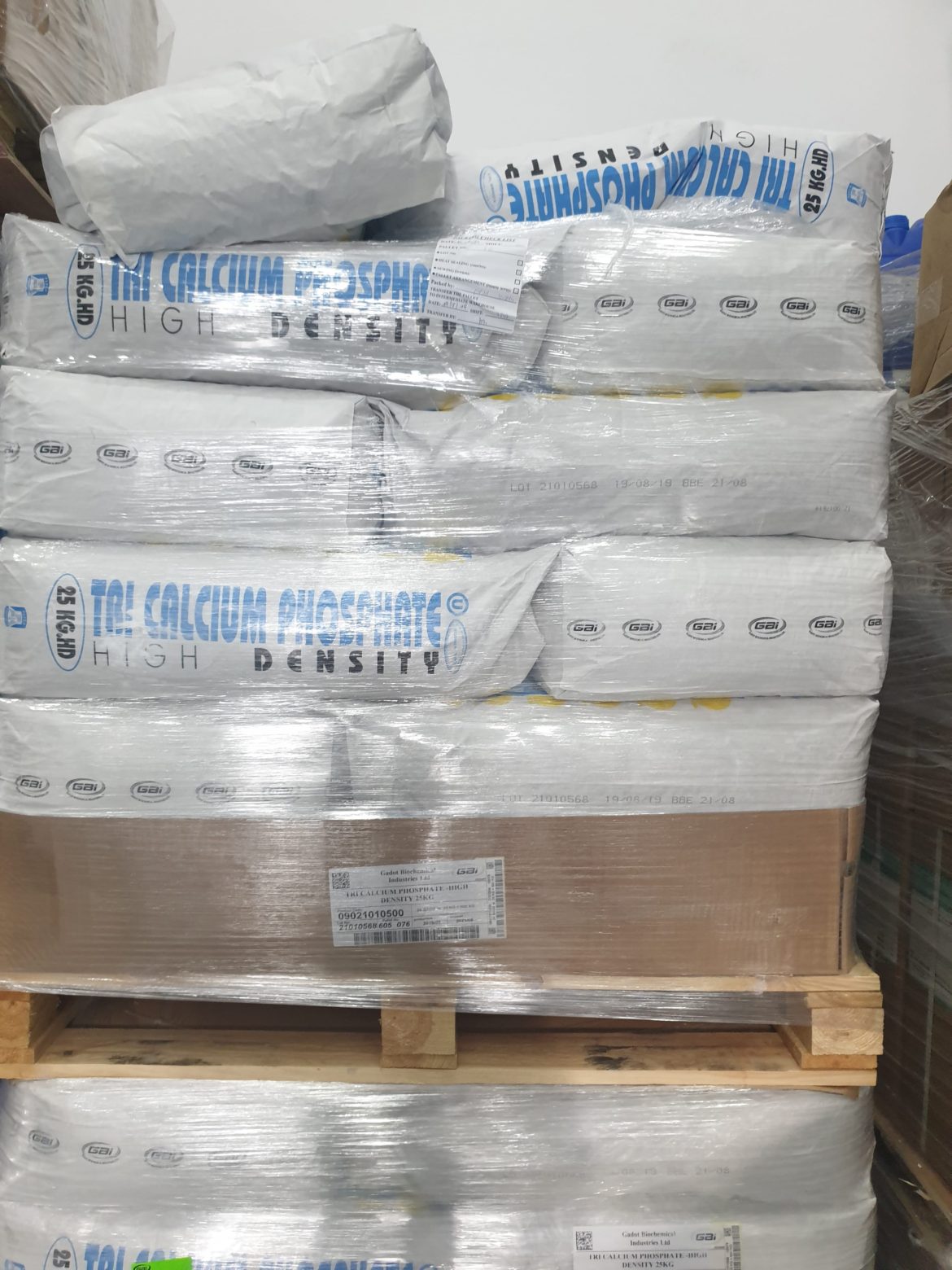
Product Documents |
|
| TRICALCIUM PHOSPHATE CERTIFICATE OF ANALYSIS | |
What is Tricalcium Phosphate?
Molecular Formula (Tricalcium Phosphate): Ca3(PO4)2
Molecular Weight: 310.18 g/mol
Chemical Name: Tricalcium Phosphate
CAS Number: 7758-87-4
There are many different types of nutritional supplements. Tricalcium Phosphate is one of them. The human body has a specific daily calcium requirement. If a person cannot meet their calcium needs sufficiently through the food they consume, they can consume TCP-fortified nutritional products.
TCP is a tribasic inorganic salt. It consists of 3 calcium atoms and 2 phosphate groups.
It is similar to the calcium phosphate compound. It is used in industry as technical grade and food grade.
Is TCP Harmful or Not?
For a toxic effect to occur, usage must exceed 2 g/kg. Therefore, uses below this ratio indicate that the harmful effects of Tricalcium Phosphate are low. If high amounts of calcium are ingested, hypercalcemia may occur.
In people exposed to high amounts of calcium, loss of appetite, thirst, dehydration, and a feeling of fatigue may occur.
Other Names Include;
- Calcium Orthophosphate
- Calcium Phosphate
- Tribasic phosphate
- Phosphoric Acid
- Calcium Salt (2:3)
- Tribasic Calcium Phosphate
- Tricalcium Bis(Orthophosphate)
- Beta-TCP
- TCP
How is it Produced?
For the production of high-purity Tricalcium Phosphate, the highest sugar concentration that allows the solution to be filtered should be used. For TCP production, a sugar solution is saturated with Calcium Oxide (CaO).
During the reaction process, the sugar solution is separated from the undissolved material.
In its production, the solution is rapidly agitated while phosphoric acid (H3PO4) is added to form a gelatinous mass.
In the production process, for every 3 moles of Calcium Oxide (CaO) in the separated sugar solution, 2 moles of concentrated phosphoric acid (H3PO4) are added, and the mixture is agitated until a fine white gelatinous precipitate of TCP is formed. The resulting precipitate is then separated from the sugar solution.
It is also obtained by reacting aqueous solutions of excess industrial ammonia, calcium chloride, and Trisodium Phosphate.
NH3 + 3CaCl2 + 2Na3PO4》Ca3(PO4)2 + 6NaCl + NH3
What are its Physical and Chemical Properties?
It is a colorless, odorless, and tasteless chemical compound. It appears as a crystalline powder.
Its density is 3.14 g/mL.
Its melting point is 1670 °C.
Tricalcium phosphate has moderate solubility in water. It dissolves easily in dilute Hydrochloric Acid (HCl) and Nitric Acid. It is insoluble in alcohols and Acetic Acid.
Its solubility decreases with increasing temperature. As a result, precipitation occurs. TCP exhibits an unusual property in this regard.
It is not reactive. That is, it is a stable compound.
Boiling Point: Information not available.
For What Purpose is Tricalcium Phosphate Used in Food Products?
- Substance used as a flour improver
- Chemical substance used as an opacifier
- Acidity regulator
- As a humectant in baking powder, sugar, and table salt
- As a leavening agent in bread and baked goods
- Used as a calcium and phosphorus supplement. These applications are found in fruit juices and cereal products.
- As a source of mineral salts in cheese production.
- Anti-caking agent
- Anti-caking agent
- Adds opacity and smoothness to reduced-fat foods and beverages.
What are the Usage Areas of Tricalcium Phosphate?
- With developing technology, its effects on human health have become highly noticeable. The human body and metabolism need energy. This energy is generated within the human body. The mitochondria is where this energy is produced. Mitochondria need ATP as an energy source. Due to the malfunctioning metabolism of some people, an ATP deficiency occurs. In case of ATP deficiency, energy cannot be produced by the mitochondria.
- To produce the energy source ATP, a phosphate group is needed. It serves as a phosphate source for the production of the energy source ATP. In this field, tricalcium phosphate is used as a phosphate source.
- Materials containing B-tricalcium phosphate are widely used in the reconstruction of diseased and damaged parts of the human body.
- The phosphorus it contains is an extremely necessary element for plants. For this reason, it is used in fertilizer manufacturing.
- TCP is used in the manufacturing of phosphoric acid and other phosphorus compounds.
- Tricalcium phosphate is used in porcelain household goods, pottery, and ceramic coating processes.
- It is used as a bone grafting material.
- It is used as a mineral source in vegan foods.
- It is used in the manufacturing of baby powder.
- TCP gives very good results in water filtration. This is because it does not dissolve well in water.
- TCP is used in the manufacturing of toothpaste.
- What is the purpose of using TCP in food;
- Bacteria form on the teats of dairy animals. To prevent this, they need to be disinfected. It is used in the production of powder disinfectants for teats. At the same time, Xanthan Gum and Sorbitol, which has sweetening properties, are used.
- It imparts acidity. Tricalcium phosphate breaks down in the food where it is used. This creates positive and negative ions. With the chelating effect of this chemical, it prevents materials like dairy products, seasonings, etc., from becoming too acidic or basic.
- It provides smoothness and opacity in some reduced-fat foods and beverages like soy milk.
- Bacterial formation occurs on the udders of lactating animals. This can later cause significant health problems. To prevent this, udder disinfectant substances are produced. It can be used as an anti-caking agent in these products.
- It is used to provide mineral supplements like calcium and phosphorus in fruit juices and some soy beverages.
- Due to its low solubility in water, it is used to prevent caking in spices and powdered drinks.
- It is used as a humectant in sugars and baking powders. Tricalcium phosphate is used as a mineral salt in cheese production.
- It is used as a stabilizer in the production of some frying oils.
- It is used as a calcium supplement in toothpaste manufacturing to strengthen tooth enamel.
- It is used as a firming agent and calcium source in tablets. In the wine industry, it is used in fermentation release tablets to enhance the binding properties of the binding agent.
- TCP is used in single-use tea bags as an anti-caking agent and to improve flowability.
- It is used to minimize damage and failures in dental implants. TCP is used as a bone grafting and bone substitute material. In this application, it preserves bone height and width and helps it heal, preventing shrinkage. It also stops bleeding.
- Tricalcium Phosphate can be used in animal feeds to ensure bone development and increase reproductive efficiency.
- It is used in the manufacturing of dental fillings.
What Factors Affect its Price?
The price is related to the profit margins set by companies that wholesale tricalcium phosphate. The chemical raw material producers are well-established. It has shown a stable increase over a long period.
The price of Tricalcium Phosphate is directly proportional to the prices of the chemicals used in its production. The price increases with the rise in ammonia prices. It increases as the price of Calcium Chloride (CaCl2) increases. It also increases as the price of Trisodium Phosphate increases.
Tricalcium Phosphate prices increased the most in 2004. The reason for this was that the use of TCP was channeled into the medical field. There was a transition to high technology here. With this process, the price of TCP showed a radical increase.
Additionally, the price of tricalcium phosphate decreases in inverse proportion to the establishment of a large TCP production facility. With the emergence of a new area of use, prices will increase due to the supply-demand balance.