

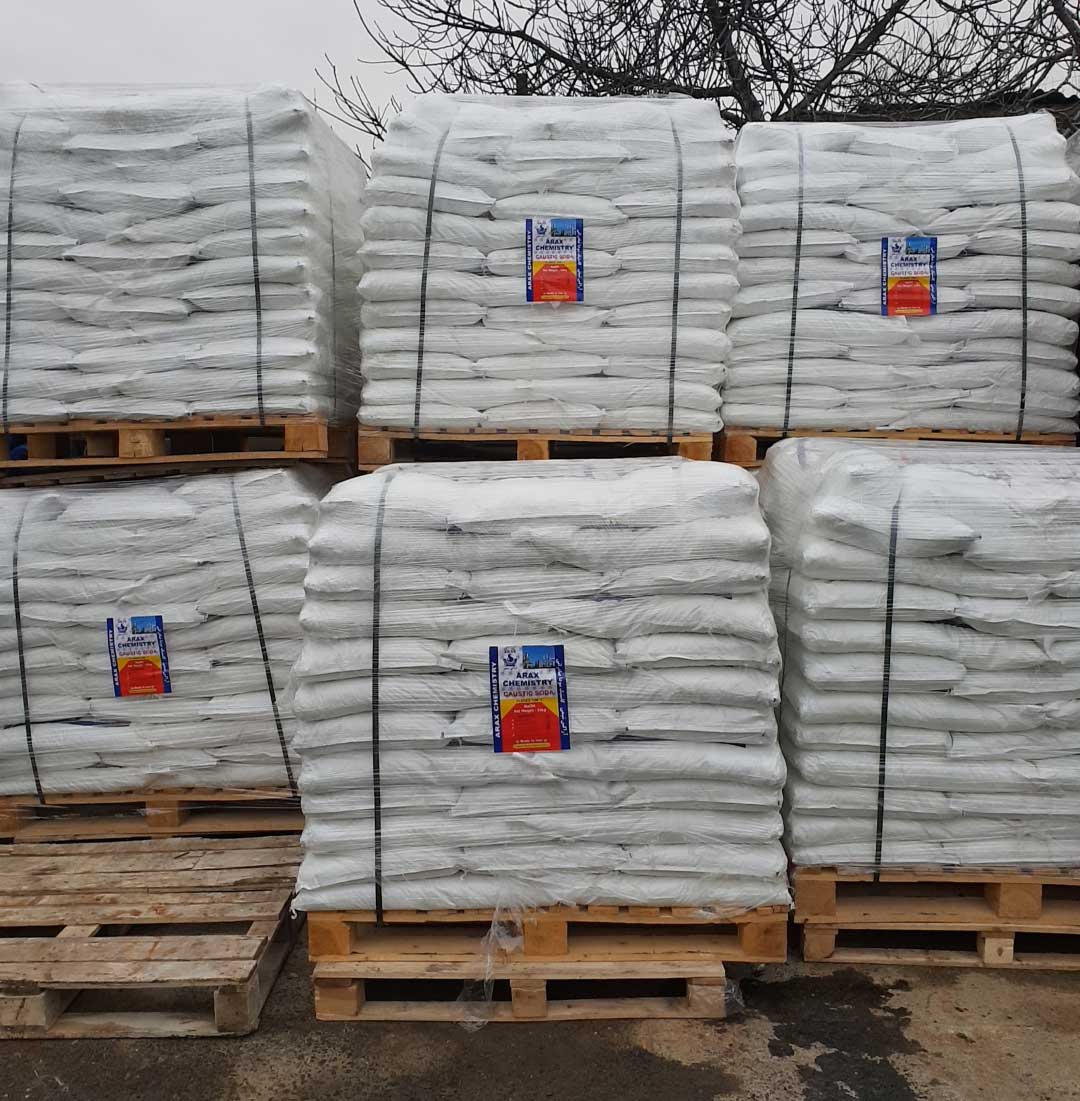
 CAUSTIC SODA FLAKES PACKAGING 25 Kg
Product Documents |
|
| CAUSTIC SODA FLAKES CERTIFICATE OF ANALYSIS | |
What is Caustic Soda Flakes?
Molecular Formula (Caustic Soda Flakes): NaOH
Molecular Weight: 39.997 g/mol
Chemical Name: Sodium Hydroxide
CAS Number:1310-73-2
It is a highly caustic substance used to neutralize acids and form sodium salts. Caustic Soda is a versatile alkali. It is an inorganic chemical.
Other Names Include;
- Sodium Hydroxide
- Caustic Soda
- 1310-73-2
- Sodium Hydrate
- Caustic Soda Flake
- NaOH
- Caustic Soda Solution
- Flake Caustic
How is it Produced?
Almost all caustic soda is produced by the electrolysis of a sodium chloride solution using one of three cell types. Through this electrolysis process, 2.25 tons of 50% caustic soda are produced for every 1 ton of chlorine.
It is obtained by evaporating the water content of liquid sodium hydroxide until it is between 0.5%-2.0%. In short, we can call it solid sodium hydroxide.
How is it Packaged and Stored?
It is generally available in a 98% concentration. Additionally, liquid Sodium Hydroxide is available at 48%.
It is packaged in 25 kg polyethylene bags. It should be stored in environments free from rain, water, and moisture. This prevents it from being exposed to conditions like melting due to temperature differences.
Some companies carry out domestic production. However, most of this chemical substance is imported from abroad.
What are the Effects on Human Health?
Caustic Soda Flakes have a corrosive effect upon contact with humans. If its fumes are inhaled, they can damage the upper respiratory tract and lungs.
If it comes into contact with the eyes, it causes severe burning of the mucous membrane.
When Caustic Soda Flakes gas comes into contact with metals, flammable Hydrogen gas is released. These containers may explode if heated.
It is not a flammable chemical. However, when neutralized with water or acids, it releases heat. That is, the reaction is exothermic.
What are the Physical and Chemical Properties of Caustic Soda Flakes?
It has a white, flaky appearance. It has a denser structure than water. If it comes into contact with the skin, it can cause severe irritation. Caustic Soda Flakes are a toxic chemical.
It has corrosive properties for skin and metals. Caustic soda flakes are a strongly caustic and hygroscopic chemical.
When it comes into contact with air, it absorbs carbon dioxide and forms sodium carbonate.
It is in the form of white orthogonal crystals. It is an odorless chemical.
Its boiling point is 1388 °C.
Its melting point is 388 °C.
In terms of solubility, Caustic Soda Flakes dissolve easily in water. It is freely soluble in ethanol. Generally, its solubility at 20 °C is 109 g/100 ml.
The density of Caustic Soda Flakes at 25 °C is 2.13 g/cm3.
It is not flammable. When heated, it decomposes, emitting toxic fumes.
Examination of Caustic Soda Flakes' Application Areas
In the Chlor-alkali production chain, it is based on the electrolysis of a solution containing salt and water by passing an electric current through it.
It begins with the breaking of salt and water molecules through electrolysis, and then they are reassembled into caustic soda, chlorine, and hydrogen molecules.
The production of caustic soda here results in 1.12 tons of caustic soda per 1 ton of chlorine.
Caustic Soda is a chemical reactant for the production of various organic chemical products. These are classified as follows.
The application areas of Caustic Soda Flakes (Caustic Soda) are classified as follows;
- Approximately 5% of its use is in the water treatment sector.
- Approximately 12% of Caustic Soda Flakes (Caustic Soda) usage is in the production of inorganic chemicals.
- Approximately 14% is used in the aluminum industry.
- Approximately 14% is used in paper and pulp manufacturing.
- 15% is used in the soap and textile industries.
- 17% is used in the production process of organic chemicals.
- The usage rate in other sectors is 23%.
How is Caustic Soda Flakes Used in Dairy Production Facilities?
Hygiene and sanitation are very important in dairy production facilities. To ensure that the milk and dairy products produced are of high quality, caustic soda flakes are modified with certain chemicals and used in cleaning processes to clean the tanks where milk is stored, the boilers where milk is pasteurized, and the equipment used, as well as to inhibit some microorganisms.
Due to its very strong alkaline property, it ensures the sterilization of equipment in milk processing plants by cleaning the protein layers that accumulate in heating boilers. At the same time, it has a corrosive effect on tin, zinc, and aluminum metals.
Where are the Application Areas of Caustic Soda Flakes?
- The most indispensable feature of this chemical is its neutralizing effect. Thanks to this, it is used to eliminate acid pollution and excess in the environment. It is an ideal chemical for removing acidity and neutralizing acid wastes and scrubbing gases.
- As it is an alkaline chemical, it is counteractive to acids. Therefore, it neutralizes acids. In neutralization reactions, salt and water are produced.
- Gas emission systems are devices designed to utilize the alkaline properties of Caustic Soda Flakes (Caustic Soda) for air pollution control. This neutralizes acid gases and prevents emission gases from chimneys from polluting the environment.
- Additionally, wastewater from metal plating manufacturing facilities contains dissolved heavy metal concentrations that must be treated before being discharged into municipal sewers. These dissolved heavy metals are removed from the environment in a controlled manner by adding Caustic Soda Flakes (Caustic Soda) to form insoluble metal hydroxide compounds.
- It is used to neutralize acid drainage from mines. During mining activities, when sulfur-containing minerals are extracted, they react with acid upon contact with air and water. As a result, other harmful chemical components are released.
- Consequently, acid mine drainage poses a great danger to the environment. It is used to neutralize low acid drainage leaks and to treat flows with high manganese content.
- In addition to its use in the production of industrial and specialty soaps, it also plays a very important role in the manufacturing process of detergents. Developing countries have a very high demand for Caustic Soda.
- It is used in the production of cream-form dishwashing detergents.
- In the manufacturing of alkaline liquid dishwashing detergents, it is used together with HEDP and linear amine oxide. In such liquid dishwashing detergent manufacturing, isopropyl alcohol is used as a solvent.
Application Areas Part 2
- Because; It is used in the manufacture of specialty soaps, soaps used to clean ovens, food preparation equipment, more effective detergents for dishwashers, metal cleaning, floor cleaning, paint strippers, liquid soaps, and shampoos.
- It is used in the production of cotton fabrics to help the fibers absorb dye. Research suggests that 90% of the cotton on the world market is treated with Caustic Soda.
- At the same time, its main functions in the food industry include refining animal and vegetable oils, removing fatty acids, peeling fruits and vegetables, and its use in the production of the antiseptic sodium phenolate. This produces Aspirin (Acetyl Salicylic Acid).
- The pulp and paper industry and the aluminum industry are also major areas of use.
Application Areas Part 3
- Caustic Soda is used in municipal wastewater treatment plants.
- Industrial applications include adhesives and sealants.
- Polyurethane foams become waste after a certain period of use or under certain conditions. For the recycling of these polyurethanes, some glycols and Sodium Hydroxide are used as catalysts.
- Caustic soda flakes are used in the manufacture of adsorbents and absorbent chemicals. It is widely used in the manufacture of non-pesticidal agricultural chemicals.
- It is used in the manufacture of bleaching agents.
- It is used for cleaning acid units in filters in mines.
- It is used in the manufacture of corrosion inhibitors and anti-scaling agents.
- In the livestock sector, digesting straw can sometimes be difficult. In such cases, the straw needs to be treated to facilitate digestion. The digestion of straw is facilitated by processing it with a wet method in a sodium hydroxide solution.
Application Areas Part 4
- It is used in the manufacture of defoaming chemicals. It is used as a pH reducer in the manufacture of finishing agents and flame retardants.
- It is used in the manufacture of sanitation chemicals in the food and beverage industry.
- Cleaning of oily areas is carried out with chemical products that require high pH properties. Caustic soda flakes are used in the manufacture of cleaning agents with high pH properties.
- It is used in the manufacture of electrical and electronic products.
- In the wastewater treatment sector, caustic soda flakes are used to adjust the pH during treatment processes.
- It is used as a catalyst in some reactions.
- In the coating industry, it is a chemical used to obtain a cleaner and smoother surface on metal surfaces.
- It is used in the manufacture of household cleaning products.
- It is used in the bleaching process of waste paper pulp.
- Caustic soda flakes are the chemical used to process cotton and synthetic fibers.
- It is used in washing and bleaching processes in the textile industry.
- It is an important substance for cleaning industrial equipment such as heat exchangers, condensers, heaters, pumps, and air evacuation equipment.
- For cleaning aluminum surfaces, it is used together with Calcium Chloride, which has effects like a corrosion inhibitor. In this application, a 50% aqueous solution is used.
- It is used together with Triethanolamine to prevent corrosion of metal surfaces and to remove the rust layer on the metal surface. The triethanolamine used here can be 85% or 99%.
- With the development of construction technology, it is necessary for the concrete setting time (the time it takes for concrete to cure) to reach levels of 60-80 in large construction processes. During the production of set-retarding chemicals in the concrete sector, Sodium Hydroxide is added to the polymerization solution to bring the pH to a level of 5-6 to carry out the reaction.
- Aluminum burrs remain in aluminum casting pans after the casting process. Caustic Soda Flakes are used to clean these burrs. Generally, domestic caustic is used. The reason for this is that domestic caustic is more effective. The usage rate increases when caustics from different countries are used. The important issue here is the price/performance ratio.
What Factors Affect its Price?
The price of caustic soda flakes is directly proportional to the prices of the raw materials used in its production.
As the price of salt increases, the price of Caustic Soda Flakes will increase.
Prices vary depending on the number of companies producing caustic soda flakes. If a new production facility is established, the price of caustic soda flakes will experience a short-term decline. Prices will reach a stable level over time.
For many years, prices have increased with the development of industry. Therefore, we can say it is directly proportional to industrial development.
Prices depend on the stocks of the companies that sell caustic soda flakes. As stocks increase, prices will increase. Therefore, the prices of these chemicals also depend on the policies of the wholesalers.