

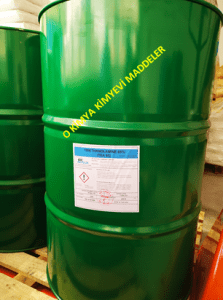
 TRIETHANOLAMINE PACKAGING
Product Documents |
|
| TRIETHANOLAMINE CERTIFICATE OF ANALYSIS | |
What is Triethanolamine?
Molecular Formula (Triethanolamine); C6H15NO3
Molecular Weight; 149.19 g/mol
Chemical Name; Triethanolamine
CAS Number; 102-71-6
Triethanolamine (TEA), also known as H3TEA or Trolamine, is a viscous, oily organic compound that is both a tertiary amine and a triol (a molecule containing three alcohol groups). This chemical substance (TEA) is a bifunctional chemical compound that exhibits the properties of both alcohols and amines.
It is a chemical compound containing an alkyl group with an amine group and alcohol groups.
Triethanolamine (TEA) is an essentially neutral compound, though it acts as a weak base.
It is a potentially toxic chemical substance. It tends to solidify below 20 °C.
Other Names Include:
- TEA
- Trolamine
- Nitrilotriethanol
- Sterolamide
- Trihydroxytriethylamine
- Daltogen
- Tri(hydroxyethyl)amine
- Alkanolamine 244
- Tris(β-hydroxyethyl)amine
- TEOA
- Triethanolamine Homopolymer
- Poly(Triethanolamine) ether
- Tris(2-hydroxyethyl)amine
- 2-[Bis(2-hydroxyethyl)amino]ethanol
- TEA USP
How is it Produced?
Triethanolamine (TEA) is produced on an industrial scale by the reaction of ethylene oxide with excess ammonia. The amount of excess ammonia used in this production is crucial.
During the production process, the reaction between ethylene oxide and ammonia proceeds slowly and is then accelerated with water.
In the production stage, a fixed-bed catalyst is used, consisting of an organic ion-exchange resin, thermally more stable acidic inorganic clays, or zeolites.
In all processes where Triethanolamine (TEA) is produced, the reaction takes place in the liquid phase. To prevent the evaporation of ammonia and ethylene oxide, the reactor pressure is significantly higher than the reaction temperature.
The reactions that occur are highly exothermic, meaning they release heat.
TEA is obtained by reacting 3 moles of Ethylene Oxide with 1 mole of Ammonia.
What are its Physical and Chemical Properties?
Physically, it is a pale yellow to light yellow color. It is an oily liquid with a mild ammonia-like odor.
Its melting point is 21 °C.
Its boiling point is 360 °C.
The density of Triethanolamine (TEA) is 1.1245 g/cm3.
It is an air-sensitive and hygroscopic chemical.
As for solubility, TEA is a compound soluble in water. It is denser than water.
Triethanolamine (TEA) is soluble in methanol, acetone, benzene, ether, carbon tetrachloride, and n-heptane. It is soluble in chloroform but sparingly soluble in petroleum ether.
It is a very hygroscopic compound. It turns brown upon exposure to air and heat.
During winter months, it freezes below a certain temperature. Therefore, it is used by melting it in a warm environment.
How is Triethanolamine Used in the Textile Industry?
In the field of textile processing, it functions as an intermediate in the reactions for manufacturing finishing agents and softening chemicals for durable-press fabrics. Due to their low alkalinity, amine-based soaps are suitable cleaning agents for wool and silk materials.
Trolamine groups are an active ingredient in the production of printing pastes due to their hygroscopic properties. Dyes are used in the manufacturing of artificial fibers, known as acetate silk. The properties of these dyes are achieved by using diethanolamine and triethanolamine.
What are the Applications of Triethanolamine?
- Its applications include the manufacturing of adhesives and sealants.
- It is used in the manufacturing of agricultural chemicals. These chemicals are specified as non-pesticidal. Triethanolamine is used as a solvent for agricultural pesticides derived from Zinc sulfate and Boric acid. Its concentration here can be between 85% and 99%.
- When cement is combined with iron in construction, corrosion occurs on the iron. To prevent or delay the formation of corrosion on reinforcing bars, this amine chemical is used to modify the cement during its manufacturing. This aims to delay the rusting and decay of construction iron exposed to moisture.
- It is used in the manufacturing of corrosion inhibitors and anti-scaling chemicals.
- It is used in the manufacturing of functional fluids used in closed systems. Its purpose here is to form a gel layer on the metal surface by being modified with different chemicals.
- It is used in the manufacturing of some intermediate chemicals.
- To remove deposits from metal surfaces and to purify the surface, Hydrochloric Acid and the weak base TEA 85% or TEA 99% can be used.
- It is used in the manufacturing of lubricant additives and lubricants.
- In the paint industry, it is used as a rheology modifier. In this application, it has significant effects on viscosity and flow properties. Its use in paint production helps to facilitate the application of paints and ensure it happens as desired.
- TEA is used as a pH-adjusting chemical for skin and hair care products.
- It is used as a surfactant in sunscreen lotions, liquid laundry detergents, polishes, paints, and cosmetics. In this field, it acts as a pH stabilizer and has a formula-thickening effect.
- It is used extensively in the manufacturing of personal care products. It is used together with glycerin and liquid paraffin to prevent water loss from the skin. In this application, while viscosity is provided by carbomer, it is used to neutralize it.
- Vehicle radiators and engine coolants tend to freeze below a certain temperature. Antifreezes are used to prevent such freezing problems in vehicle systems. Triethanolamine is used in the manufacturing of the Antifreeze and de-icing products used here.
- It is used in the manufacturing of textile and leather products not coated elsewhere. It is used in the manufacturing of metal products not coated elsewhere.
- In the production of antifreeze for aircraft, Carboxymethyl Cellulose is used as a thickener. TEA is used as a neutralizing agent in this application.
Other Applications Include:
- It is used in the manufacturing of paper products.
- It is used in the manufacturing of processing aids.
- Triethanolamine (TEA) is used as a solvent, becoming part of the product formulation.
- It is used in the manufacturing of printing inks.
- Triethanolamine (TEA) is used in building and construction materials, and in the processing of wood and wood products.
- It is used in the manufacturing of some oils and greases.
- It can be used for the removal of acidic gas pollutants such as H2S and COS from petroleum gas. However, monoethanolamine is commercially more preferred.
- It is used in the manufacturing of photographic supplies, film, and photographic chemicals.
- It has thickening and wetting agent properties. It also has an effect that holds droplets together and reduces surface tension. Therefore, it is used in the production of thick and dense shaving foam.
- It is used in the manufacturing of photochemicals.
- In skin lightening compositions, it is used as a neutralizing agent in the skin brightening formula along with many other substances such as Edta, Sorbitol, and Glyceryl Stearate (GMS 90).
- In ultrasound gel production, it is used to neutralize the Carbomer agent.
- In cold weather, the body can catch a cold. Pains occur as a result of the common cold. To relieve body aches, it is used together with a non-steroidal anti-inflammatory drug active ingredient, taking advantage of its neutralizing property. It is used in the production of complex gels along with Carbomer, menthol, the preservative phenoxyethanol, Ethylhexylglycerin, and many extracts.
- During the removal of Hydrogen Sulfide from gases, the organic amine TEA is used with polyaminopolyacid to control the pH of the reaction solution.
- It is used as a neutralizing agent in the production of percutaneous-type local anesthetic creams.
- It is used together with Liquid caustic soda to prevent metal surfaces from rusting. This makes metal surfaces resistant to corrosion.
- It is used along with Potassium Permanganate and Castor Oil in the production of lubricating oils where the lubricant bases, easily soluble in organic lubrication bodies, increase in consistency from a thin medium to a solid mass, and the transition temperature from a non-liquid phase to a liquid form increases.
- It is used as a neutralizing agent in local anesthetic injections or gels where Lidocaine HCl is used.
- It is one of the auxiliary chemicals used as an activator in the production of roll-on deodorants.
- In plastic and rubber production, it is the catalyst used to accelerate the reaction between Isocyanate and Polyol.
- In paper production, it is used to increase the gloss of the paper surface and to form a protective layer.
- It is a compound used as a corrosion inhibitor in metal cutting fluids (soluble oil).
What Factors Affect Its Price?
The price of Triethanolamine (TEA) is directly dependent on the price of the chemicals used in its production. As the price of ethylene oxide increases, the price will increase. As the price of ammonia increases, its prices will increase.
The price of Triethanolamine (TEA) is generally directly linked to its application areas. As its use increases, the price of this chemical will show an increase.
Prices have been on an upward trend since it began to be used with the development of industry.
Triethanolamine (TEA) prices increase due to logistics costs as the distance from the places where it is used increases.
Since Triethanolamine (TEA) is used in many sectors, its price changes with the increase in human population. If its production does not increase in parallel with the population growth, TEA prices will continue to rise.