

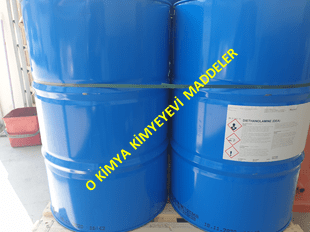
 DIETHANOLAMINE PACKAGING
Product Documents |
|
| DIETHANOLAMINE CERTIFICATE OF ANALYSIS | |
What is Diethanolamine?
Molecular Formula (Diethanolamine) : C4H11NO2
Molecular Weight: 105.14 g/mol
Chemical Name: Diethanolamine
CAS Number: 111-42-2
Diethanolamine is commonly abbreviated as DEA. It is an organic chemical compound that is both a secondary amine and a dialcohol. It is a white solid at room temperature. Above a certain temperature, it is a colorless liquid.
At room temperature, it is a clear hygroscopic liquid that absorbs moisture from the air or a mild crystalline solid that may have a faint ammonia odor as the temperature rises.
Ethanolamines are chemical compounds belonging to the groups of amines and alcohols. This causes them to have the property of reacting with both groups.
Other Names Include;
- 2,2’-Iminodiethanol
- Diolamine
- Iminodiethanol
- Bis(2-hydroxyethyl)amine
- N,N-Diethanolamine
- Diethanolamine
- Diethanolamine
- Bis[2-hydroxyethyl] Amine
- Aliphatic Amine
- Ethanol, 2,2’-iminobis-
How is it Produced?
Diethanolamine is an organic compound synthesized in the reaction of ethylene oxide and ammonia. It has been produced on a large industrial scale since the early 1930s.
The production reaction occurs in the liquid phase. The reaction that takes place in this production is highly exothermic, meaning heat is released during the manufacturing process of this chemical.
In the diethanolamine production reaction, Triethanolamine is formed as a byproduct. Recently, some studies have been developed to prevent the formation of this undesirable byproduct. In these studies, a Zeolite Electrolyte containing Silicon Dioxide (SiO2) and Aluminum Oxide (Al2O3) but without a binder is used as a catalyst. This helps to prevent unwanted reactions.
What are its Physical and Chemical Properties?
Melting point is 28 °C.
Boiling point is 268 °C.
The density of Diethanolamine (DEA) at 25 °C is 1.096 g/mL. It has a density greater than that of water.
It has the appearance of a viscous liquid. It is hygroscopic.
In terms of solubility, it dissolves in Ethyl Alcohol and Acetone.
It is a stable chemical. It is incompatible with carbon dioxide, strong acids, and strong oxidizing agents.
It has a structure that can dissolve in moist environments.
It is a water-soluble chemical substance.
The pH of a 10% solution of Diethanolamine is around 11.5. It is a basic chemical.
What are the Usage Areas of Diethanolamine?
- Diethanolamine (DEA) is used in many consumer products such as shampoos, cosmetics, and pharmaceuticals. Its purpose in these applications is to act as an emulsifier, foaming agent, and pH control agent (acidity regulator).
- Its aqueous solutions are used as a solvent for numerous drugs administered intravenously.
- It is used in textile processing, in industrial gas purification activities, and as an anti-corrosion agent in metalworking fluids to remove acid gases.
- It is used in the manufacturing of chemical substances produced for agricultural use. It can be a good solvent for Zinc Sulfate and Boric Acid.
- DEA is used as a pH regulator in the manufacture of liquid laundry and dishwasher detergents.
- It has been widely used in the preparation of Diethanolamide and DEA salts of long-chain fatty acids, which are formulated as surfactants and used in shampoos and hair conditioners.
- In the process applied for recycling polyurethane foams, it is an important component in the glycolysis process. In this process, Sodium Hydroxide is used as a catalyst. Diethylene Glycol is also a chemical used in this process.
- It is used as an intermediate chemical in the production of rubber chemicals.
- DEA is used in the manufacture of textile specialties, herbicides, and surface-active agents used in the production of petroleum emulsifiers.
- Diethanolamine is used in organic syntheses as a humectant and softening chemical agent.
- To safely remove deposits from metal surfaces and to purify the surface, the weak base DEA can be used together with Hydrochloric Acid instead of Urea Hydrochloride.
- It is a chemical substance used in the separation of solid materials. Its main function in this application is its solvent effect.
- It is used to impart an odor to gas.
- It is a starting material in the production of Cocodiethanolamide (CDE).
- Natural gas contains acidic impurities. To remove these acidic impurities from the natural gas, it is directed to an absorption tower or a system called a contactor. Diethanolamine coming from the opposite direction absorbs the acidic impurities.
What Factors Affect its Price?
The price of Diethanolamine (DEA) is directly linked to the prices of the chemicals used in its production. As the price of Ethylene Oxide and Ammonia increases, the price of DEA will also increase.
The price of Diethanolamine (DEA) varies depending on the pricing policy of the companies that sell DEA.
Diethanolamine prices increase as its areas of use expand. The emergence of a new application area will lead to an increase in demand, as the amount of raw material produced will not be sufficient to meet the demand.
One of the biggest factors affecting Diethanolamine prices is directly proportional to logistics costs. The price of (DEA) will increase with distance from the production facility.