

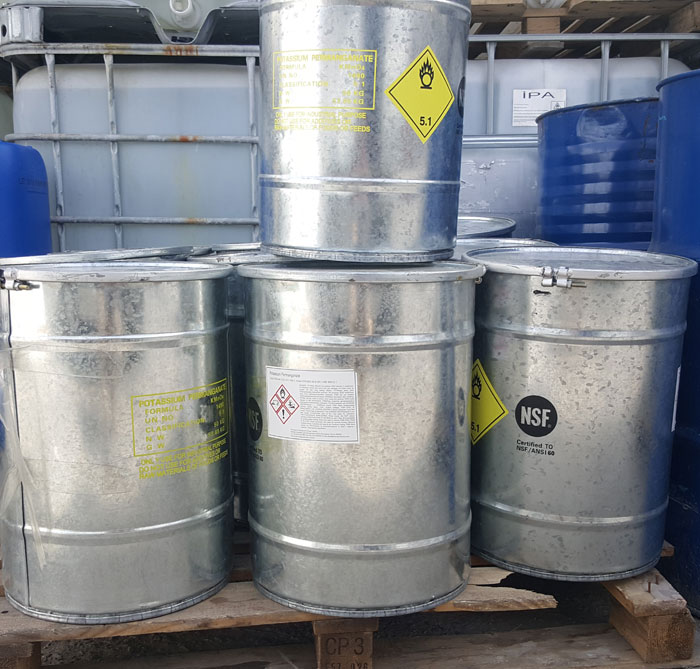
 POTASSIUM PERMANGANATE PACKAGING 50 Kg
Product Documents |
|
| POTASSIUM PERMANGANATE CERTIFICATE OF ANALYSIS | |
What is Potassium Permanganate?
Molecular Formula (Potassium Permanganate); KMnO4
Molecular Weight; 158.032 g/mol
Chemical Name; Potassium Permanganate
CAS Number; 7722-64-7
The molecular formula of Potassium Permanganate is KMnO4. It is an inorganic salt in solid form, widely used worldwide. It is generally a solid in the form of dark purple crystals. When dissolved in water, it forms a distinctly purple solution. Permanganate is not flammable, but it can accelerate the combustion of flammable materials.
Its chemical structure contains 1 Potassium (K) atom, 4 Oxygen (O) atoms, and 1 Manganese (Mn) atom.
In terms of oxidizing properties, it is more effective than Sodium Dichromate.
Other Names for Potassium Permanganate are as Follows;
- Potassium
- Permanganate
- 7722-64-7
- KMnO4
- Potassium Salt
- Potassium Permanganate Solution
- Disinfectant
What are its Physical Properties?
It is a solid in the form of shiny, purple-colored crystals. It is an odorless chemical.
Its density is 2.7 g/mL.
The melting point of Potassium Permanganate is considered to be 250 °C.
Commercially, it is available in powder, crystalline, and tablet forms. Although it may appear brownish from a distance, it has a purple color upon closer inspection. It is soluble in water at 20 °C.
What are its Chemical Properties?
It has a structure that dissolves easily in water, forming a characteristic bright purple, magenta, or dark pink solution. Due to the formation of MnO2, a reduced dark brown anion, it stains all organic materials it comes into contact with. It is a chemical with oxidizing properties.
It is stable under normal conditions. However, it decomposes under heat, yielding MnO2 ions. For this reason, it is extremely oxidizing. Potassium Permanganate (KMnO4) reacts very violently with concentrated sulfuric acid, glycerol, and some alcohols.
Boiling Point: Decomposes, no boiling point
Solubility: Soluble in water
How is Potassium Permanganate Produced?
Permanganate production is synthesized by first reacting pyrolusite and alkali with oxygen and roasting it in air. And the following reaction occurs. The chemical compound used can be Potassium Hydroxide.
2MnO2 + O2 + 4KOH = 2K2MnO4 + 2H2O
The mixture obtained in production is washed with water. Then, in the resulting alkaline solution, the conversion of manganate to permanganate occurs. This equation can be realized as follows.
3K2MnO4 + 2H2O = 2KMnO4 + MnO2 + 4KOH
It is possible to obtain products with different concentrations during its production.
Commercially, it is available on the market with purities ranging from 20% to 99.9%.
What are its Effects on Human Health?
A person exposed to potassium permanganate by inhalation will experience a burning sensation. In this case, the exposed person suffers from a sore throat, shortness of breath, and difficulty breathing. To prevent this, forced breathing should be avoided. As a first aid measure, rest in fresh air in a semi-upright position; artificial respiration may be necessary, for which medical assistance should be sought.
It is caustic upon skin contact. It burns the skin and causes pain. To prevent skin contact with Potassium Permanganate, protective gloves and clothing should be worn. If it comes into contact with the skin, it should be washed with plenty of water for several minutes, and then a doctor should be consulted.
If Potassium Permanganate comes into contact with the eyes, it can cause redness, pain, and severe burns. To prevent eye contact, face and eye protection that allows for breathing should be used. In case of contact, first wash with plenty of water. And a doctor should be consulted.
In case of oral exposure, a burning sensation, abdominal pain, nausea, and vomiting may occur. Shock or weakness may occur in case of oral exposure. If ingested, do not eat or smoke. If ingested, rinse the mouth with plenty of water. Drink plenty of water to dilute the potassium permanganate in the body, but do not induce vomiting. Then go to a doctor.
How is it Stored?
Potassium Permanganate is filled into 50 kg drums with plastic bags inside. It is stored in a place away from sunlight. Its packaging must be airtight and watertight. It is an extremely reactive chemical towards organic substances.
It should be kept away from flammable and reducing agents.
Contact with powdered metals should be prevented. The packaging must be kept closed.
Analysis of Global Demand
In recent years, with the proliferation of wastewater treatment plants and the increase in per capita water consumption, the use of potassium permanganate has also increased. This is because potassium permanganate is used in wastewater treatment and to eliminate bad odors in water. This situation has increased the amount of use in recent years.
In the foundry industry, the chemical with igniting properties is potassium permanganate. It is used in production by mixing it with other igniting substances to achieve a rapid combustion reaction in the foundry sector. This oxidizing effect leads to rapid combustion, and better efficiency is achieved in a shorter time in the foundry industry.
In the chemical industry, potassium permanganate is a very good catalyst for the synthesis of many organic compounds. The increase in this area of use in the chemical industry has increased the demand in the global market.
Working Principle
The working principle of Potassium Permanganate is based on the direct transfer of electrons to a reducing agent. The number of electrons transferred in the reaction is directly dependent on the pH of the medium. And it is strongly affected by the pH.
As the pH of the medium decreases, the number of electrons transferred by potassium permanganate increases. The pH range in groundwater is 4 to 8. Therefore, in such an environment, an MnO2 reaction occurs with 4OH- ions. The resulting precipitate is Manganese Dioxide (MnO2). In laboratory studies, we can determine that Manganese is reduced to the Mn+2 ion.
How is Potassium Permanganate Used in Animal Diseases?
Due to its strong oxidizing effect, it oxidizes microbial tissues that cause damage to animal tissues. It has a sterilization role. It has a killing effect on some types of bacteria.
To control parasitic diseases in fish, such as anchor worm disease, ringworm disease, carp papilloma virus, and Lernaea disease, an aqueous solution of 10-20 mg/L Potassium Permanganate is applied to the body, and a 4-7 mg/L aqueous solution is applied to the entire pond for 15-30 minutes.
In young animals, a 0.01% aqueous solution of potassium permanganate is administered orally to treat conditions like mucosal irritation, skin irritation, and ulcers. For washing methods, a 0.1% solution is applied.
To eliminate bacterial and viral contamination in bees, an aqueous solution in the range of 0.1%-0.12% is used.
Note: The data here is for reference only. This chemical is very hazardous. Therefore, do not work with it without obtaining professional advice.
Where is Potassium Permanganate Used?
- Applications involving hazardous chemical substances like Potassium Permanganate should be carried out after consulting experts with technical knowledge on their use.
- In the denim industry, potassium permanganate is applied by spray or brushing methods to bleach jeans and add visual effects.
- Potassium permanganate is used in drinking water treatment plants to eliminate bad odors. It is used in water purification processes in the treatment sector.
- It is used for the removal of iron and manganese from water. Iron and manganese are commonly found in water. With potassium permanganate, iron and manganese in the water are removed. If iron and manganese are not removed from the water, we will have to experience a metallic taste when drinking it.
- In some bodies of water, there are dense and uncontrolled growths of Asiatic clams and zebra mussels. These can cause blockages in water systems. These Asiatic clams and zebra mussels damage water systems and cause the taste of the water to deteriorate. It helps to remedy the issues that arise here.
- It is used to disinfect water. Potassium Permanganate disinfects water by attacking microorganisms such as bacteria, viruses, fungi, and algae. This is because it reacts very quickly with organic substances.
- It is used together with Triethanolamine 85% in the manufacture of lubricating oils used in mixtures with neutral media. It is also used to create stable high-temperature lubricating greases and lubricating emulsions.
- In fire extinguishing systems, i.e., Pyrophobic Systems, chemical fire suppression, and some fire extinguishers, its oxygen-consuming effect is utilized. This way, there is not enough oxygen to sustain combustion, and the burning event does not occur.
- It is used as an oxidizing agent in oil fields.
What are Other Areas of Use?
- Helps to control and reduce the formation of DBPs (Disinfection Byproducts).
- It is used in fish farms to clean, disinfect, and clarify fish ponds. The application recipes here should be controlled by experts. They should be determined according to the relevant legislative standards.
- It is synthesized in organic chemistry and reacts with various organic compounds.
- In analytical chemistry, it is used to determine the amount of oxidizable organic matter. The purpose here is quantification. Those who want to perform quantification can conduct analysis with this chemical.
- It is used to disinfect breeding ponds in aquaculture.
- It is used for its sterilization effect on shrimp farms, fish farms, and chicken farms. Chemicals like Povidone-Iodine and Hydrogen Peroxide are used as disinfectants in this field.
- It is used in the production of some medicines. It is used as the active ingredient in drugs of this category, leveraging its antiseptic properties.
- It is used as a cholera disinfectant.
- Potassium permanganate is used as an active ingredient in the manufacture of drugs for the treatment of oral thrush.
- Potassium permanganate is used in the manufacture of signaling devices used to indicate location during emergencies in heavy snowy weather conditions.
- It is used as a general disinfectant agent.
- It is used to alter colors in photographs.
- It is widely used in the medical field as an antiseptic and fungicide.
- It is used in the treatment of various skin infections such as eczema, dermatitis, acne, and other fungal infections of the hands and feet.
- It is used as an acute treatment method for fungal infections in athletes, such as athlete's foot.
- It is the most common chemical used for the treatment of fish diseases and parasites on fish farms. It treats bacterial gill infections and skin ulcers due to its chemical properties.
- It improves water quality by reacting with organic substances like bacteria, algae, and particles, thereby minimizing the Biological Oxygen Demand (BOD).
- It is used for COD (Chemical Oxygen Demand) and color removal in wastewater. In this application, it has lower efficiency compared to Hydrogen Peroxide. However, its use for COD and color removal contributes to significant positive results.
- In zinc plating, it helps in softening before the plating process for pre-treatment cleaning. It has corrosion-inhibiting effects.
- It is used for the removal of Calcium and Magnesium salts in water.
- It ensures the inhibition of parasites with growth potential by disinfecting ponds on fish farms. In these applications, it has properties that prevent the formation of bacterial and fungal infections.
How Do Its Prices Change?
The price of permanganate is constantly rising with the increase in global demand.
It exhibits a rising trend according to the supply-demand balance. If the demand for potassium permanganate increases, its price also increases proportionally.
The largest producers of Potassium Permanganate are located in China.
The price of permanganate varies according to the product's concentration. As purity increases, the product price also increases.
Some buyers think they are getting the same product at a lower price, but it is not the same product. They have purchased potassium permanganate with a lower concentration. In reality, the usage amount has exceeded the product's performance level. In short, consumption has increased.
The price of Potassium Permanganate is dependent on the price of Potassium Hydroxide used in its manufacturing. As the price of ores containing potassium increases, the price of permanganate also increases.