

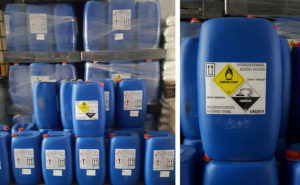
 HYDROGEN PEROXIDE PACKAGING 65 kg
Product Documents |
|
| HYDROGEN PEROXIDE CERTIFICATE OF ANALYSIS | |
What is Hydrogen Peroxide?
Molecular Formula (Hydrogen Peroxide); H2O2
Molecular Weight; 34.02 g/mol
Chemical Name; Hydrogen Peroxide
CAS Number; 7722-84-1
Other names used for Hydrogen Peroxide are as follows;
- Perhydrol
- Hydroperoxide
- Dihydrogen dioxide
- H2O2
- Peroxide
- Dioxidane
- Hydrogen Peroxide solution
- Oxydol
- Superoxol
- Peroxide, Hydrogen
It is commercially produced in concentrations between 20% and 70%. It is a pale blue chemical. When mixed with water, it becomes colorless.
It acts as both an oxidizing and a reducing agent. The reason for these strong effects is that the oxygen atoms have an oxidation state of -1. In Hydrogen Peroxide, Oxygen can gain 1 electron to become -2, making it a strong oxidizing agent. It can also lose 1 electron to reach a 0 oxidation state. These properties determine the chemical's applications.
The molecule is a disinfectant with bacteriostatic properties. Due to this property, it prevents the division and proliferation of bacteria.
What are its Physical and Chemical Properties?
It is used industrially in concentrations of 27%, 35%, and 50%.
The boiling points of Hydrogen Peroxide at 27%, 35%, and 50% concentrations are 105 °C, 108 °C, and 114 °C, respectively.
The freezing points at 27%, 35%, and 50% concentrations are -23 °C, -33 °C, and -52 °C, respectively.
At low temperatures, it is a crystalline solid. It has a slightly sharp and irritating odor.
It is generally used as an aqueous solution. It has a slightly acidic taste. It is a partially unstable chemical.
Its density is 1.11 g/cm³. This density is for a 30% solution. As the concentration in the solution increases, its density also increases.
As the concentration in the solution increases, the boiling point also increases.
However, as the concentration in the solution increases, the freezing point decreases.
Its properties depend on environmental conditions such as temperature and concentration.
How is it Produced?
Questions like how it is obtained or made have led us to explain the necessary information for the production of this chemical.
The production process has 4 steps. The 1st step is the Hydrogenation phase. In the hydrogenation phase, Anthraquinone reacts with Hydrogen in the presence of a Palladium catalyst to form Anthrahydroquinone.
Q + H2 》H2Q
- In the 2nd step, a filtration process is performed. The catalyst used, i.e., Palladium, is filtered out and removed from the solution.
- In the 3rd step, an Oxidation solution is created through the Oxidation process.
H2Q + O2 》H2O2 + Q
- In the 4th step, the Extraction process is carried out. Here, Hydrogen Peroxide (H2O2) is present in a liquid-liquid mixture. Through the extraction process, Hydrogen Peroxide is extracted from the liquid mixture and concentrated using vacuum distillation.
What are its Effects on Human Health?
It is a toxic chemical. In case of ingestion, inhalation, or contact, it can cause serious harm to humans.
The use of personal protective equipment is mandatory when working with Hydrogen Peroxide.
Even its fumes can cause serious damage to the eyes because it is an unstable chemical with strong oxidizing effects.
In case of inhalation, it can cause fatal incidents.
How is it Stored?
It is packaged in 65 kg PVC drums or in stainless but PE-lined containers. Sometimes it can be stored in 1200 kg IBC Tanks.
Due to being a strong oxidizing chemical, its stability level is very low. Therefore, it reacts very quickly with organic substances.
It should not be stored in areas exposed to direct sunlight, and container lids should not be left open. Storage areas must be well-ventilated.
The Effect of Hydrogen Peroxide in Wound Treatment
It is a topical antiseptic used in wound cleaning that kills pathogens through oxidative burst and local oxygen production. It has been stated to be a reactive biochemical molecule synthesized by cells, capable of changing biological behaviors through various mechanisms. Its use results in the activation or inactivation of different signaling pathways due to changes in membrane potential, the formation of new molecules, and shifts in the intracellular redox balance.
Hydrogen Peroxide affects tissues through its high oxidation level. This is actually the required level of Hydrogen Peroxide. Therefore, its normal use is indispensable for wound healing. And this is a necessity.
It is an essential oxidative agent for wounds. It has a cell behavior-regulating function.
The Reason for and Research on Hydrogen Peroxide Use in Hospitals
Infections caused by certain fungi, bacteria, and viruses are very common occurrences in hospitals. Disinfection procedures are carried out to reduce such infections in hospitals.
Hydrogen peroxide fumigation is applied to reduce the numbers of such microorganisms. These applications are for patient rooms, operating theaters, and areas where general medical interventions are performed. As a result of disinfection procedures with this chemical, almost no growth occurred, depending on the type of fumigants and the duration of exposure to the disinfection process.
What are the Application Areas of Hydrogen Peroxide?
- With the expansion of cleaning and disinfection areas, the use of hydrogen peroxide in this field has become widespread.
- High-concentration forms of hydrogen peroxide are used as a bleaching agent in the wood pulp, paper, and grinding industries.
- It is used in chain metal production.
- In the production of Pharma Grade Pvp K90, it is used together with ammonia to remove toxic impurities.
- It is used in the caustic baths for the manufacturing of epoxy and polymer products.
- It is used in municipal wastewater and drinking water treatment systems.
- It has applications in oil, gas, and petrochemical refinery processes.
- It acts as a catalyst to prevent the oxidation of alcohol groups. It is considered a safe chemical.
- It is used to remove harmful toxins that have formed or are present in Superfund sites. The concentration of hydrogen peroxide used here is high.
- Recently, it has been used for the removal of modern but little-known chemicals, as their harmful effects are understood. It is also used to produce innovative products from fuels.
- In concrete admixtures, it is the initiator used to start polymerization agents in the production of set retarders. In addition, Ammonium Persulfate or Potassium Persulfate can also be used.
- It has long been used as a fuel in rocket propulsion, space travel, and racing vehicles.
- Hydrogen Peroxide will soon be used as a universal fuel type in public transport vehicles. It is predicted that Hydrogen Peroxide will be used extensively in the transportation sector in the future to reduce pollution.
- It is an effective chemical used to clean molds, including black mold.
- It is used as a component in the manufacturing of flu medications.
- In the agricultural sector, better release of oxygen in the soil is necessary to ensure better root development of plants. This allows plant roots to receive more oxygen and helps plants grow healthier.
- It is used in the manufacturing of hair dyeing products.
- It is used in the production of chemicals that remove blood stains.
- In the textile industry, it is used as a bleaching agent for denim products.
- In the medical field, its most well-known uses are as a disinfectant and antiseptic for the skin.
- It is used in the production of teeth whitening products.
- Perhydrol is used as a hair-fixing chemical in hair curling and straightening processes.
- In the cosmetics industry, it is used as an oxidizing agent in the production of hair bleaching products. It works by opening the outer layers of the hair cuticle, allowing other colors to penetrate the hair better.
- It is used as a component in solutions for relieving ear congestion, where its disinfectant properties are utilized.
- It is used as an oxidant for cleaning industrial equipment.
- Hydrogen peroxide is used in solvent-detergent baths during the dry cleaning of white garments. In this application, volatile ammonia is used to make the water phase slightly alkaline.
- It is used in swimming pool disinfection by dosing a certain amount at specific intervals.
Other Application Areas?
- There are some chemical substances produced using Hydrogen Peroxide. These are detailed as follows.
- Sodium Peroxide (Na2O2).
- Oxidation of Lead Sulfide to Lead Sulfate.
- Iodine formation.
- Sodium Arsenate formation.
- Ferrocyanide formation.
- It yields a Cr2O5 solution that is highly stable in an ether solution.
- It reduces Silver Oxide to Silver.
- Formation of potassium ferrocyanide in the presence of Hydrogen Peroxide.
- Ethanediol formation.
- In agriculture, chemical disinfection is necessary to prevent clogging of irrigation hoses in drip irrigation systems. Instead of chlorine, which has toxic properties, the more environmentally friendly hydrogen peroxide is used.
- It is used as an etching agent in the production of circuit boards in combination with Sulfuric Acid.
- It is used for etching the copper circuits that supply electricity to LCDs.
- It is used in the manufacturing of PVC plastisols used in soybean oil production. In this application, an emulsion of hydrogen peroxide and formic acid acts by oxidizing the carbon double bonds in the fatty acids to form the desired epoxides.
- It is used in the production of caprolactam, which is used in the manufacturing of Nylon and Fiber.
- It is used in the manufacturing of concrete admixtures produced to delay concrete setting. This product also contains a chain transfer agent.
- Peroxide is used to lighten the color of olive oil and pomace oil.
- During the farming of commercial trout, a parasite of the Argunlus species harms the fish. This organism is known to cause their death by releasing toxins into the fish. Some active substances are used to prevent this, but products like hydrogen peroxide do not provide permanent solutions.
- In the textile industry, sodium persulfate or hydrogen peroxide is used for desizing. This method prevents the release of environmentally polluting chemicals as waste.
- The effect of hydrogen peroxide in wastewater treatment can be expressed as COD removal. Color removal can be achieved with an efficiency of about 43%. This value is higher than the color removal obtained from the use of Potassium Permanganate.
- During the processing of some woods, after the wooden material is cleaned, it is used together with Sodium Hydroxide and Oxalic Acid.
- Due to its oxidizing properties and its ability to break down organic matter, it removes rust stains from carpets.
- In the production of Ferric Chloride (Iron(III) Chloride Hexahydrate), it is used as a free oxidant to enable electrolytic chloride production.
- It is used as an oxidizing agent in oil fields.
- It is included in compositions used to lighten hair color and to color specific areas of the hair.
- It is used in the manufacturing of chemicals produced for better processing of ores in mining applications.
What Factors Affect its Price?
Its price varies according to the input costs of the chemicals used in its production. The most determining factor among these is the price of the main active compound, Anthraquinone. An increase in the price of Anthraquinone will also increase the price of hydrogen peroxide.
In addition, Hydrogen Peroxide applications are being developed in different sectors worldwide every day. The increase in its application areas will also increase its price due to the balance of supply and demand.
Although the establishment of a new Hydrogen Peroxide production facility on a global scale will temporarily decrease its price due to the supply-demand balance, it will eventually stabilize at reasonable market prices over time.