

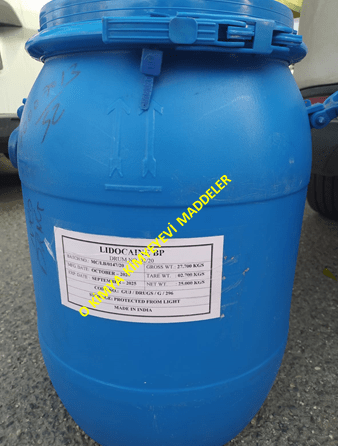
LIDOCAINE PACKAGING
Product Documents | |
What is Lidocaine?
Molecule Formula (Lidocaine): C14H22N2O
Molecular Weight: 234.34 g/mol
Chemical Name: 2-(Diethylamino)-N-(2,6-dimethylphenyl)acetamide
CAS Number: 137-58-6
It is a chemical compound with anesthetic properties belonging to the antiarrhythmic class. Another name for it is Xylocaine. It is a local anesthetic that has replaced procaine in recent years. It is a monocarboxylic acid.
It is a synthetic aminoethylamide. Ion channels in the body, such as Sodium, Potassium, and Calcium channels, are known as voltage-gated channels.
Lidocaine exhibits its inhibitory effect by binding to voltage-gated sodium channels among these, thereby stabilizing the neuronal membrane. Consequently, it stops the ionic flux system required for the initiation and conduction of impulses, facilitating local anesthesia. This is caused by the neurons of local tissues being unable to send sensory signals to the brain.
Other Names Are As Follows;
Xylocaine
Anestacon
L-Caine
Lidocaine
Lidocaine
137-58-6
Lidocaina
HCl
Hydrochloric Acid
Base
How is Lidocaine Produced?
Lidocaine production is carried out by the acylation reaction of 2,6-Dimethylaniline with Chloroacetyl Chloride, which belongs to the class of carboxylic acids, and the subsequent reaction of the resulting intermediate with diethylamine.
During the production process, 2,6-Dimethylaniline is reacted with chloroacetyl chloride in glacial acetic acid (99%-100%). Sodium acetate is then added to the reaction mixture. The obtained product (chloroacetyl-2,6-dimethylanilide) is boiled with diethylamine in an inert solvent (Benzene).
In the next stage of lidocaine production, a drying process is carried out. Lidocaine crystallizes upon the removal of water molecules, and a high-purity product is obtained.
What are the Physical and Chemical Properties?
In terms of physical appearance, it is a white crystalline chemical compound in needle-like form.
The melting point is in the range of 68 °C to 69 °C.
The boiling point is between 180 °C and 182 °C.
Density: 1.02 g/cm³.
In terms of solubility, Lidocaine dissolves in Ethyl Alcohol. It is also soluble in ether, chloroform, water, and oil. The HCl form dissolves easily in water, but the Base form is practically not easily soluble in water.
The most commonly used form, Lidocaine Hydrochloride (H14H22N2O.HCl), has a white crystalline powder form. The monohydrate form is insoluble in water (this form is referred to as Base). It is soluble in alcohol and has a bitter taste.
What are the Usage Areas of Lidocaine?
Due to its high solubility in oil, it has the ability to act faster than amino ester local anesthetic compounds such as procaine and tetracaine. It also has long-lasting efficacy.
It is an important anesthetic used in epidural anesthesia.
In pediatric patients, it is used parenterally or topically as an eutectic mixture, alone or in combination with prilocaine or etidocaine.
Lidocaine is used in pharmaceutical creams or lotions to treat inflammatory skin problems.
It is used for the local numbing of the surgical area during surgery.
It is administered via injection to eliminate rhythm disorders in patients who have had a heart attack.
By inhibiting sodium channels, it prevents the relevant area from sending signals to the brain. As a result, no pain or ache is felt. It is an anesthetic chemical used in such applications.
In oral care and dental health activities, numbing is performed on the palate before tooth extraction or procedures. Local anesthetic creams containing lidocaine are used before numbing with a needle. It is a local anesthetic agent in the production of these creams.
It is used as an active ingredient in the manufacture of percutaneous absorption type local anesthetic creams. In addition, Triethanolamine 85%, Polyvinyl Alcohol, and CMC (Carboxymethyl Cellulose) are used as excipients.
In the manufacture of male genital desensitizers, it is used with substances such as ethyl alcohol and glycerin. In this application, it penetrates the nerves in the stratum corneum and reduces absorption into the bloodstream.
It is used in the manufacture of local anesthetics produced for use in gel form and via injection.
It is used in medicines produced in gel form to reduce or eliminate allergic itching by creating local numbness in the itchy areas. In these applications, the water-soluble form, Lidocaine Hydrochloride, is used.
At the laboratory level, some research is being conducted on Lidocaine. These studies include its anti-tumor activities, focusing on details regarding the suppression of colon cancer proliferation and the death of cancerous cells.
What are the Factors Affecting Prices?
The price of Lidocaine depends directly on the prices of the chemicals used in its production. As the prices of Chloroacetyl Chloride and Acetic Acid increase, the price of this chemical substance will increase. As Diethylamine prices increase, the price of Lidocaine increases.
Companies selling Lidocaine control prices based on their stocks. As stocks decrease, the price of Lidocaine increases.
Companies that are distributors of Lidocaine keep the sales and stock status of this chemical substance under control. The best prices are provided by distributor companies.
Lidocaine Sales
Chemical substances are packaged in packages determined by international standards. These are sold starting from the smallest package to the largest package or in bulk with tanker. These can be 1 gram packaging, 1 ton big bag packaging, the smallest drum packaging, or packaging-free sales with tanker.
All information here should be used in accordance with the legislation by expert people and professionals in the field.