

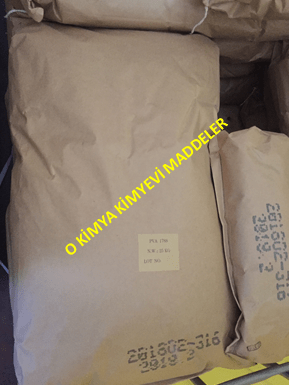
POLYVINYL ALCOHOL PACKAGING
Product Documents | |
What is Polyvinyl Alcohol?
Molecular Formula (Polyvinyl Alcohol): (C2H4O)x
Molecular Weight: 44.053 g/mol
Chemical Name: Polyvinyl Alcohol
CAS Number: 9002-89-5
It is a polymer prepared from polyvinyl acetates by replacing acetate groups with hydroxyl groups. Polyvinyl Alcohol (PVA) is a water-soluble synthetic polymer obtained through the polymerization of vinyl alcohol.
To date, PVA has not been found to occur as a natural chemical.
It has both hydrophilic and hydrophobic functional groups. Therefore, it is used as a surfactant in some production processes.
The grades of this raw material vary according to their molecular weight and degree of hydrolysis. Molecular weight is generally expressed in terms of solution viscosity.
Emulsions made with Polyvinyl Alcohol and surfactants, wetting agents, defoamers, and thickeners become vulnerable to microorganisms.
Other Names Include:
PVOH
PVA
Ethenol
Vinyl Alcohol
Hydroxyethene
Ethenol, homopolymer
9002-89-5
Ethenol Homopolymer
Poliviol
Polyviol
Polydesis
PVA 24 88
PVA 17 88
PVA 05 88
How is it Produced?
Polyvinyl Alcohol production is achieved through the hydrolysis of Polyvinyl Acetate. The key raw material for creating PVA is the vinyl acetate monomer. It is obtained by the polymerization of Vinyl Acetate.
Subsequently, it undergoes partial hydrolysis, completed in the presence of aqueous sodium hydroxide, where the ester group in Vinyl Acetate is partially replaced by a hydroxyl group. Polyvinyl Alcohol (PVA) is gradually precipitated from the aqueous saponification agent. It is then washed, dried, and packaged.
What are its Physical and Chemical Properties?
It is odorless and non-toxic. It is resistant to oils and Solvents.
PVA is a white, odorless, tasteless, and water-soluble chemical.
Its pure aqueous solutions are neutral or slightly acidic.
It has the appearance of translucent, white, or cream-colored granules.
Its melting point ranges from 212 °C to 267 °C.
In terms of solubility, it is highly soluble in water. It is sparingly soluble in Ethanol. The solubility of Polyvinyl Alcohol increases as its molecular weight decreases.
It is insoluble in other organic solvents.
Its density is in the range of 1.19 – 1.31 g/cm³.
Regarding stability, it is stable under standard storage conditions.
A 4% solution has a pH range of 5.0 – 6.5.
Its most important physical and chemical properties are viscosity and degree of hydrolysis. For example, a solution of PVA 24 88 at the same concentration is more viscous than PVA 17 88.
As the degree of hydrolysis increases, its ability to dissolve faster increases.
Commercially, the most important properties of Polyvinyl Alcohols are their viscosity, degree of hydrolysis, and degree of polymerization. The PVA 24 88 product has a viscosity of approximately 47 mPas, PVA 17 88 has a viscosity of approximately 24 mPas, and PVA 05 88 has a viscosity of approximately 5 mPas. This viscosity is referenced from 4% aqueous solutions.
Properties of Polyvinyl Alcohol-Based Binder Fibers
These fibers are used in the production of paper and non-woven fabrics. When PVA binder fibers are used in this application, they exhibit good melting capability and high adhesion during drying.
In such applications, PVA resin with a low degree of saponification or ionic functional groups can be used. These ionic functional groups can be compounds like quaternary ammonium compounds or carboxyl groups. Alternatively, a cationic group can be added. This increases the solubility of the resulting resin.
To increase the solubility of the resin, PVA with a low degree of saponification is used. At the same time, the degree of polymerization of the PVA resin must be low to increase its solubility.
Where is Polyvinyl Alcohol (PVA) Used?
It is used as the main component in the preparation of Polyvinyl Butyral.
It is used as a protective colloid in many parts of the world. Stabilizers are used for some aqueous dispersions and emulsions. These stabilizers can be PVA-based protective colloids. Additionally, Sodium Polyacrylate, Carboxymethyl Cellulose, and Hydroxyethyl cellulose can also be used in such applications.
It is used to make polyvinyl acetate dispersions.
In the production of tablet-form pills for the common cold, it is used along with Ascorbic Acid, the active ingredient of the drug, xanthan gum, and Microcrystalline cellulose for its binding properties.
It is used for emulsion polymerization in the production of Vinylon.
It is used as a protective colloid in carpet coating compositions. The usage rate can be between 0.05% and 4% of the total emulsion amount.
It is very widely used in the manufacture of adhesives. It is also used in industry and agriculture for emulsion polymerization.
It is used in film formation and packaging manufacturing.
Its adhesive properties are utilized to produce high-speed corrugated cardboard. A reaction initiator is also used, which is usually Hydrogen Peroxide.
It is used as a thickening agent in anti-fading compositions for the manufacturing of titanium and titanium alloy coating materials.
What are Other Areas of Use?
It is modified and saponified with chemicals from the Polyhydric Alcohol group, such as 1,3-Butylene Glycol and Monoethylene Glycol, to be used in the manufacture of water-soluble films.
PVA is also used in the cementing, paper, textile, ceramic, and seed coating industries.
To obtain PVA gels with high elasticity, a small amount of Acetone and Polyethylene Oxide must be used as a solvent. This strengthens the cross-linking and extends the relaxation times, helping it exhibit stronger elastic behavior in a short frequency range.
The degrees of hydrolysis are very important in the use of PVA. To determine the application area for this chemical, it is necessary to first identify the one with the correct properties.
It is used as a suspension chemical in the polymerization of vinyl acetate and vinyl chloride.
It is used as a pigment binder in paper coatings. It is used to improve the smoothness of the paper surface, reduce its uneven appearance, and ensure that the ink penetrates the paper surface well during printing.
For the treatment of acne, hyperpigmentation, and keratinization disorders, it is used together with Monopropylene Glycol, Disodium EDTA, and Retinoic Acid, utilizing its adhesive effect in this application. It thus binds the other components together, making the face mask easier to peel off.
Polyvinyl Alcohol is used in the production of hydrogels that act as carrier organisms for microorganisms in wastewater treatment processes.
What are Other Areas of Use?
Polyvinyl alcohol (PVA) is preferred in the manufacture of printed hydrographic films due to its ease of use.
It is used as the main component to produce clear contact lenses.
It is used as a binding agent in the manufacture of nasal tampons.
In the textile industry, it is used for textile warp sizing.
In pharmacology, it is used in solutions produced to relieve eye dryness. Its function here is as a lubricant.
In the seed industry, it is used to coat the outer surface of seeds.
Polyvinyl Alcohol is mixed with additives such as Calcium Carbonate, sodium bicarbonate, polyvinylpyridine, and polyvinylpyrrolidone and used in the manufacture of toilet blocks and devices that sterilize the air.
PVA is used as a release agent to prevent FRP rods produced by the pultrusion method from sticking to each other.
It is used for distribution systems in the manufacture of pesticides, herbicides, and fertilizers due to its water-soluble and biodegradable properties.
It is used to prepare Urea-Formaldehyde Vinyl Alcohol solutions or resins for preparing wood surfaces with high abrasion resistance.
It is used in the production of vascular stents through 3D printing of cross-linked polyvinyl alcohol, followed by a series of reactions and processes. This makes it resistant to complex tissue printing.
In sustainable agriculture practices, PVA-based hydrogels can be used to increase the water retention capacity of the soil and for the controlled release of fertilizers. Hydrogels made using Soy Protein together with Polyvinyl Alcohol hold great potential in agricultural applications.
What are the Physical Methods for Designing Biomaterials Used in Biomedical Applications with Polyvinyl Alcohol?
It is a biosynthetic or biocompatible polymer that is non-toxic and can form hydrogels through chemical or physical cross-linking.
With Polyvinyl Alcohol (PVA), chemical cross-linking provides more control over the properties of the resulting hydrogel.
Physically cross-linked hydrogels or blends with another biocompatible polymer are more suitable for biomedical applications.
With the advancement of technology and medicine, interest in biocompatible and biodegradable polymers used to create scaffolds in the field of tissue engineering is increasing over time.
There are primary requirements for designing a scaffold in tissue engineering.
These are;
High Porosity
Interconnected porous structure
Large surface area
A microenvironment that allows for the adhesion, proliferation, differentiation, and preservation of the cell phenotype
Many different polymers, including hydrogels, have been researched and used in the field of tissue engineering.
Polyvinyl Alcohol is a water-soluble, non-toxic, biocompatible polymer that enables hydrogen bonding through the hydroxyl (OH) groups contained in its repeating units.
It can form hydrogels through chemical or physical cross-linking pathways, providing high water content.
It is briefly referred to as PVA. Sometimes, using it as Polyvinyl Alcohol can cause confusion for some sellers or users.
It is known in the market as PVA 1788. It causes foaming during application. Therefore, it creates undesirable properties in products.
However, the advanced version of Polyvinyl Alcohol, 1788 A, eliminates foaming during application. This is because PVA 1788 A has the anti-foaming properties of PVA 1788.
Therefore, PVA 1788 A is a more attractive type.
What Factors Affect Its Price?
The price of Polyvinyl Alcohol has been on a continuous upward trend throughout its history.
The price of PVA is directly linked to the prices of the chemicals used in its production. As the price of Polyvinyl Acetate increases, the price of this chemical will also increase.
Its price will increase as the application areas of PVA expand. The price of PVOH also depends on the production of Vinyl Acetate. If Vinyl Acetate production decreases, the price of PVOH will increase.
Polyvinyl Alcohol (PVA) prices also depend on the inventory systems of companies that wholesale Polyvinyl Alcohol (PVA). For example, if a company that sells Polyvinyl Alcohol (PVA) cannot maintain adequate stocks of Polyvinyl Alcohol (PVA), the prices for Polyvinyl Alcohol (PVA) will increase in that region.
Polyvinyl Alcohol Sales
Chemical substances are packaged in packages determined by international standards. These are sold starting from the smallest package to the largest package or in bulk with tanker. These can be 1 gram packaging, 1 ton big bag packaging, the smallest drum packaging, or packaging-free sales with tanker.
All information here should be used in accordance with the legislation by expert people and professionals in the field.