

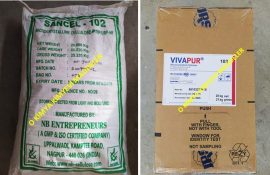
 MICROCRYSTALLINE CELLULOSE PACKAGING
Product Documents |
|
| MICROCRYSTALLINE CELLULOSE ANALYSIS CERTIFICATE | |
What is Microcrystalline Cellulose?
Molecular Formula (Microcrystalline Cellulose): C14H26O11
Molecular Weight: 370.35 g/mol
Chemical Name: Microcrystalline Cellulose
CAS Number: 9004-34-6
It is a substance also known as cellulose. It acts as a binding agent applied to pharmaceuticals and food supplements. Cellulose is an important factor found in green plant cell walls. It is the most abundant natural polymer in the world.
In cases where the polymer structure is not very large (cases where the number of repeating units is less than 200), cellulose becomes microcrystalline cellulose.
It is an organic hydrocolloid with the ability to disperse in water.
Microcrystalline cellulose processed with cellulose is called silicified MCC. It is a form developed for wet granulation products. It has compressibility properties. In this way, it has binding and diluting properties.
Microcrystalline Cellulose E Code: E460
Other Names are as Follows;
- Cellulose
- Microcrystalline cellulose
- MCC 102
- Gel Cellulose
- Hydroxymethyl Cellulose
- MCC
- 9004-34-6
- E 460
- MCC 101
How is Microcrystalline Cellulose Produced?
The production of this substance is partially depolymerized pure cellulose synthesized from α-cellulose.
It is obtained by the depolymerization of highly purified wood pulp. It is combined with sodium carboxymethyl cellulose because the original crystal regions of the wood pulp in the crystalline structure act as a protective colloid and also have a positive effect on the dispersion of the obtained substance.
In the subsequent process, it is dried by spraying or spreading methods.
Microcrystalline Cellulose (MCC), obtained as wood pulp from plant fibers, can be hydrolyzed with dilute mineral acid.
What are the Physical or Chemical Properties?
In terms of physical appearance, it is in the form of a fine white to almost white crystalline powder.
It is odorless.
The pH is between 5.0 and 7.5.
Its density at 20 °C is 1.5 g/cm3.
Melting Point is in the range of 76-78 °C.
Boiling Point: No information available.
It is a stable chemical in terms of stability. It has flammable properties. It is incompatible with oxidizing agents.
In terms of solubility, it does not dissolve in water. It is practically insoluble in acetone, anhydrous ethanol, toluene, dilute acid, and sodium hydroxide solution.
What are the Usage Areas of Microcrystalline Cellulose?
- It is used as a bulking agent, i.e., a thickening agent, for foams and emulsions.
- It is used as a stabilizer in pharmaceutical production.
- It is used in the manufacture of milk chocolate to provide consistency and keep particles in suspension. This also allows for less milk usage.
- It can also be used as an anti-caking agent, stabilizer, and extrusion aid.
- In tablet production, it acts as a matrix to keep active ingredients together and prevent them from dispersing.
- It is a carbohydrate polymer consisting of glucose units. It is used as a fiber source and bulking agent by companies producing food supplements.
- It is used in tablets and capsules as a non-nutritive filler, to add binding properties, and as a preventive agent in some food supplements.
- In the production of frozen desserts, it is used for its heat shock stabilizing and body-building properties.
- It is used together with polyvinyl alcohol (PVA) as a binder, Xanthan Gum for its thickening property, Talc used as a filler, and pseudoephedrine hydrochloride as an active ingredient in medicines produced for the common cold. Ascorbic Acid is also used as a source of Vitamin C.
- It is an excipient with very good disintegration and binding effects due to its compressibility properties in tablet formulations.
- It is used as a thickener in the production of concentrated Salicylic Acid gel, which is used for the safe transport of Salicylic Acid.
- Fermentation release tablets are used for the controlled progress of fermentation during wine production. Microcrystalline Cellulose is used in these tablets to regulate the disintegration rate of the tablet so that the release can be achieved in a stable amount.
- It provides an increase in volume in confectionery manufacturing and also controls moisture adsorption.
- In the production of rubber composites, these properties can be provided by partially replacing with Silica to lower the energy required during dispersion within the rubber matrix, to lower the Mooney viscosity of rubber composites, to lower the apparent shear viscosities, and to lower the apparent shear stress of rubber composites.
- In the food industry, it is used to increase the consistency of the drying-providing mixture in freeze-drying processes. MCC stands out as an important component, especially for the preparation of fruit purees.
- It provides high absorption in baby powder due to its low density.
- It is used in the production of liquid and frozen yogurt to give consistency and to ensure that fruit particles or other solid particles remain suspended in the yogurt.
- It is used together with carboxymethyl cellulose in the production of antipyretic syrups.
- It is used to produce magnesium supplements in the production of tablets containing Magnesium Carbonate.
- Carboxymethyl cellulose is used in pulps to increase mycelial release in oyster mushroom production.
- It is used in the production of chewable tablets as a bulking agent and to ensure the tablets are in the desired size and shape.
- It is mostly used in pharmaceutical, food, and cosmetic preparations.
- MCC is used during the calcination of extrudates due to its combustible filler property. This eliminates the need for a lubricant and binder.
- It is used in whey protein powders and beverages containing whey.
- It is a chemical compound used as a binder and to ensure flowability in the production of drugs in tablet form.
What are the Factors Affecting its Prices?
Microcrystalline Cellulose price is directly dependent on the prices of the chemicals used in its production. As the prices of the materials used in its production increase, the price of this substance will increase. As Carboxymethyl Cellulose (CMC) prices increase, this chemical will increase in price.
Prices are directly dependent on usage areas. Its usage has increased with the rise of gyms. This situation has caused prices to rise from past to present.
When companies that are distributors of Microcrystalline Cellulose increase their stocks, prices will drop for a short period.