

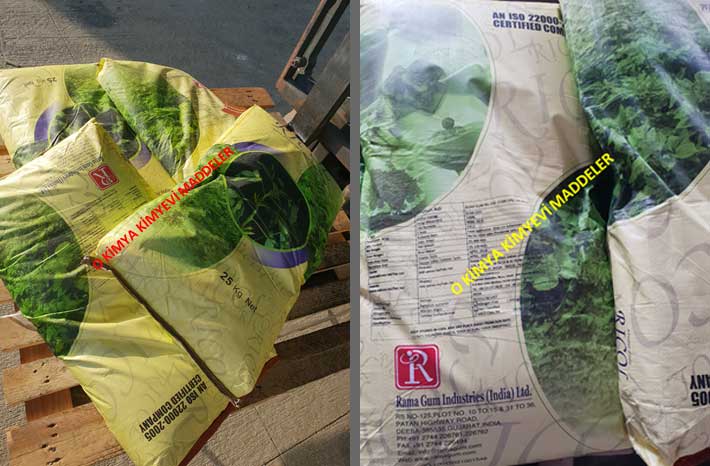
 GUAR GUM PACKAGING
Product Documents |
|
| GUAR GUM CERTIFICATE OF ANALYSIS | |
What is Guar Gum?
It is also known as guaran. It is obtained from the guar plant. Guar possesses many unique properties, which has given it a significant role among domesticated plant species.
Guar Gum is a natural potential source of protein, containing approximately 42% crude protein.
Guar Gum is a common powdered product widely used for stabilizing, emulsifying, and thickening certain foods and industrial products. It is of vegetable origin.
Guar Gum is a type of galactomannan. It is produced by a method similar to other seed gums, which are created by grinding the endosperm (seeds) of legumes or grains. It has a galactose to mannose ratio of 1:2.
Guar Gum is low in calories and high in fiber. This helps you feel fuller after a meal.
Guar Gum has the ability to absorb a large amount of fluid in the digestive system. It has been found to be more functional compared to similar products used as thickening agents in foods, such as corn starch and locust bean gum.
The most important property of Guar Gum is its ability to hydrate very quickly in cold water to achieve very high viscosity, even at very low concentrations. Its colloidal nature gives the solution a thickening power 6-10 times greater than that of starch. It is stable over a wide pH range.
This substance increases the fluidity and pumpability of fluids. Due to its structure, it has a superior friction-reducing effect.
Crude Guar Gum is a white to grayish-white powder, 90% of which is soluble in water.
Guar powder is typically a free-flowing, pale, off-white powder.
It has been found to exhibit therapeutic properties in cases of physiological disorders.
Other names include:
- Guaran
- Guar Gum
- Guar Plant
- 9000-30-0
- Stabilizer
- Thickener
- Thickening Agent
What are its Physical and Chemical Properties?
In appearance, it is a yellowish-white solid chemical.
It is a stable chemical, in the form of a fine powder. It is incompatible with strong oxidizing agents.
Chemically, it is an excellent viscosity modifier.
The viscosity of Guar Gum is highest in the pH range of 6 to 8. It begins to decrease as the pH drops from 6 to 3.5. Below pH 3.5, its viscosity increases as the pH decreases.
Its main structure consists of polysaccharides. Its viscosity is approximately 5-8 times that of starch.
Density: 1.2 – 1.4 g/cm³
Melting Point: Not available
Boiling Point: Not available
Solubility: Soluble in water
What are the Oil and Drilling Applications of Guar Gum?
It is widely used to enhance the recovery of oil and natural gas from geological formations.
Hydraulic fracturing, also known as fracing, is a technique used to increase the extraction of oil and natural gas trapped deep within the Earth's crust, especially in shale rock formations.
In the Oil and Gas industry, Guar Gum is utilized for its thickening properties. By creating high-viscosity water, it facilitates the extraction of natural gas and oil from between rock formations.
Large quantities of Guar slurry are required by oil and drilling companies for every stage of the hydraulic fracturing process.
It is used to thicken the water pumped into underground rock formations. In drilling operations, the addition of Guar Gum increases the viscosity of fluids, thereby significantly improving the efficiency of pumping and fracturing under high pressure.
This allows for a smoother flow of gas and oil to the surface.
What are the Pharmaceutical Applications of Guar Gum?
Substances like lipids, proteins, carbohydrates, and polysaccharides are natural polymeric materials. They are used as excipients in pharmaceuticals to control the release of the drug in the dosage form.
Among these, Guar Gum has become a popular pharmaceutical excipient due to its ability to form viscous dispersions or gels in aqueous environments.
The most important characteristics for its use in pharmaceuticals are its non-toxicity and its excellent viscosity-providing properties. It is well-suited for solid, liquid, and semi-solid dosage forms.
Roles of Guar Gum in Pharmaceuticals:
- Disintegrating Agent
- Binding Agent
- Film-Forming Ability
- Sustained-Release Agent
- Viscosity Enhancer
- Thickener
- Stabilizer
- Emulsifier (Phase mixer)
- Suspending Agent (Cellulosic effect)
- Bio-Adhesive Agent
It functions in these roles.
What are the Usage Areas of Guar Gum?
- Its primary area of use is the food industry, where it is used as a stabilizer.
- It is used as a thickener/thickening agent in foods.
- In the production of poultry feed, guar gum induces a feeling of fullness and causes physical bulking when consumed by animals. Its 42% protein content makes it an excellent nutritional supplement.
- In gluten-free products and baked goods, it is one of the most frequently used binding gums. In this application, it helps retain water and air, making gluten-free doughs less crumbly.
- It is an excellent product for holding texture together. It helps impart crispness, elasticity, or bounce to products like cakes, bread, and pizza dough without using high levels of gluten.
- It is used in the manufacturing of processed food additives and cereal products.
- In the cosmetics industry, its use in liquid products like foundation and blush ensures better application on the skin.
- Guar gum is used in making yogurt and fruit sorbets to aid in thickening and maintaining a homogeneous texture.
- As a bulking agent, it is used to add volume to fiber supplements or laxatives.
- It is used to help increase the feeling of satiety.
- In the food industry, it is generally utilized for its thickening, emulsifying, and stabilizing properties. Due to these properties, Guar Gum also has beneficial applications in the following industrial sectors.
What are Other Usage Areas?
- In the manufacture of pet food and veterinary supplements, it is used as a thickener and gelling agent to retain water and keep ingredients in suspension.
- In the pharmaceutical industry, powdered Guar Gum is used as a disintegrant in capsule-type drugs. In this context, it acts as a binder before digestion. The rate, amount, and timing of drug breakdown in the body can be controlled with Guar.
- In the cosmetics industry, it is added to toothpaste and similar products to ensure stable tube extrusion. It imparts texture to creams and lotions, providing thickening capabilities.
- In the paper industry, a denser surface layer is created for easier writing, which is achieved with Guar Gum. Its adhesive properties improve the paper's erasability and writability. Guar Gum also aids in paper folding. Sheet formation in the paper industry is accomplished with this substance.
- In the textile industry, it is used as a thickener for sizing, finishing, and printing. Its flexibility factor reduces warping and sticking. Its emulsifying property helps reduce dust formation, leading to more efficient production.
- The Petroleum Industry is one of the main sectors that uses Guar Gum. It is used as a suspending agent, stabilizer, surfactant, synthetic polymer, and thickener in well fracturing, shale oil extraction, oil well stimulation, and mud drilling.
- In this field, Guar Gum reduces friction, minimizing power requirements. It also maintains the viscosity of drilling muds to facilitate the removal of drilling debris from deep wells.
- In the mining industry, Guar Gum is used as a flocculant to separate solids.
- It is among the thickening agents used during the freeze-drying of fruits. Pectin can also be used in this application.
- Guar Gum is used as a binding agent in tablets for some applications.
- It is used as a thickener in the production of car shampoo.
- Certain soluble fibers are used in the treatment of Type II diabetes, and Guar Gum has recently emerged as a prominent choice.
- To produce toothpaste, a thickening and binding agent is needed. Therefore, its thickening and binding properties can be utilized.
What Factors Affect its Price?
The price of Guar Gum has been steadily increasing since its use expanded from India to the rest of the world.
Guar Gum prices rise as its applications increase.
Prices may experience short-term drops due to an increase in Guar Gum production facilities. However, they are expected to stabilize after a certain period.
The price varies according to the inventory levels of the companies selling Guar Gum. As their stocks increase, its price increases.