

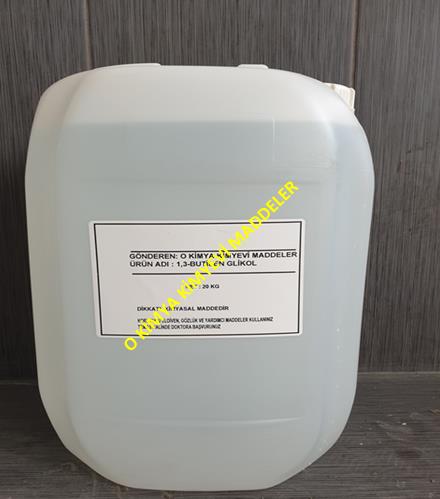
 1,3 BUTYLENE GLYCOL PACKAGING
Product Documents |
|
| 1,3-BUTYLENE GLYCOL (1,3-BUTANEDIOL) CERTIFICATE OF ANALYSIS | |
What is 1,3-Butylene Glycol (1,3-Butanediol)?
Molecular Formula of 1,3-Butylene Glycol (1,3-Butanediol): C4H10O2
Molecular Weight: 90.12 g/mol
Chemical Name: 1,3-Butanediol
CAS Number: 107-88-0
1,3-Butylene Glycol (1,3-Butanediol) is a polar organic solvent with a very high boiling point used in organic applications. It belongs to the polyhydric alcohol class.
It is a chemical in the glycol class. It has the appearance of a colorless, clear, fluid liquid.
It is used as an alternative chemical when Propylene Glycol or Glycerol are used.
It has high purity and no odor problems. It has very good moisturizing properties.
Other Names Are As Follows;
- 1,3-Butanediol
- Butyl Glycol
- 1,3-Butane diol
- 1,3-Butylene Glycol
- 1,3-Dihydroxybutane
- 1-Methyl-1,3-propanediol
- Methyltrimethylene Glycol
- Beta-Butylene Glycol
- 1,3-Butanodiol
- b-Butylene Glycol
- Butane-1,3-diol
How is it Produced?
Butylene Glycol is produced using Ethyl Alcohol as the starting chemical. The reason for using Ethyl Alcohol is that it is inexpensive and easily obtainable.
The production of 1,3-Butylene Glycol (1,3-Butanediol) involves converting an Ethyl Alcohol solution to Acetaldehyde in the presence of an NaOH solution through an electrochemical reaction. Then, an integrated reaction is carried out in the anode compartment of a divided electrolytic cell, and another integrated reaction is conducted in the cathode compartment, with all these reactions running concurrently.
During the production of 1,3-Butylene Glycol, Ethyl Alcohol is oxidized to Acetaldehyde in the anode compartment of an electrolytic cell. The Acetaldehyde formed in this process is condensed to aldol. And the aldol is reduced to 1,3-Butanediol in the cathode compartment of an electrolytic cell.
This production process for 1,3-Butylene Glycol (1,3-Butanediol) requires high energy. This makes it one of the largest costs in its production.
Recently, research has been conducted on the production of biomass-based 1,3-Butylene Glycol. However, this first requires the development of microorganisms that can catalyze this production.
What are the Physical and Chemical Properties of 1,3-Butylene Glycol (1,3-Butanediol)?
It is a chemical with a colorless, fluid, and clear appearance.
Its boiling point is between 203°C - 204°C. The pH value of 1,3-Butylene Glycol is between 6-7 at 20°C. This means that temperature affects the pH value of 1,3-Butylene Glycol.
Its melting point is below 50°C.
Its flash point is 108°C.
The density of 1,3-Butylene Glycol is 1.005 g/cm³. This density is valid for a temperature of 20°C.
In terms of solubility, 1,3-Butanediol is soluble in water. It is also soluble in Aliphatic Hydrocarbons, benzene, toluene, and Carbon Tetrachloride. It is slightly soluble in ether.
What are its Effects on Human Health?
1,3-Butylene Glycol may cause skin irritation. It may cause serious eye irritation.
In case of exposure through the respiratory tract, it can lead to serious problems. Therefore, if exposure to this chemical occurs, respiratory tract irritation and abrasion may happen.
How is it Stored?
During storage, 1,3-Butanediol should not be placed in areas exposed to direct sunlight. It should be stored in the same area with chemicals of the same class. It must be kept away from incompatible chemical substances according to ADR standards.
What are the Usage Areas of 1,3-Butylene Glycol (1,3-Butanediol)?
- 1,3-Butylene Glycol is a very widely used organic solvent in the production of flavoring agents.
- It is a co-monomer used in some polyurethane and polyester resins.
- In the field of biology, it is used as a hypoglycemic agent.
- 1,3-Butylene Glycol can be used to soften the skin and for its cleansing effect in components produced for hair curling and straightening purposes.
- It is used as a formulation aid in the production of sausage casings.
- 1,3-Butylene Glycol is used as a water-soluble solvent in cosmetic formulas containing Flavonoids and Vitamin B to prevent skin hyperpigmentation and wrinkles.
- It is used as an intermediate in many areas of the industry.
- It is used for its moisturizing property in the manufacturing of mosquito repellent body lotions. Xanthan Gum is used as a thickener.
- It is used in the manufacture of skin creams produced for wrinkle filling to increase Hyaluronic Acid synthesis. It also prevents water loss from the skin.
- In the cosmetics industry, 1,3-Butylene Glycol forms a barrier that prevents cosmetic products from losing moisture and drying out after they are manufactured.
- Also in the cosmetics industry, it helps prevent the crystallization of insoluble chemicals. 1,3-Butylene Glycol (1,3-Butanediol) is a highly preferred chemical for this property.
- Compared to similar organic compounds like Propylene Glycol, Glycerol, and Sorbitol, 1,3-Butylene Glycol (1,3-Butanediol) can be considered the most potent antimicrobial agent among them.
- It is used as a high-quality moisturizing agent in scalp treatment shampoo formulations.
- It acts as a solvent and moisturizing agent in skin lightening cosmetic ingredients.
- It is highly effective in removing and inhibiting fungi, mold, and yeasts, more so than gram-positive and gram-negative microorganisms.
- It is used in the manufacturing of skin care and hair care products.
- It is used in the manufacturing of synthetic rubber resins.
- It is used to enhance the effectiveness of preservatives used in the cosmetics industry. A very small amount can significantly reduce the quantity of the preservative chemical needed.
- It is used as an auxiliary substance in the manufacture of creams produced with caffeine to reduce puffiness around the eyes.
- It can be used instead of mono propylene glycol along with caffeine to reduce puffiness around the eyes.
What Factors Affect Its Price?
The price of 1,3-Butylene Glycol is directly dependent on the price of Ethyl Alcohol. As the price of ethyl alcohol increases, the price of 1,3-Butylene Glycol will also increase.
Its price shows a direct correlation with the inputs in its production process. As the prices of raw materials used in its production increase, the price of 1,3-Butanediol will also increase.
The price of Butylene has shown a rapid increase in recent years with the expansion of its application areas.
In recent years, it has increased due to the positive attitude of people towards the cosmetics industry. This is because one of the most common uses of 1,3-Butylene Glycol (1,3-Butanediol) is in cosmetic products.
The price of 1,3-Butylene Glycol is directly proportional to the energy cost used in its production. Therefore, as energy prices increase, its price will also increase.