

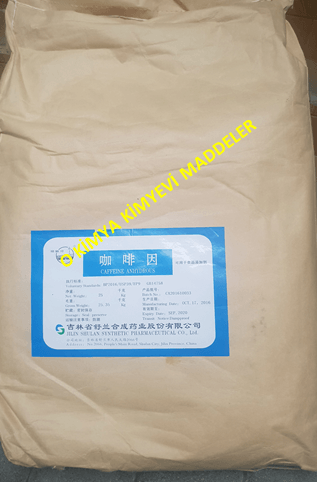
Product Documents |
|
| CAFFEINE ANALYSIS CERTIFICATE | |
What is Caffeine?
Molecular Formula (Caffeine): C8H10N4O2
Molecular Weight: 194.194 g/mol
Chemical Name: 1,3,7-trimethylxanthine
CAS Number: 58-08-2
It occurs naturally in some beverages. In addition, it is a methylxanthine used as a pharmacological agent. It is also a purine alkaloid.
Caffeine is structurally related to Adenosine and primarily acts as an adenosine receptor antagonist in psychotropic and anti-inflammatory activities.
It is a methylxanthine alkaloid that can be found in the seeds, nuts, or leaves of some plants native to South America and East Asia.
In short, it is an alkaloid compound with stimulant effects. It is found in the fruits, seeds, and leaves of approximately 60 plants. It has the property of paralyzing insects that feed on these plants. Therefore, caffeine acts as a natural insecticide.
This compound is not a nutrient. It acts as a dietary component with stimulant properties in the body.
It is a chemical compound produced by the extraction method within the scope of FEMA 2224.
According to some authorities, the daily caffeine requirement of a person is a maximum of 300 mg/day. Consumption above standard values may cause blood pressure, heartburn, and habit formation.
Other Names for Caffeine are as Follows;
- Guaranine
- Caffeine
- Caffeine
- Methyltheobromine
- 1,3,7-trimethylxanthine
- Anhydrous Form
- 58-08-2
- Hycomine
- Synthetic Form
How is it Produced?
Caffeine production is carried out by solvent extraction from green coffee beans and tea leaves. The high-pressure extraction process called Zosel contains specifically selected less toxic properties in the presence of supercritical carbon dioxide. It is a more complex caffeine production system resulting in safe removal.
In the circular economy, coffee grounds emerge as waste in large coffee restaurants. These coffee grounds are extracted with supercritical fluid technology. Here, coffee oil and coffee fiber are obtained. Caffeine can be isolated from coffee oil with some solvents and water &glycerol.
What are the Physical and Chemical Properties?
It is found in solid form as an odorless white powder or white shiny needles. It has a bitter taste. It has white, prismatic crystalline properties.
Boiling point is 178 °C.
Melting point is 235 °C.
Caffeine solubility is 21,600 mg/L at 25 °C. It dissolves in pyridine. It dissolves freely in pyrrole. It has a slight solubility in petroleum ether.
Solubility in water is good, but it crystallizes when returned to room temperature. To prevent this crystallization, the amount of dissolved caffeine should not exceed a certain ratio. At the same time, a certain amount of Mono Propylene Glycol should be mixed.
In addition, it dissolves freely in Tetrahydrofuran containing 4% water in terms of solubility.
Its density is 1.23 g/cm3.
Caffeine solubility does not increase as the amount of co-solvent increases. For example, as the concentration of solvent mixes such as Isopropyl alcohol, Ethyl Alcohol, 1.3 Butylene Glycol increases, the solubility decreases.
It has good solubility in Trichloroethylene. It has significant effects for separating impurities. Precipitates are separated with this solvent and caffeine is recovered.
What is the Mechanism of Action of Caffeine on the Body?
Due to its structure, caffeine has a stimulant effect on the central nervous system. CNS stimulants accelerate physical and mental processes. Its molecule is similar to drugs. It has the ability to cross the blood-brain barrier easily. The blood-brain barrier serves to protect the Central Nervous System (CNS). Normally, many drugs cannot pass through the blood-brain barrier. However, its molecule can easily pass through this area.
The exact reason for this due to the structure of caffeine is not known. However, some researchers can explain the reason as follows:
Having the ability to easily pass through all membranes as a result of dissolving in both water and oil due to its chemical structure.
The molecule can easily pass across the blood barrier by binding to an adenosine-derived carrier.
Most Suitable Time to Use Caffeine
It can show its effect in almost every system where our central nervous system is involved or supported in our body.
It performs the opposite action of Adenosine. It is also an antagonist found in the A1 receptor.
It has a tendency to perform the mobilization of free fatty acids before exercise. Therefore, the use of caffeine before exercise provides weight loss as a result of fat burning.
The most known mechanism of action works by reducing adenosine transmission in the brain.
What are the Usage Areas of Caffeine?
- In medical drugs, it is used in the manufacture of some drugs as a CNS respiratory stimulant.
- It is used together with a propellant liquid and a breath-freshening compound in the production of spray formulas produced to create fresh breath. Breath freshening formulas applied in spray form are easy to use and absorb. It is especially suitable for use by the elderly who have difficulty swallowing capsules and tablets.
- In the production of multivitamin supplements, it increases the mental sharpness (clarity) of the body by being used together with Vitamin C, Guarana, Zinc Sulfate, and Zinc Gluconate.
- Due to its lipolytic effects on fat cells, it can break down fats and help free fatty acids. Due to these properties of caffeine, it is used in some formulations produced to tighten the skin.
- Eye creams are also among its usage areas. When used in this area, its properties that reduce puffiness emerge.
- It is a food additive used in soft drinks due to its mild stimulant effect and different levels of flavor properties. Caffeine is used in colas and some other soft drinks upon demand.
- It is used in the manufacture of some supplement drugs due to its properties of relieving fatigue and increasing awareness.
- It is used in the manufacture of anti-cellulite creams due to its many beneficial properties. Its use in creams has some positive effects such as viscosity, pH, and moisturizing ability.
- The use of 2% caffeine to increase the viscosity of body lotions can have the ability to double the viscosity of the lotion. At the same time, it provides a better moisturizing effect.
- It is used as an active ingredient in tablets and capsules in supplement production.
- It is used in the production of caffeine-coated tablets. Steam is condensed with the help of heat. Generally, a condensation aerosol is used.
- It is used together with menthol, 1,3-Butylene Glycol, Carbomer, and Vitamin E Acetate in green tea gels produced for weight loss purposes.
- It is added into capsules as a multivitamin supplement.
- It can be used in the manufacture of body care creams to prevent excessive fat accumulation within cells.
- Caffeine is used in cola production.
- By ensuring the optimization of energy use in muscles, it allows carbohydrate molecules to be used more effectively for the body.
- Due to its antifeedant effect, it also has pesticide effects. It can be used as a pesticide against insects and similar pests.
- Narcolepsy is a disabling neurological disorder defined in the 1880s. Symptoms of narcolepsy include excessive daytime sleepiness, hypnagogic and hypnopompic hallucinations, cataplexy, sleep paralysis, and REM sleep at the onset of sleep. Caffeine is used as an immunosuppressant in the manufacture of drugs produced to treat such disorders.
- It is used together with Acidity Regulator Citric Acid Monohydrate and some sweeteners for the purpose of temporary energy increase and concentration increase in sports foods.
- Some creams and lotions are produced to prevent the formation of bruises and bags under the eyes together with Vitamin E (DL-Alpha Tocopherol). It is used in the manufacture of these products.
What are the Factors Affecting Their Prices?
Caffeine prices vary depending on the yield of the plants produced that season. As the yield of the plants increases, the price will increase.
In terms of price, it is directly proportional to its use. As the usage area increases, the price of caffeine will increase.
The prices of this chemical are inversely proportional to the stocks of the companies that sell it. As stocks increase, prices decrease.
Caffeine has shown a rapid price increase in terms of price in recent years. This is because its use in the medical and cosmetic fields has experienced a rapid usage trend.
Our company has a wide dominance in the market as a distributor of 2 companies that are among the world's largest caffeine producers.