

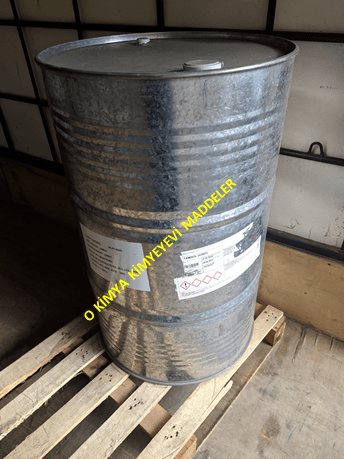
 1,4 BUTANEDIOL PACKAGING
Product Documents |
|
| BUTANEDIOL CERTIFICATE OF ANALYSIS | |
What is 1,4-Butanediol?
Molecular Formula (1,4-Butanediol): C4H10O2
Molecular Weight: 90.12 g/mol
Chemical Name: 1,4-Butanediol
CAS Number: 110-63-4
It is a colorless, fluid, and viscous chemical derived from butane, formed by the attachment of a hydroxyl group to the carbon atoms at each end of the butane molecule, which belongs to the alkane group.
Butanediol is a chemical in the alcohol group.
Other Names are as Follows;
- Butane-1,4-diol
- 1,4-Butylene Glycol
- Tetramethylene Glycol
- 1,4-Dihydroxybutane
- 4-Hydroxybutanol
- 1,4-Tetramethylene glycol
- Tetramethylene 1,4-Diol
- Butane-1-4-diol
How is it Produced?
Various production methods for 1,4-Butanediol are used worldwide. The market is generally dominated by large manufacturers. The most common production method involves reacting Acetylene and Formaldehyde under high pressure. Besides this, other production methods used for 1,4-Butanediol are as follows.
- It is produced by the continuous hydrogenation of 2-Butyne-1,4-diol with the help of a Nickel (Ni) catalyst.
- Through a catalytic reaction process, Butadiene and Acetic Acid form 1,4-diacetoxy-2-butene. Then, 1,4-Diacetoxybutane is formed through hydrogenation. Finally, it is produced by a hydrolysis reaction.
- 1,4-Butanediol can be obtained from the reaction of Allyl Alcohol and Synthesis gas.
- In another production method for 1,4-Butanediol, Chlorine is added to Butadiene to form a mixture. This creates 1,4-Dichloro-2-Butene and 3,4-Dichloro-1-Butene. This mixture then reacts with Sodium Acetate to form 1,4-diacetoxy-2-Butene. The final product obtained here is directly hydrogenated to the main chemical.
- In another production method, diperoxybutene is reacted with a peroxide. Here too, 1,4-Butanediol is obtained as a result of a hydrogenation reaction.
As seen here, almost all production methods for 1,4-Butylene Glycol include a hydrogenation stage.
What are the Physical and Chemical Properties of Butanediol?
1,4-Butylene Glycol is one of the 4 stable isomers of butanediol. It exists as an odorless, colorless liquid or solid.
Melting point is 20 °C.
Boiling point is 230 °C.
Its density is 1.017 g/mL at 25 °C.
In terms of solubility, it is readily soluble in water, alcohols, glycol ethers, ketones, and glycol ether acetates. 1,4-Butanediol is immiscible with aliphatic hydrocarbons and chlorinated hydrocarbons.
It has hygroscopic properties.
It has stable chemical properties. 1,4-Butylene Glycol is also flammable. It is incompatible with mineral acids, strong oxidizing agents, acid chlorides, and acid anhydrides.
What are its Effects on Human Health?
1,4-Butanediol is harmful if swallowed. It has effects that can cause drowsiness and dizziness.
Its fumes should not be inhaled. Hands should be washed thoroughly after working with this chemical. In case of skin contact, you should wash your skin with plenty of water.
When working with 1,4-Butylene Glycol, you should not eat, drink, or smoke.
How Should it be Stored?
Since 1,4-Butylene Glycol is a flammable chemical, it should not be stored in direct sunlight. 1,4-Butylene Glycol is stored in stainless steel drums. 1,4-Butanediol freezes at 20.1 °C. Although it is normally a liquid, it will freeze at this temperature. However, it will return to its liquid state when warmed again.
This chemical substance should be stored at temperatures between 2°C - 8°C. The safest storage conditions are within this temperature range.
What are the Usage Areas of 1,4-Butanediol?
- It is a high-quality intermediate product. 1,4-Butylene Glycol and its derivatives have a very wide range of applications in the Chemical Industry.
- 1,4-Butanediol is used as a cross-linking agent, modified with a few other chemicals, to prevent color loss in dyed hair.
- 1,4-Butylene Glycol is used in the manufacturing of technical plastics and polyurethanes.
- The applications of 1,4-Butanediol also include the production of solvents and electronic chemicals.
- It is also used in the manufacturing of elastic fibers.
- It is also used in the medical field. Here, it is used in the synthesis of epothilones, a new cancer drug.
- Another medical application for 1,4-Butylene Glycol is in the synthesis of the stereoselective product of (-)-Br Evisamide.
- Its largest area of consumption is for the manufacturing of Tetrahydrofuran (THF). This requires the presence of phosphoric acid and high temperatures. Tetrahydrofuran, in turn, is used to make polytetramethylene ether glycol, which is used to manufacture spandex fibers, urethane elastomers, and copolyester ethers.
- In the chemical industry, it is used as a solvent in the manufacturing of some elastic fibers and polyurethanes.
- In organic chemistry, it is used to synthesize γ-butyrolactone (GBL).
- It acts as a cross-linking agent for polyester plasticizers, paints, and coatings.
- This chemical acts as an intermediate. As an intermediate, 1,4-Butylene Glycol is used intensively in the manufacturing of polytetramethylene ether glycol (PTMEG), polybutylene terephthalate (PBT), and polyurethane (PU).
- Another area of use is in the manufacturing of industrial cleaning products and glue removers.
- It is used as a carrier and solvent in printing inks.
- It is used in the agricultural sector and in the manufacturing of veterinary products.
What are the Factors Affecting its Price?
The price of 1,4-Butanediol is directly linked to the prices of the chemical raw materials used in its production. As the prices of Acetylene and Formaldehyde increase, the price of this chemical will also increase.
The establishment of a new global-scale 1,4-Butanediol production facility will lead to a price increase.
The price of 1,4-Butanediol is constantly increasing due to the expansion of its application areas, which disrupts the supply-demand balance. The price of 1,4-Butylene Glycol will increase with the emergence of a new application area.
The price of 1,4-Butylene Glycol increases due to logistics costs, which depend on the distance from the production facility to the point of use.
Prepared by: O Kimya