

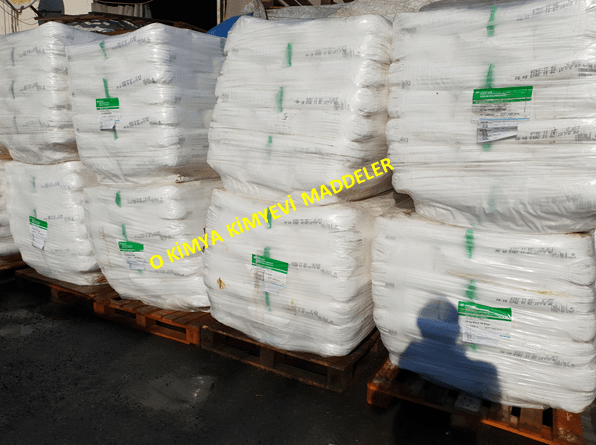
 SODIUM BICARBONATE PACKAGING 25 KG
Product Documents |
|
| SODIUM BICARBONATE CERTIFICATE OF ANALYSIS | |
What is Sodium Bicarbonate?
Molecular Formula (Sodium Bicarbonate): NaHCO3
Molecular Weight: 84.01 g/mol
Chemical Name: Sodium Hydrogen Carbonate
CAS Number: 144-55-8
Sodium Bicarbonate is the monosodium salt of carbonic acid, possessing alkalinizing and electrolyte-replacing properties.
Upon dissociation, it forms Sodium (Na+) and Bicarbonate (HCO3–) ions. This ion formation increases plasma bicarbonate, buffers excess hydrogen ion concentration, and in turn raises blood pH.
It is also commonly known as baking soda.
Other names for Sodium Bicarbonate are as follows;
- Sodium Hydrogen Carbonate
- Soda
- 144-55-8
- Carbonate
- Sodium Acid Carbonate
- Carbonic Acid Monosodium Salt
- Sodium Hydrocarbonate
- Monosodium Hydrogen Carbonate
- NaHCO3
- Baking Soda
How is it Produced?
Sodium Bicarbonate is produced chemically from sodium carbonate or from Sodium Chloride and Carbon Dioxide.
It is produced by the carbonation of a saturated solution of refined soda ash.
In the reaction process, it is produced by the ammonia-soda process. After this process, carbon dioxide is passed through a common salt solution in ammonia water. It is then precipitated in the next stage. The Ammonium Chloride solution is heated with lime. This way, ammonia is regenerated and returned to the process.
It is produced for three classes of use.
Food Grade Bicarbonate
Technical Grade Bicarbonate
Feed Grade Bicarbonate
What are its Physical and Chemical Properties?
Physically, it is an odorless substance with a slightly bitter (alkaline) taste. It appears as a white crystalline powder.
The pH of Sodium Bicarbonate is approximately 8.3. Factors affecting the pH value depend on the properties of the chemicals used in production.
Its melting point is around 50°C.
Boiling Point: Decomposes.
Its solubility is 100 g in 1 L of water at 25°C.
Its density is 2.1 g/cm3.
In terms of solubility, it is soluble in water and insoluble in ethanol.
It is stable in dry air but tends to decompose slowly in moist environments.
The Effect of Sodium Bicarbonate on Respiratory Pathogens
It has been found that microbes grow within a specific pH range. If the environmental pH level changes, pathogens can show different effects.
Lung infections are caused by bacteria, fungi, viruses, and parasites. All known microbes require a specific pH range. Many factors such as enzyme activity, reaction rate, protein stability, and the structure of nucleic acids affect biological action.
Sodium Bicarbonate is frequently used in cardiopulmonary resuscitation after ventilator use, circulatory support, and the onset of hyperkalemia.
The use of bicarbonate in this field reduces the effects of metabolic alkalosis, pulmonary edema, congestive heart failure, hyperosmolar syndrome, hypervolemia, and hypertension.
In conclusion, it has been determined that its use in this area significantly inhibits pathogens.
How is Sodium Bicarbonate Used for Sulfur Removal in Flue Gases?
Bicarbonate is used as a dry sorbent injection for sulfur removal in flue gases. Coal-fired steam power plants are potential sites for the application of this system.
The reaction of Sodium Bicarbonate with SO2 converts to Sulfate at a temperature of 650°F. At temperatures above 550°F, the exposure time to SO2 for Sulfate conversion is an important factor.
It has been found that the particle size of the chemical is not very important in the SO2 removal reaction with Sodium Bicarbonate.
How is Sodium Bicarbonate Used in Effervescent Tablets?
In the pharmaceutical industry, oral dosage administration via effervescent tablets is one of the most preferred methods. Disadvantages such as slow absorption of effervescent tablets make drug absorption difficult.
For effervescent tablets to function well, they must dissolve and disperse well in water. They need to release carbon dioxide when dissolved in water.
A reaction related to the use of Sodium Bicarbonate in an effervescent tablet is as follows;
C6H8O7(aq) + 3NaHCO3(aq) 》Na3C6H5O7 (aq) + 4H2O + 3CO2 (g)
Even a very small amount of water in the environment acts as a catalyst in this reaction. The presence of water enables this reaction to occur. Therefore, effervescent tablets using sodium bicarbonate must be produced by completely preventing contact with water.
What are its Areas of Use?
- It is an inorganic salt used as a buffering agent and pH adjuster.
- It is used in combination with many chemical compounds in the treatment of acne. Its interaction with an active ingredient like Salicylic Acid is important.
- It is used with Sodium Carbonate to create a highly stable buffer solution. This buffer solution is applicable for enzyme studies on the phenolic esters of phosphoric acid.
- Due to its neutralizing properties, Sodium Bicarbonate is used in the manufacturing of skin-smoothing powders.
- In the food industry, it is used to release carbon dioxide, which adds better volume and provides a delicate eating quality to baked goods.
- It is used to create carbonation in dry mix beverages.
- It is the main chemical component used in the production of baking powder.
- It is used in the manufacture of many sodium salts. From this, we can conclude that many sodium salts are actually produced with bicarbonate. Therefore, it is a very important chemical.
- It is used in the manufacturing of odor-absorbing products. It can also be used as a cleaning agent.
- In the production of animal feed, it is used as an acidity regulator. Here, it contributes to production by stabilizing the pH between 6.0-6.8.
- The use of Sodium Bicarbonate in animal feed production increases the feeding efficiency of animals.
- Corrosion occurs in some batteries. Sodium Bicarbonate is used to clean the rust that forms on the terminals and connections of batteries, to polish these connection points and terminals, and to eliminate rusting.
- In the pharmaceutical industry, the acid-neutralizing effect of bicarbonate is utilized. It provides potential binding and cleaning properties with other chemicals.
- It is used in the manufacturing of effervescent tablets with different properties.
- It is used in the manufacturing of toothpaste. In this application, it acts as a mild abrasive.
- Thanks to its moisture-absorbing capability, it is used in the production of stable effervescent tablets.
- It is used in the manufacturing of some pesticides.
- It is used in the manufacturing of drugs containing Sodium Alginate to treat people with conditions like heartburn (reflux).
- During the stabilization of alcoholic beverages, it is necessary to change the pH level of the medium. For this, the pH can be balanced with basic substances like Sodium Bicarbonate.
What Factors Affect its Price?
Its price has been increasing for a long time. Sodium Bicarbonate prices are directly proportional to the prices of the chemicals used in its production. For example, as salt prices increase, the price of this chemical will increase.
Prices are inversely proportional to the number of sodium bicarbonate production facilities. As the number of production plants increases, the price of Bicarbonate will decrease because there will be enough baking soda on the market.
Companies that sell Sodium Bicarbonate wholesale sometimes have a major impact on prices. As their stocks increase, the price will fall.