

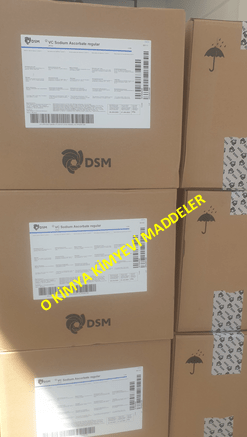
 SODIUM ASCORBATE PACKAGING
Product Documents |
|
SODIUM ASCORBATE ANALYSIS CERTIFICATE |
|
What is Sodium Ascorbate?
Molecular Formula (Sodium Ascorbate): C4H7NaO6
Molecular Weight: 198.11 g/mol
Chemical Name: Sodium Ascorbate
CAS Number: 134-03-2
It is the sodium salt obtained by replacing the hydrogen proton in the 3-hydroxy group of ascorbic acid with sodium. It is a Vitamin C that has high solubility in water.
It is often confused with Ascorbic acid. However, while Ascorbic acid is an organic acid with a simple structure, L-ascorbate is the salt form of this acid. Due to its low acidity, drugs produced with this chemical substance are used in the pharmaceutical industry as solutions derived from ascorbic acid for people with gastrointestinal problems.
Other Names are as Follows;
- L-Ascorbic Acid sodium salt
- 134-03-2
- Vitamin C, Sodium Salt
- Na-L-Ascorbate
- Mono Na-L Ascorbate
- Tablet Grade Ascorbate
- E 301
How is Sodium Ascorbate Produced?
Sodium ascorbate production is obtained by the reaction of equal amounts of ascorbic acid and sodium bicarbonate. Isopropyl alcohol is used for further precipitation processes.
What are the Physical and Chemical Properties?
It appears physically in the form of small crystals or as a white powder.
It is an odorless chemical substance.
It should be stored in areas that do not receive direct sunlight.
The melting point is 218 °C.
Density: 1.65 g/cm³
Boiling Point: No information available.
Its solubility in water at 25 °C is approximately 62 g/100 ml water.
It is slightly soluble in alcohols (Ethyl Alcohol, Methyl Alcohol, Isopropyl Alcohol).
In terms of stability, if ascorbate is in solution form in water, it undergoes oxidation when exposed to air.
For this reason, medications must be airtight and protected from light.
What are the Usage Areas of Sodium Ascorbate?
- It is an active ingredient in the production of drugs used for the treatment of intravenous infusion diseases.
- It is used in the manufacture of drugs administered directly into the bloodstream via the intravenous method for medically monitored patients in the treatment of advanced cancer patients.
- It is used as a curing agent in the sausage, ham, and meat processing industry together with Sodium Tripolyphosphate and Tetrasodium Pyrophosphate (TSPP).
- It is the main raw material for drugs used in the treatment of people suffering from Vitamin C deficiency.
- It is used as an alternative to ascorbic acid in the treatment of people with gastrointestinal disorders.
- It is used in drugs produced to prevent scurvy.
- It is a Vitamin C form suitable for the stomach as it is less acidic than ascorbic acid. Therefore, it is used in the manufacturing of effervescent tablets and capsules.
- It is used as an antioxidant and antimicrobial substance in the manufacture of some food products. This is why it is listed in the antimicrobial chemicals category.
What are the Factors Affecting Prices?
Sodium Ascorbate price is directly dependent on the prices of the raw materials used in its production. As the prices of ascorbic acid and sodium bicarbonate increase, the prices increase. When the price of isopropyl alcohol increases, the ascorbate precipitation costs will increase. Therefore, the prices increase.
As companies selling sodium ascorbate increase their stocks, prices will decrease. As stocks decrease, the prices of this chemical substance will increase for a short period.
The price of L-Ascorbate is directly proportional to its usage areas. With the increase in usage areas, prices will increase. It has continuously increased depending on the development of the pharmaceutical industry in the medical field.