

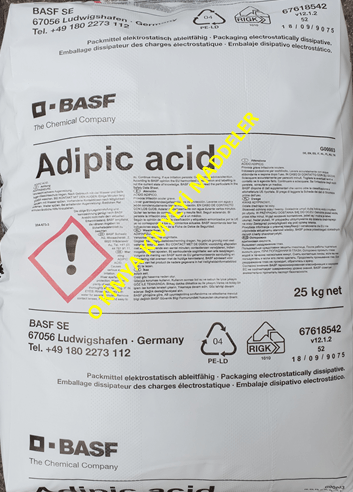
 ADIPIC ACID PACKAGING 25 KG
Product Documents |
|
| ADIPIC ACID CERTIFICATE OF ANALYSIS | |
What is Adipic Acid?
Molecular Formula (Adipic Acid): C6H10O4
Molecular Weight: 146.142 g/mol
Chemical Name: Hexanedioic Acid
CAS Number: 124-04-9
It is one of the most important dicarboxylic acids in terms of global production capacity. It is a chemical that is rarely found in nature. It has a tart taste.
It is typically found exogenously in both urine and blood.
It is a white crystalline solid. It is insoluble in water.
Other Names Include:
- Adipate
- Calcium Salt
- Diammonium Salt
- Hexanedioic Acid
- 124-04-9
- Adipinic Acid
- 1,4-Butanedicarboxylic Acid
- 1,6-Hexanedioic Acid
- Hexane-1,6-dicarboxylate
- Adipic acid
- Adipinate
- Hexane diacid
- Molten Adipate
- 1,6-Hexanedioate
How is it Produced?
Two important reaction stages are used in the production process of Adipic Acid. In this reaction, an intermediate product is formed in the first reaction stage.
It is produced through the oxidation of cyclohexane, cyclohexanol, or cyclohexanone with air or nitric acid.
Almost all of the global production is derived from cyclohexane.
What are its Physical and Chemical Properties?
It is a chemical with a white crystalline solid appearance. It has white, odorless crystals.
It has a tart taste.
Its boiling point is 337.5 °C at 760 mm Hg pressure.
Its melting point is between 151.5 °C and 154 °C.
Its flash point is 196 °C.
Regarding solubility, it is insoluble in water. It is freely soluble in Ethanol. It is insoluble in acetic acid and ligroin.
It does not dissolve easily in petroleum ether.
Its density is 1.36 g/cm3.
It is stable under recommended storage conditions. Generally, it is a stable chemical.
It is not a hygroscopic substance. Therefore, it is suitable for storage in Big Bags.
Use of Adipic Acid as a Food Additive
In the food industry, it functions as an acidity regulator, neutralizing agent, buffering agent in gels and jams, and as an additive in dietetic products.
The E number for Adipic Acid is E355.
Currently, manufactured adipic acid is derived from petroleum-based products (fossil sources). Due to rising oil prices, research is being conducted on production methods that would qualify it as a green product.
For this reason, bio-based production studies have accelerated. Studies on fermentation as a production method have shown that this chemical can be produced. Sugar-based raw materials, aromatic raw materials, and fatty acid sources have been deemed suitable for fermentation. The use of adipic acid produced by fermentation as a food additive is expected to become more widespread.
What is the Importance of Adipic Acid in Cables?
Copper and aluminum wires wear out over time. This is because hydrocarbons and external factors cause the cables to age.
To prevent cable aging, they undergo a series of processes during manufacturing. In these processes, substances containing adipic acid are used to reduce the aging effects of hydrocarbons. To coat copper wires with age-resistant cables, polyester resins obtained from dicarboxylic acid are used.
It is the most suitable dicarboxylic acid for preparing polyester resins. Besides this, oxalic acid is also a suitable dicarboxylic acid.
What are the Uses of Adipic Acid?
- In industry, it is used as an additive and gelling agent in gelatins.
- It is used in some Calcium Carbonate antacids to make them tart.
- It is used as a corrosion inhibitor and scaling agent.
- It is used as an additive in some food products.
- It is used in the manufacture of plasticizers.
- Excellent results have been obtained with its solutions, used together with ammonium nitrate, for stripping paint from ferrous and non-ferrous metals. The solvent here is monochloroacetic acid. This cleaning composition also has the ability to remove limescale and rust.
- It is used in the manufacturing of adhesives and sealing products.
- Its uses also include the manufacturing of water treatment products.
- It is used extensively in the production of nylon.
- It is used in the manufacturing of lubricant components.
- Food-grade adipic acid is used as a gelling aid, acidulant, buffering agent, and leavening agent.
- It is also used in the manufacture of some polyurethanes.
- It is used in chlorine tablet production to create effervescent tablets.
- It is used as a monomer in nylon production.
- In polyester production, polyester resin is obtained by a dehydration method in an esterification reaction with succinic acid and 1,4-Butanediol.
- Flue gases from thermal power plants contain sulfur. Compounds containing adipic acid are used to capture the sulfur in the smoke emitted from the stacks of thermal power plants.
- Its low acidity feature offers an excellent opportunity in pH-controlled systems that require low acidity.
What Factors Affect Its Price?
Adipic Acid prices increase arithmetically each year.
It is directly dependent on the prices of the chemicals used in its production. As the price of cyclohexane, used in the production of this chemical, increases, the prices will increase.
Prices are directly linked to the application areas of this chemical. The emergence of a new application area will cause prices to rise.
The price of Adipic Acid varies depending on its production. The establishment of a new production facility will increase its price.
The price will increase with distance from the production site.