

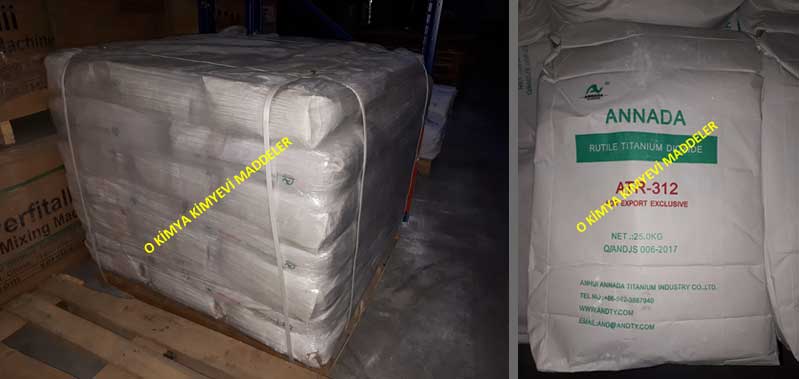
 TITANIUM DIOXIDE PACKAGING 25 KG
Product Documents |
|
| TITANIUM DIOXIDE CERTIFICATE OF ANALYSIS | |
What is Titanium Dioxide?
Molecular Formula (Titanium Dioxide) ; TiO2
Molecular Weight; 79.866 g/mol
Chemical Name; Titanium Dioxide
CAS Number; 13463-67-7
It is a naturally occurring mineral used as a sunscreen agent in many fields. Its high refractive index has made it an indispensable component in formulas used for whitening purposes.
Its molecular formula is TiO2. It is derived from naturally occurring minerals found in a series of crystal forms. Because, naturally occurring oxide crystals can be mined and allow for the derivation of commercially used titanium dioxide.
Titanium Dioxide E Code= E 171.
Other names are as follows;
- Titanium White
- Rutile
- Anatase
- 13463-67-7
- Tioxide
- Titania
- Titanic Anhydride
- Kronos
- Tronox
- Nano Anatase
- Rutile Titanium Dioxide
- Dioxotitanium
- Titandioxid
- E 171
What are its Physical and Chemical Properties?
It is a white chemical. It is also a soft solid that melts at 1800 °C.
Density: 4.23 g/cm³
Boiling Point: 2972 °C
It is a chemical with varying corrosion properties.
It is a polymorphic chemical. It exists in 3 structural forms: Rutile, Anatase, and Brookite. Commercially, only Rutile and Anatase are used.
Titanium Dioxide Refractive Index is 2.76 and 2.55.
It is a dilute alkaline chemical. It is insoluble in dilute acids. It is soluble in concentrated sulfuric acid. Regarding solubility, it can also dissolve in hydrochloric acid and nitric acid.
Its relative density is the lowest among the most commonly used white pigments. Of titanium dioxide pigments of the same quality, the one with the larger surface area has a larger pigment volume.
Due to its high dielectric constant, it has very good electrical properties.
The form with the lowest permeability is Anatase.
Its conductivity increases as the temperature rises. Titanium Dioxide is very sensitive to hypoxia.
Anatase plate titanium dioxide can transform into Rutile at high temperatures. Therefore, Rutile and Anatase do not have distinct melting and boiling points.
Its melting point depends on its purity.
Although its hygroscopic property is not very strong, it is related to its hydrophilic surface area.
If the surface area is large, the moisture absorption rate is also high. The moisture absorption rate is also related to the surface treatment and nature.
It is a chemical with very good thermal stability.
It is not a toxic chemical and is stable. The answer to questions like 'Is it harmful to health?' also depends on the usage rate of this product.
It is a partially acidic oxide.
It does not react with oxygen, hydrogen sulfide, sulfur dioxide, carbon dioxide, and ammonia.
It is insoluble in water, fatty acids, other organic acids, alkalis, and weak inorganic acids other than hot nitric acid.
It can react with some special substances.
Under prolonged boiling, it can react with Sulfuric Acid and Hydrofluoric Acid.
How Does Titanium Dioxide Dissolve?
Its solubility varies depending on the solvent used. When comparing citric acid dissolved in water with malic acid dissolved in water, the solubility of titanium dioxide was higher in the solution prepared with malic acid.
As solubility increases, the effects of titanium dioxide in its application areas also increase visibly.
How is it Produced?
It is obtained from ilmenite, rutile, or titanium slag.
Titanium Dioxide pigment is extracted using sulfuric acid or chlorine. Of these methods, the sulfate process is carried out using a simpler technology than the chloride process. However, this process can use lower-grade and cheaper ores.
The sulfate process is more expensive to set up than a chlorine plant. The production cost in the sulfate process is also higher.
65% of titanium production is obtained from the chloride process.
In the sulfate process production of titanium, waste costs are high.
Pollution control in the sulfate process is expensive.
While Anatase and Rutile are produced in the Sulfate Process, only Rutile is produced in the Chloride process.
How Should it be Stored?
It should be kept away from areas exposed to direct sunlight.
Before handling titanium, all engineering controls must be implemented, and protective equipment requirements and personal protective equipment must be allocated.
Storage of Titanium Dioxide should be done in areas that do not generate dust.
In the storage area, there should be no substances that could react with this chemical.
How is Titanium Dioxide Used in Sunscreens?
Due to some of its unique elemental properties, Titanium Dioxide is widely used in various industries and the cosmetics sector. It is a chemical with a high refractive index compared to other compounds. It has a refractive index 2 times higher than water.
In the cosmetics industry, it is used in various makeup products for its whitening and thickening properties. Due to its ability to absorb Ultra Violet (UV) light, it has been used as a sunscreen. Over time, it has established a place in the market for consumer convenience, including nanoparticle formulations.
What is the Mechanism of Action of Titanium Dioxide?
In terms of its chemical properties, Titanium Dioxide is a continuously used chemical due to its sustainability in production and low-cost advantage. It is a chemically neutral substance. The concept of 'inert' here means that it has no effect when it comes into contact with other substances. Because of this property, Titanium Dioxide has been approved as safe in the food, cosmetics, and pharmaceutical industries.
The crystalline forms of Titanium Dioxide are semiconductors with a high refractive index. Its high refractive index property helps the substance scatter visible light. In addition, its whitening property is utilized in areas where it is used as an additive.
A high refractive index can sometimes create cosmetically unattractive properties upon topical application. Therefore, formulations are generally micronized. In previous years, titanium dioxide particles with a particle size of 150-300 nm were used. However, now titanium dioxide with a particle size of 15-150 nm is used. These are used for topical applications. Work is being done on transparent and micro-formulations of Titanium at these sizes.
What are its Application Areas?
- Titanium dioxide is used as a bright white pigment in paint production.
- It is also used in the food industry to color food products.
- In the cosmetics sector, titanium dioxide is used in sunscreens to block UVA and UVB rays.
- It is used as an additive in the production of fire-resistant ceramics and similar products to provide brightness and improve properties like light reflection.
- It is a compound used in the formulas of coating paints.
- It is used in combination with other ingredients to add white color to cold medications. These include Silicon Dioxide (Aerosil 200), and PVP K30.
- In the production of lubricants for servo systems, nanoparticle lubricants are produced by using it together with liquid paraffin (Paraffin oil).
- It is also used as a pigment for pharmaceutical products such as gelatin capsules, tablet coatings, and syrups.
- Also in the cosmetics sector, titanium dioxide is used as a pigment to provide color in toothpaste, lipstick, creams, ointments, and powders.
- It is used as an opacifier to make pigments opaque.
- It has high UV light absorption properties. For this reason, it is used as an active ingredient in sunscreens. Its use in this field should have a particle size ranging between 10-100 nm.
- It is used as a bleaching and opacifying chemical in porcelain enamels. Thanks to the Titanium used here, brightness, hardness, and acid resistance are achieved.
- It is used in the Cosmetics and Pharmaceutical industries because it is thought to block ultraviolet rays.
- Due to its photocatalytic property, when exposed to Ultraviolet Radiation, it creates thin coatings that are self-cleaning and disinfecting. Alloys made from Titanium Dioxide are very light and have high tensile strength. They have high resistance to corrosion and high temperatures. Therefore, it is actively used in the construction of aircraft, power plants, armor plating, ships, spacecraft pipes, and missiles.
- It is used by ink manufacturers.
- It is used as a main component (Titanium Source) in anti-yellowing and anti-corrosion compositions for Titanium and Titanium alloys.
- For use on fabric materials, it is used as a pigment in the manufacturing of inkjet printable transfer papers.
- It is the most important component in the manufacturing of environmentally friendly paints. In this application, it is used as a white pigment.
What Factors Affect its Price?
The price of Titanium Dioxide is directly dependent on the production process. If it is obtained from the sulfate process, it will be more expensive.
If it is obtained from the chloride process, it will be cheaper.
It is directly proportional to the prices of the mines where titanium ores are extracted. As the price of ores increases, the price of titanium dioxide will also increase.
The upward trend in the automotive sector in recent years has positively affected the price of titanium dioxide. In particular, the intensive progress of the construction sector has led to an increase in the price of pigment ores, i.e., titanium dioxide. The use of exterior composite materials in the construction sector has increased recently. For this reason, prices have increased due to the use of pigments and opacifiers in composite material production.