

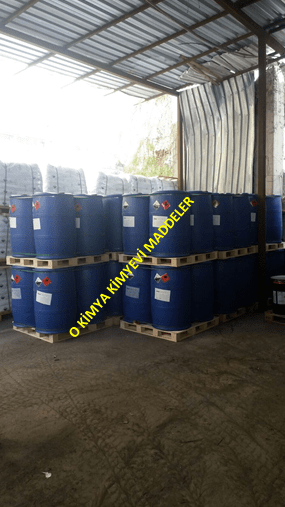
 ACRYLIC ACID PACKAGING 250 KG
Product Documents |
|
| ACRYLIC ACID CERTIFICATE OF ANALYSIS | |
What is Acrylic Acid?
Molecular Formula (Acrylic Acid): CH2=CHCOOH:C3H4O2
Molecular Weight: 72.063 g/mol
Chemical Name: Acrylic Acid
CAS Number: 79-10-7
Acrylic Acid belongs to the class of organic compounds, also referred to as 2-Propenoic Acid or Acrylate. It exists as a water-soluble liquid and a weakly acidic chemical compound. It is also known as the simplest unsaturated carboxylic acid.
When its structure is examined, it is seen that a vinyl group is attached to a carbonyl group, and the compounds of this acid undergo processes similar to the reactions of carboxylic acids.
The double bond and the functional carboxylic acid group in its structure play a significant role in giving characteristic reactions similar to the properties of carboxylic acid.
Other Names are as Follows;
- 2-Propenoic Acid
- 79-10-7
- Propenoate
- Acrylic Polymer
- Vinylformic Acid
- Acroleic acid
- Propene acid
- Ethylenecarboxylic Acid
- Polyacrylate
- Glacial Form
- Acrylic Resin
- Potassium salt
- Sodium salt
- Zinc salt
- Silver salt
How is Acrylic Acid Produced?
There are several methods for the production of Acrylic Acid. These can be listed as follows:
- It can be obtained by the condensation of Ethylene Oxide with hydrocyanic acid, followed by reaction with sulfuric acid at 320 °F.
- It can be obtained as a result of the reaction of acetylene, carbon monoxide, and water with a Nickel catalyst.
- Propylene is oxidized with steam to acrolein, which is then oxidized to acrylic acid at 300 °C with a Molybdenum-Vanadium catalyst.
- Hydrolysis of acrylonitrile
A propylene to acrolein reaction based on gas-phase catalytic oxidation can be carried out in single or two-stage reactions. In the production process, the acrolein reaction is preferred due to its higher yield.
During its production, the oxidation of propylene produces acrolein, acrylic acid, acetaldehyde, and carbon oxides. In this production process, Acrolein can be recovered from the primary oxidation while being fed to a second stage to produce this chemical. Purification is then carried out by azeotropic distillation.
In some studies, it can also be synthesized from Lactic acid by the dehydration method in the presence of a catalyst.
What are its Physical and Chemical Properties?
Physically, it is a colorless liquid chemical compound with a distinctly pungent odor.
Its boiling point is 141.2 °C.
Its melting point is 13.5 °C.
In terms of solubility, it is very soluble in water. It is miscible with ethanol, ethyl ether, acetone, benzene, and carbon tetrachloride.
Its density is 1.54 g/mL at 25 °C.
Acrylic and Methacrylic acid easily polymerize in the presence of light, heat, and oxygen, as well as in the presence of oxidizing agents like peroxides.
It is a chemical that can rapidly decompose in the atmosphere through photochemical attack on the double bond.
If decomposition is achieved by heating, it emits fumes.
It has a corrosive effect on metals.
Its pH level is approximately 3.
Regarding polymerization, it polymerizes in the presence of iron salts and at high temperatures, rapidly releasing high energy. It polymerizes easily in the presence of oxygen.
What are the Usage Areas of Acrylic Acid?
- It is used in the production of plastics, paint formulations, and other products.
- It is used in latex applications. The use of this chemical in latex applications increases the colloidal surface of the latex, thereby increasing the passage of water vapor.
- It is used in the manufacture of floor polishes.
- In the plastics industry, it is converted into Polyacrylic Acid through a polymerization process. This increases the durability and flexibility of plastics.
- It is used in polymer solutions for coating applications.
- It is used in leather coatings and paper coatings.
- In industry, acrylic acid is used in the manufacture of adhesives and sealants.
- Protecting mild steel in aqueous environments with an environmentally friendly chemical is important. In such areas, acrylic acid is used in the manufacture of Corrosion inhibitors and anti-scaling agents. Its use here is achieved by forming polyacrylic acid.
- Acrylic acid is used in the manufacture of many paint additives and coating additives.
- It is used in the manufacture of water treatment chemicals.
- It is also used in the manufacture of chemical intermediates.
- It is used in the manufacture of some chemicals in the pharmacology field, such as Carbomer gel.
- Acrylic resins are used in the production of dentures and prostheses. Such resins are also produced using acrylic acid. In pharmacology and biochemistry, it is used in the manufacture of materials used in the field of prosthetics.
- In the cosmetics industry, it is used in the manufacture of acrylic nail polishes. It is also utilized for its adhesive properties in the manufacture of acrylic nail foils.
- It is used in the manufacture of solvent-based resins.
- In recent years, it has been used in the manufacture of Super Absorbent Polymers (SAP) and detergent polymers.
What are the Factors Affecting its Price?
The price of acrylic acid has been increasing for many years. Prices have doubled in recent years.
In terms of price, it is directly dependent on the prices of the chemicals used in its production process. It is directly proportional to the price of ethylene oxide used in production. As the price of ethylene oxide increases, the price of acrylic acid will increase.
The price varies depending on the stock levels of companies that sell acrylic acid. The more stock a selling company has, the prices will change inversely.
The price is directly related to the application areas of acrylic acid. As its usage area expands, the price will increase because existing production facilities will not be able to meet the demand.
Prices also depend on the number of acrylic acid production facilities. If a new production facility is established, its price will decrease in the short term.