

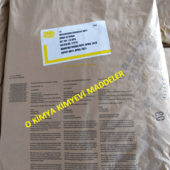
 POTASSIUM SODIUM TARTRATE PACKAGING
Product Documents |
|
| POTASSIUM BITARTRATE ANALYSIS CERTIFICATE | |
What is Potassium Sodium Tartrate?
Molecular Formula (Potassium Sodium Tartrate): KNaC4H4O6
Molecular Weight: 210.158 g/mol
Chemical Name: Potassium Sodium Tartrate
CAS Number: 6381-59-5
It is a double salt prepared in 1675 by La Rochelle and Pier Seignette. Therefore, the salt is known and named as Seignette salt or Rochelle salt.
Potassium Sodium Tartrate (Rochelle Salt) should not be confused with rock salt, which is the mineral form of sodium chloride.
It has been used in organic synthesis to increase emulsions in aqueous processes. Monosodium Tartrate and Monopotassium Tartrate were the first chemicals to exhibit piezoelectricity.
Sodium Potassium Tartrate E Code: E 337
Other names are as follows;
- Potassium Sodium Tartrate
- Seignette Salt
- Rochelle Salt
- Potassium Sodium L(+)-tartrate
- Sodium Potassium L-tartrate
- Sodium Potassium DL-tartrate
- Tartaric Acid Monopotassium Monosodium Salt
- Potassium Sodium Tartrate anhydrous
- 304-56-9
- 2,3-Dihydroxybutanedioic Acid, monopotassium monosodium salt
- 6381-59-5
- Potassium Sodium (2R,3R)-2,3-dihydroxybutanedioate
How is it Produced?
Its production is obtained by processing natural tartaric acid (raw tartaric acid). Many chemicals are used in this production process. These emerge as a salt of L (+)- Tartaric Acid.
In the production process, it is the process of replacing Sodium Carbonate with a double molar portion of Potassium Bitartrate with a hot base.
What are the Physical and Chemical Properties?
In terms of physical appearance, it is in the form of colorless crystals and white crystalline powder. Sometimes the crystals may be covered with white powder.
In terms of taste, it has a cool salty taste.
The boiling point is 200 °C.
The melting point is 70-80 °C.
In terms of solubility, it is slightly soluble in alcohol. Its solubility in water is good and it dissolves completely.
Its density is approximately 1.79 g/cm3.
It gives a cooling taste similar to salt water.
It is a colorless blue-white salt that crystallizes in the orthorhombic system.
In terms of stability, it starts to decompose and becomes unstable above 225 °C.
It deteriorates if stored in humid environments.
What are the Usage Areas of Potassium Sodium Tartrate?
- It is used as a nutrient food additive in the food industry.
- It has been used as a laxative in the medical field. It is a component of Fehling's solution and was used in previous times for the determination of reducing sugars in solutions.
- An amine smell occurs during the cooking of squid, which is indispensable for rakı tables. To reduce and eliminate this amine smell, acidic odor removal is provided by using food additives containing this chemical. At the same time, it removes acidity in this area.
- There are emulsifying agents that form the basis of processed cheese production; these agents are used to provide a smooth structure that also affects the physical, chemical, and microbial quality of the cheese. It is the chemical that provides this effect in this field.
- It is used in the detection of aldose and ketose functionality.
- It is used in metal treatment, micro-electronics industry, piezoelectric effect, plating, and cement industry. It has the effect of providing very good sound output due to its effect of collecting currents of 2 volts and above.
- It is used in the silver coating process of mirrors to provide excellent effects.
- In pectin and jam production, it is used as a buffer salt for the standardization process together with citrate and other substances. In the process of standardizing pectin, each substance is used in a certain ratio.
- It is used as a meat preservative.
- It is used in the determination of uric acid.
- Cigarette papers should not go out while smoking. For this, the combustible properties of the papers should be good. It is used in the manufacture of these papers to increase the combustibility of cigarette papers.
What are the Factors Affecting Prices?
Price-wise, it is directly dependent on the price of Tartaric Acid. When the price of Tartaric Acid increases, the price of this product increases. Prices will increase as grape prices increase.
Prices are directly dependent on usage areas. As the usage area of Sodium Potassium Tartrate increases, the price of this chemical increases. Prices will increase with the creation of a new usage area.
The prices of this chemical vary depending on the number of companies manufacturing this chemical. As the number of manufacturing companies increases, Potassium Sodium Tartrate prices will decrease.
Prices vary depending on the number of companies selling this chemical and their stocks. As stocks increase, prices will decrease.