

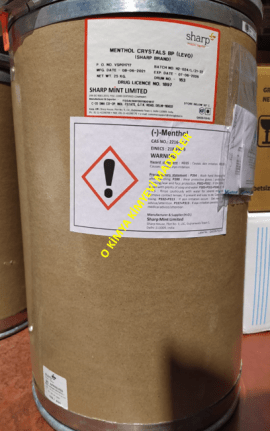
 Crystal Menthol Packaging
Product Documents |
|
| MENTHOL ANALYSIS CERTIFICATE | |
What is Menthol?
Molecular Formula (Menthol): C10H20O
Molecular Weight: 156.26 g/mol
Chemical Name: 2-Isopropyl-5-methylcyclohexanol
CAS Number: 1490-04-6 or 15356-70-4
It is an organic compound. It is also a compound with local anesthetic properties. It is a substance obtained from mint or peppermint oil. It is a cyclic hydrocarbon.
Menthol is known as a muscle relaxant. It works by causing the skin to which it is applied to first cool down and then warm up.
It has a cooling effect on the skin and mucous membranes. It is the most important flavoring agent after vanilla and citrus.
It has two isomers as L- and D- forms, which are mirror images of each other. These are called enantiomers of each other.
The most important feature of Menthol is its cooling effect. This feature was discovered in recent years. Its working principle involves binding to certain regions of sensory neurons called the TRPM8 receptor, which opens pores. Consequently, calcium ions enter the cell and send a message to the brain to create this action.
Other Names are as Follows;
- 2-Isopropyl-5-methylcyclohexanol
- Menthyl Alcohol
- 15356-70-4
- Menthol
- 4-Isopropyl-1-methylcyclohexan-3-ol
- 3-p-Menthanol
- 3-Hydroxy-p-menthane
How is Menthol Produced?
In menthol production, 4 different stereoisomers are formed. Its racemic form can be synthesized by the hydrogenation of thymol.
Some manufacturers produce this chemical starting from citral. In this system, the asymmetric hydrogenation method is applied. The most important aspect of this method is ensuring the production of a specific enantiomer with high yield as a result of the reaction in the presence of a catalyst.
Crude mentha oil is obtained from a type of mint plant. This mentha oil has an L-Menthol content in the range of approximately 50%-95% by weight. Crystals of acceptable purity are obtained from this mentha oil in a crystallizer.
In this production method, L-Menthol must first be crystallized by gradual cooling from crude mentha oil. The L-Menthol obtained here is approximately 98% pure. This purity level is below pharmaceutical preparations and international pharmaceutical standards.
The way to overcome this is through the recrystallization method. The crystallization temperature can be gradually lowered to a range between -30 °C and 30 °C. The purity of L-Menthol obtained after the recrystallization process is at least 99.4%.
L-Menthol production can be carried out without human contact and in accordance with GMP standards. The most important advantage of this method is that L-Menthol can be purified to even higher levels within a closed vessel.
What are the Physical and Chemical Properties?
It is a white crystalline solid that resembles mint in smell and taste.
The Boiling Point is 212 °C.
The Melting Point is 39 °C.
Solubility is 420 mg/L at 25 °C.
It dissolves in alcohol, chloroform, ether, hexane, and glacial acetic acid.
Its density at 18 °C is 0.9131 g/cm³.
What are the Usage Areas of Menthol?
- It is used as a flavoring agent in the production of peppermint gum to provide mint aroma.
- When the cooling effect penetrates muscle pain resulting from fatigue, the body's sensory receptors are stimulated and the sensation of pain decreases. Menthol is used to create this cooling effect in muscles.
- In the medical field, it is used in the manufacture of cough syrups and nasal inhalers.
- It is used to provide mint flavor in the production of mint candies.
- Crystal menthol is used as a flavor component in the manufacture of dental and oral care products.
- It is used as an auxiliary substance (excipient) in the manufacture of non-steroidal anti-inflammatory creams for the relief of joint pain.
- It is found as a component in the manufacture of topical preparations used for the relief of muscle pain. In this application, it can be modified with methyl salicylate. To convert Menthol into gel form, Carbomer 940 or Carbomer 980 form is used.
- It is used in the production of medicines used to treat patients suffering from oral irritation.
- It is used as a starting material in the manufacture of menthol stereoisomers produced to evoke a fresh sensation. In this field, components with methoxy groups are produced. They have a significant ability to evoke a feeling of freshness.
- It is generally treated as an inactive substance in the pharmacology sector.
- It is used in toothpaste production to provide mint freshness.
- It acts as a flavoring agent for mint confectioneries.
- Menthol is used in the manufacture of medical intervention products used for injuries such as sudden sprains in athletes.
- In the production of muscle relaxant complex gels, it provides freshness to the skin when used together with Carbomer, methyl salicylate, triethanolamine, hyaluronic acid, and many extracts. In such products, phenoxyethanol and Ethylhexylglycerin are used as preservatives.
- It is used in the manufacture of some sunscreen creams. In this application, Vitamin E (Alpha Tocopherol) is also used.
- It is used in the composition of liquid cooling pads, solid cooling pads, and gel cooling compounds.
What are the Factors Affecting Its Price?
The price of menthol is directly dependent on the prices of the raw materials used in its production. As citral prices increase, the price of this flavoring agent will increase.
Menthol distributor companies generally keep market prices under control. The most important factor affecting prices can be identified as the expansion of the usage areas for these substances.