

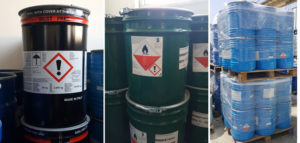
 SODIUM HYDROSULFITE PACKAGING 50 kg
Product Documents |
|
| SODIUM HYDROSULFITE CERTIFICATE OF ANALYSIS | |
What is Sodium Hydrosulfite?
Molecular Formula (Sodium Hydrosulfite); Na2S2O4
Molecular Weight; 174.107 g/mol
Chemical Name; Sodium Dithionite
CAS Number; 7775-14-6
Sodium hydrosulfite is a free-flowing, dry, white chemical available in various concentrations with different levels of sodium dithionite. It is an inorganic salt.
It is a very strong reducing agent. It exists in solid, powder, or crystal form.
In the presence of another chemical compound, it works by adding sulfur (S) to that compound. Here, sodium dithionite donates sulfur (S), electrons, and acts as a sulfonating agent to other compounds. In this way, it chemically reduces other components and functions as a reducing agent.
Commercially available hydrosulfite contains 85-90% Sodium Dithionite by weight.
Other Names Are As Follows;
- Sodium Dithionite
- Sodium Sulfoxylate
- Disodium Hydrosulfite
- Disodium Dithionite
- Dithionite de sodium
- Sodium Dithionite (Na2(S2O4))
- Sodium Dithionite (Na2S2O4)
- Natrium dithionit
- Ditionito de sodio
- Dithionous acid, sodium salt (1:2)
- Disodium dithionate
- Sodium Hyposulfite
- Vatrolite
How is it Produced?
Sodium Hydrosulfite is produced through 2 main reactions and 4 main raw material inputs. The main chemical inputs are as follows.
- Zinc (Zn) powder
- Soda Ash (Na2CO3)
- Sulfur Dioxide (SO2)
- Sodium Chloride (NaCl)
The reactions of these chemicals proceed in the following order.
- Reaction
Zn + 2SO2 + H2O 》 ZnS2O4
- Reaction
ZnS2O4 + Na2CO3 》ZnCO3 + Na2S2O4
What are the Physical and Chemical Properties of Sodium Hydrosulfite?
Hydrosulfite is a chemical with an odor similar to Sulfur Dioxide. It is in a solid form with a white or light yellow crystalline structure.
Sodium Hydrosulfite is not a stable chemical. It heats up spontaneously upon contact with air and moisture. This heat can ignite flammable materials nearby.
Its melting point is 52 °C.
In terms of solubility, hydrosulfite is very soluble in water. It has slight solubility in alcohol. It does not dissolve in acids.
At 20 °C, it has a solubility of 24.1 g in 100 g of water.
Its density is 2.4 g/cm3.
During its use and storage, the formation of dust and aerosols should be prevented. An appropriate ventilation system must be installed. It should be kept away from flammable materials.
Boiling Point: Decomposes, no boiling point.
What are its Effects on Human Health?
It is a highly hazardous substance. It is extremely stable in a closed container. Solid sodium hydrosulfite is stable as long as it is kept in sealed containers. However, it has a very reactive chemical property, decomposing when the solid is exposed to air or moisture, or when it comes into contact with a small amount of water. This decomposition will result in spontaneous ignition of the sodium hydrosulfite and the release of toxic SO2 into the environment.
Chemically, it can burn or explode upon reaction with oxidizers. Since its reaction with some chemicals can be dangerous, current MSDS information should be reviewed.
Its reaction with acids releases toxic gas. Therefore, extreme caution should be exercised when handling the material.
How Should it be Stored?
Sodium Hydrosulfite should be kept and stored in sealed, clean drums or bulk containers. It should be kept away from acids, moisture, and oxidizing chemicals. It should be kept away from flammable organic materials.
It must be stored away from heat, sunlight, places where sparks may occur, and open flames.
In the event of a fire caused by Sodium Hydrosulfite, a large amount of water should be used to extinguish it.
What are the Types of Sodium Dithionite?
There are raw materials with very different properties on the market. These include Sodium Dithionite of Chinese, Belgian, Indian, Italian, and German origin. Among these, hydrosulfites of Italian and German production have a concentration of approximately 90%. Hydrosulfites of Chinese origin have a concentration of approximately 74%.
What are the Usage Areas of Sodium Hydrosulfite?
Sodium Hydrosulfite is used in industry for the following 3 purposes.
- As a reducing agent, it is used to reduce other components by donating electrons.
- As a sulfonating agent, it acts by adding sulfur (S) to another chemical compound.
- It adds a cation or sodium to a product or chemical.
- In the pulp industry, sodium hydrosulfite is used for bleaching or brightening recycled paper fibers for decolorization.
- The reducing effect of sodium hydrosulfite is utilized to brighten kaolin clay.
- The primary use of Sodium Hydrosulfite in textiles is in the processing of indigo dyes and vat dyes. Here, it is used for the reduction of vat dyes and sulfur-containing dyes. The purpose of this reduction reaction using Sodium Dithionite is to form the leuco components of the dyes, which are water-soluble and have a high affinity for the textile fabric.
- Since this process alone is not 100% effective, Hydrogen Peroxide, Sodium Hypochlorite, and Sodium Chlorite are added as well.
- In the pulp and paper industry, Sodium Hydrosulfite is used as an additive or reducing agent.
- Sodium hydrosulfite is the chemical that reduces the function of the alcohol and carbonyl groups responsible for the color of the textile fabric.
- It is used as a color-reducing agent in the textile industry. This property allows for the lightening of material colors.
- In water treatment systems and bleaching environments, sodium hydrosulfite is used for iron flash control on white fabrics.
- It is used in gas purification systems.
- It is used extensively in polymers, chemical processing, cleaners, clay, leather, food, and beverages.
- In the carpet cleaning industry, it is used to give brightness to carpets. It is used to correct intertwined colors in carpets.
- It is used to reduce the Chromium (VI) value in cement. Sometimes Iron(II) Sulfate Heptahydrate is also used.
- It is used together with Oxalic Acid in wood bleaching solutions.
What are the Factors Affecting its Price?
The price of Sodium Hydrosulfite is directly proportional to the price of the raw materials used in its production.
As the prices of the materials used in its production—soda ash, sulfur dioxide, zinc powder, and sodium chloride—increase, the price of sodium hydrosulfite also increases. As the prices of these inputs decrease, the prices fall.
When a global sodium hydrosulfite production plant is established, prices experience a temporary decline. However, over time, they reach a stable level. Since this chemical is not produced domestically, it is imported from abroad by companies that sell Sodium Hydrosulfite. The companies that sell this chemical are generally large wholesalers. However, companies selling sodium hydrosulfite can also be small firms rather than large ones. These companies selling this chemical usually act as distributors to the end-user.
At the same time, since the price of sodium hydrosulfite depends on the prices of the chemicals used for its production, the price of sodium hydrosulfite changes after a production facility for these input chemicals is established.