

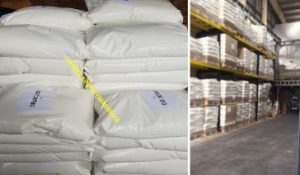
 FLOCCULANT PACKAGING 25 kg
Product Documents |
|
FLOCCULANT CERTIFICATE OF ANALYSIS |
|
What is the Purpose of Flocculants?
In a heterogeneous solution, small charged particles are attracted to the charge groups of the polymer. They then combine to form larger flocs. This process causes precipitation within the solution. The purpose of the flocculation process is precipitation.
What is a Flocculant?
Flocculants are high-molecular-weight substances with different functional groups used for the purpose of treating wastewater. Flocculants have a polymer structure.
The flocculants currently used worldwide are synthetic organic flocculants. However, for about 30 years, research has been conducted on bioflocculants.
Flocculants are divided into two types.
Inorganic Flocculants and Organic Flocculants.
Density, Melting Point, Boiling Point, Solubility: Varies depending on the type.
How Do Flocculants Work?
In a heterogeneous solution undergoing flocculation, there isn't just one type of charge group. There are particles with different charges. These can be Anionic, Cationic, or Non-ionic. Therefore, flocculants require anionic, cationic, and non-ionic polymer structures.
The reason for this is to form a suitable bond between the particles and the polymer structure. The most important factors here are the nature of the charge, the charge distribution on the molecule, and the length of the polymer.
To bring flocculants to the desired operating level (pH level), acids and bases can be added.
When selecting flocculants, anionic, cationic, and non-ionic precipitating polyelectrolytes can be used.
Flocculation is essentially the aggregation of suspended particles with polyelectrolytes (anionic, cationic, and ampholytic) through either a bridging or a patching mechanism.
In flocculation applications, destabilization by bridging occurs when a polymer chain adsorbs onto and links multiple particles together. When a polymer molecule comes into contact with a colloidal particle, some reactive groups on the polymer attach to the particle's surface, leaving other parts of the molecule extending into the solution.
The main goal in flocculation is to form a particle-polymer-particle aggregate where the polymer acts as a bridge.
In recent years, one of the biggest advantages in solid-liquid separation in flocculation systems has been the development of organic polymers that have sufficient ability to bind clots in the solution even when added in small amounts (at ppm levels).
In the application of flocculants, results can be achieved if effective bridging is performed. The optimal working system for a flocculant requires that the adsorbed polymers extend far enough from the particle surface to attach to other particles, and also that there are some free surfaces available for the adsorption of extended segments.
In this flocculation process, if excess flocculant is added and adsorbed, restabilization occurs due to surface saturation of the particles. It becomes sterically restabilized.
What are the Types of Flocculants?
These flocculants are divided into two types. These are;
Synthetic Organic Flocculants; These collectors are formed in the presence of monomers such as acrylamide, acrylic acid, diallyl dimethyl ammonium chloride (DADMAC), styrene sulfonic acid, etc.
Natural Organic Flocculants; These are based on polymers such as starch, cellulose, natural gums and mucilages, and their derivatives.
If the monomers in a polymer contain ionizable groups (Carboxyl, Amino, Sulfonic, etc.), this polymer is called a polyelectrolyte.
Based on charge, a flocculant is divided into 4 groups. These are called non-ionic, anionic, cationic, and ampholytic.
Which Flocculants are Used in Wastewater Treatment Systems?
Each flocculant has its own unique properties, and there are hundreds of types of flocculants. The selection is based entirely on laboratory studies.
In such processes, to determine the correct type of flocculant, analyses of the solution water and the solid particles within the solution must first be performed. The flocculant is selected based on the data obtained from these analyses. And this is a continuous process. The determination of a flocculant does not mean the flocculation process will be flawless.
In flocculation processes, a sustainable approach will be healthier. This is because the composition of the water used may have changed, or the structure of the materials used may have changed. Consequently, the flocculant to be used must be selected appropriately.
Additionally, for the flocculation process to work optimally, dosage parameters must be applied correctly.
How Should Flocculants be Selected for Wastewater Treatment Systems in Quarries?
Wastewater is generated during the processing of stones extracted from quarries. This wastewater is either reused in the work area or discharged into the water environment. Before discharge occurs, solid materials in the wastewater must be removed. For this, certain flocculants are used depending on the structure of the solid matter in the wastewater. These flocculants are chosen based on the nature of the solid material.
Due to the nature of the particles in the wastewater, the settling time is long. Therefore, large settling ponds are needed to settle this wastewater. To shorten the settling time of fine particles in the wastewater and to increase the efficiency of the settling ponds, organic polymers (flocculants) need to be added.
The selection of flocculants to be used in settling ponds depends on the structure of the substance to be settled. In ponds with marble particles, anionic flocculant (polyelectrolyte) is used, while in settling ponds with granite and basalt, cationic flocculant (polyelectrolyte) is used.
Of course, in these settling processes, the dosage of the selected flocculant also affects the suspension's sedimentation rate and the clarity of the pond.
Where are Flocculants Used?
- Sectors where flocculation systems are applied include the Metal Plating Industry, Slaughterhouses, the Food Industry, and finally, the Textile Industry.
- Flocculation is generally used in the Textile Industry for wastewater treatment. Coagulation or flocculation can be used for the treatment of general industrial wastewater. However, the efficiency is higher for purifying more concentrated solutions from dyeing, printing, and back coating applications.
- Flocculants are used in the treatment of wastewater in the food industry, including meat processing, oils and fats, slaughterhouses, and sugar refining systems.
- It is used in the treatment of wastewater generated during tank cleaning, drum cleaning, or packaging cleaning.
- Flocculants are used in the treatment of degreasing baths and rinse waters in the automotive industry. In this application, it is also combined with phosphate removal and metal precipitation.
- Definition and Areas of Use: During the pumping of excess activated sludge from the settling tank to filter presses or belt presses, cationic polyelectrolyte is added to the sludge line to ensure sludge dewatering.
- Cationic polyelectrolyte is widely used in the sludge dewatering units of wastewater treatment plants. In processes where sludge dewatering is performed by centrifuge decanters, belt presses, or filter presses, the flocculant, mixed using a static mixer, is dosed into the pressurized sludge line.
- The working principle of a cationic polyelectrolyte product is generally based on the ion exchange between the polymer chain in the aqueous solution and the electrical charges of the solid particles suspended. The stable structures of the solid particles are disrupted, which leads to coagulation or flocculation.
- Cationic polyelectrolytes are diluted to between 0.05% and 0.5%. The preparation solution is generally prepared at 0.1% by adding the original product to water during mixing. Since the characteristics of the sludge to be dewatered vary, the dosages to be applied are determined by jar tests in a laboratory setting and operational trials.
Other Areas of Use
- Cationic polyelectrolyte: Polyelectrolytes used to ensure flocculation in wastewater treatment systems are divided into two main groups: anionic and cationic polyelectrolytes.
- Although nonionic polyelectrolytes exist, they are not widely used.
- Generally, anionic polyelectrolytes are used in chemical treatment plants to combine and precipitate particles found in wastewater.
- Cationic polyelectrolytes, on the other hand, are used in predominantly biological water treatment plants to float the flocs to be formed or to increase efficiency during the dewatering of waste sludge from all treatment plants.
- There are various types of polyelectrolytes used based on these principles. It is essential that the necessary jar tests for wastewater systems are conducted by experts to select the appropriate polyelectrolyte for the system and ensure its optimal use. As a result, the healthy and efficient operation of the treatment system can be ensured.
- Cationic polyelectrolyte, unlike its anionic form, is generally used on excess activated sludge from biological treatment plants. During the pumping of excess activated sludge from the settling tank to filter presses or belt presses, cationic polyelectrolyte is added to the sludge line to ensure sludge dewatering.
What Factors Affect Flocculant Prices?
Flocculants are chemicals whose production and application require very high specific knowledge and expertise.
Flocculant prices vary depending on the work done by the flocculant manufacturer. A polymer producer can manipulate the price of acrylic polymer as they wish. The important point here is the effectiveness of the flocculant used.
That is, it is the level of effect of the amount of flocculant used to treat a certain amount of wastewater. If a flocculant with a high level of effectiveness at a low dosage is chosen, the polyacrylamide price will be high for the buyer.
Another radical factor affecting the flocculant price here is the concentration of the flocculants. If the concentration of the purchased acrylic polymer is high, the flocculant price will be higher compared to another product.
Flocculants are generally provided to the workplace by the company from which consultancy services on flocculation are received, along with the consultancy service itself. This is because flocculation processes are a kind of treatment process. In this process, continuous control and examination of the relevant process are necessary. Otherwise, it can cause very big problems.
Flocculant prices are established in the market by companies that sell flocculants wholesale. Companies that sell flocculants wholesale are generally few. Here, the companies that wholesale these chemical substances meet the market demand through high-volume connections.
The price of the flocculant is not actually very important. What is important is to solve the system's problem and apply the treatment accordingly. In other words, the operation of the flocculation system is what matters.